
Two American towns have spent decades arguing over who invented the ice cream sundae, and the strawberry version at the center of that American story is at its peak right now. July brings the country’s best local berries into season, and today, National Strawberry Sundae Day, is the right moment for anyone already reaching for small, inexpensive food pleasures to finally make one right.
This post may contain affiliate link(s). As an Amazon Associate, I earn from qualifying purchases. See Disclosures.
The sundae’s origin is one of the more entertaining arguments in American food history. Two towns have spent decades trading escalating correspondence over the claim, including a cease-and-desist filing that settled nothing. What both stories share is the same trigger: a 19th-century Blue Law that banned soda sales on Sundays, and a soda fountain owner who found a workaround.
2 towns, 1 very stubborn argument
In 1881, a man named George Hallauer walked into Edward Berner’s soda fountain in Two Rivers, Wisconsin, and asked for an ice cream soda. Berner had a problem. Blue Laws in the area restricted the sale of soda on Sundays. Rather than turn Hallauer away, Berner poured chocolate syrup over a dish of ice cream and handed it over. The treat sold for a nickel and caught on fast.
Ithaca, New York, tells a different version. On a Sunday in 1892, a minister stopped into Platt and Colt’s pharmacy and ordered ice cream. Chester Platt added cherry syrup and a candied cherry on top on a whim. The minister liked the result so much that they agreed to name it for the day. Platt later filed a trademark request for the name “Sunday” in 1894, and changed the spelling to “sundae,” a move widely attributed to avoiding offense among religious leaders who might object to a dessert named after the Sabbath.
Both towns claim the title with full conviction, and neither has backed down. Two Rivers points to an official Wisconsin Historical Marker in its Central Memorial Park. Ithaca points to a newspaper advertisement for a “Cherry Sunday” placed in the Ithaca Daily Journal on April 5, 1892, the earliest written evidence on record. The dispute is unresolved and, frankly, entertaining.
The shops that never stopped
A handful of American soda fountains never modernized, and walking into one today feels less like nostalgia tourism and more like proof that some things were right the first time.
Lexington Candy Shop opened on the corner of Lexington Avenue and 83rd Street in Manhattan, New York, in 1925, and the same family has run it across three generations ever since. It celebrated its 100th anniversary last year. Every soda, float and egg cream is still mixed by hand at the original fountain. The counter stools spin, the formica shows its age and the menu has not changed in ways that matter.
Eddie’s Sweet Shop in Forest Hills, New York, has been a soda fountain for decades, and the Citrano family has run it long enough to know exactly what they are doing. Owner Vito Citrano makes the ice cream, the hot fudge, the whipped cream and most of the syrups from scratch. “We make everything, all the ice cream. We whip the whipped cream by hand,” Citrano said in a CBS News article. Customers sit on the original marble counter stools and eat from metal dishes that have been in the shop for nearly a century, and the formula has not changed because it does not need to.
July changes everything
Most of the year, a strawberry sundae is only as good as whatever strawberries are available, which is to say, frequently not very good. The grocery-store berry has been bred for shelf life and long-distance travel, which means it arrives firm, picked before peak ripeness and with flavor that took a back seat to durability. It is not the strawberry’s fault. It is a logistics problem.
July is when the logistics change. Strawberry season runs through mid-July across the Northeast and Upper Midwest, with U-pick fields in the northernmost states among the last to close. The berries available right now are less firm, deeper in color and significantly sweeter, the kind that bruise if you handle them wrong and stain your fingers before they make it to the bowl. Hulled and sliced with a little sugar worked in to draw out the juice, they do not need much help. Built into a sundae with good vanilla ice cream and real whipped cream, they are the version of this dessert worth actually seeking out.
The little treat worth making at home
Something has changed in how Americans think about small indulgences. A 2026 study found that 62% of Americans indulge in a small, affordable treat at least once a month, with food and beverage leading all categories at 65%. The strawberry sundae fits that moment precisely; it takes 10 minutes to make. And right now, in July, the main ingredient is at its best in nearly every part of the country.
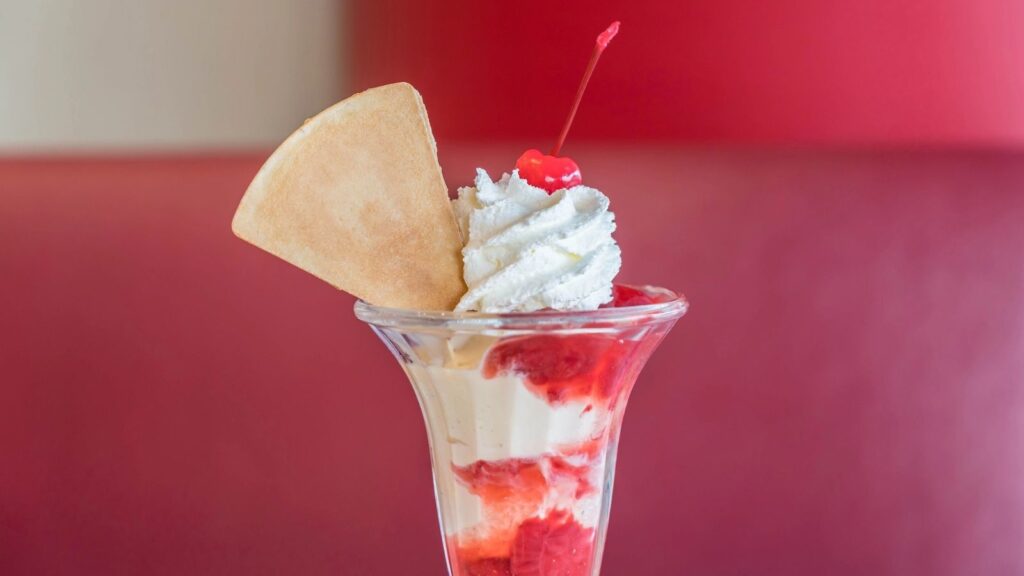
Making it well does not require special technique so much as intention. Quality vanilla ice cream, not the cheapest option in the freezer case. Fresh strawberries, hulled and sliced, with a little sugar worked in to draw out the juice. Real whipped cream if you have five minutes and a bowl. A cherry on top if you want to honor the history. The tulip glass is optional, but it helps.
The sundae has always been about this
What made the sundae stick was never the novelty. Berner and Platt were both solving a simple problem: How do you give someone something cold, sweet and satisfying when the usual option is not available? The answer they arrived at independently, in different states, in different decades, was ice cream, something on top of it and nothing more complicated than that.
More than a century later, that answer has not changed. The strawberry sundae does not need a new format or a restaurant behind it. It needs good fruit, a little time and the decision to make something deliberately good on an ordinary Tuesday in July. That, it turns out, is enough.
Mandy Applegate is the creator behind Splash of Taste and seven other high-profile food and travel blogs. She’s also the co-founder of Food Drink Life Inc., a unique and highly rewarding collaborative blogger project. Her articles appear frequently on major online news sites, and she always has her eyes open to spot the next big trend.