
In early June, government officials in Sardinia announced a new ordinance that restricts the use of umbrellas at Punta Molentis Beach for everyone between the ages of 10 and 65. The move is a safety measure in response to a fire-spawned evacuation in 2025 that almost ended disastrously due to the quantity of beach umbrellas. But tourists and residents alike push back, pointing out Sardinia is one of the few beaches where anyone could create a shady spot in the sand.
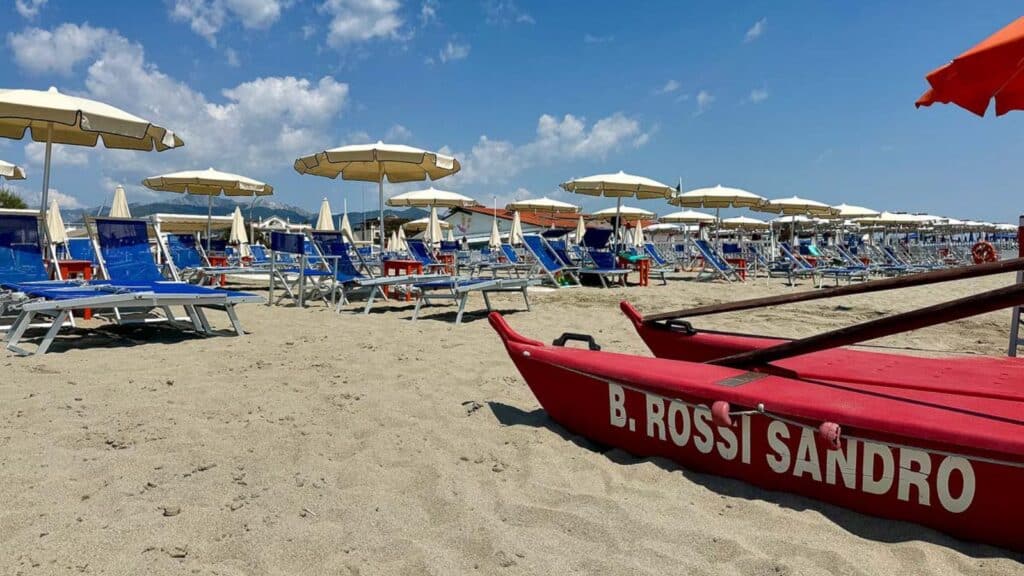
Rows of colorful umbrellas dotting the sand are an iconic image of Italy’s coastal areas. But most of these umbrellas are placed and rented by private families and companies, creating a monopoly of sorts. Those shady spots, referred to as stabilimenti or bagni, rent at prices that range from $25 for an hour to up to $575 for a day, depending on location.
The most popular umbrella spots include Tuscany, Positano on the Amalfi Coast, Monterosso al Mare, Sicily, Venice and the aforementioned Sardinia. It’s estimated that only 5% of Italy’s nearly 5,000 miles of coastal beach are free from private ownership, concessions or pollution.
History in the making
The umbrellas and the nearby changing cabins go back generations. The first instances predate World War I. “In 1895 the business started, we have a huge concession, driven by our family,” explains Iacopo Del Freo, with Bagno Rossi Sandro, named for his grandpa’s mother and brother. “The purpose of the business was to give shade to rich patrons who could afford it. Women in Victorian clothes used to be our guests, and we have pictures of them bathing in those uncomfortable clothes.”
Del Freo notes the umbrellas became a fixture in the 1920s. After World War II, things shifted, and permanent structures had to be more portable so they could be removed off season. That was also when they decided to serve drinks and simple food, like fritto misto.
The Rossi Bagni go back 131 years. The original family plot has now been broken up into 4 separate bagni. “The longest-standing family relationship our business has with a customer spans more than sixty years,” Del Freo adds through a translator. “It is with a family from Milan who first began coming with the grandmother, and over time, the tradition has continued seamlessly across generations. The daughter then started visiting with her own children, and now, in the third generation, her grandchildren continue to come and stay with us.”
Family traditions
Nowadays, Italian beach clubs are not just for the rich and well to do. Even though vacation time is decreasing somewhat across the board, the bagni are now embedded in many families’ stories. It’s not just nostalgia, but habit, an accumulation of memories they all share.
“Beach clubs are a uniquely Italian institution. They are not just service spaces, but social environments where daily summer life unfolds in a structured yet relaxed way,” explains Leonardo Bagnoli, president of Sammontana Holding. “Many of them have been passed down through families for generations, with the same ownership, the same staff and often the same regulars. They have their own unwritten rules, their own internal hierarchies, their own rituals. They are seasonal micro-communities.”
“Italians traditionally are not big on change,” points out Michael Kovnick from Culture Discovery Vacations. “I can remember years ago my wife’s family would not just go to the same place every year, but get the same room in the same hotel year after year. They had a set of friends there, they knew everyone that worked there well, they watched the bangini grow up. It was like a second home.”
“Many families got priority over umbrella and sun-bed position. The closer to the water, the better the spot,” adds Tamar Miller, a Roman archaeologist turned travel planner. “… the same families returning year after year to not only the same beach club, but to the exact same sun bed on the beach. Over time, a tradition was born. Many of these clubs expanded into Airbnb-style rentals with restaurants attached. By the way, the Italian food at beach clubs is usually fantastic.”
Food, lots of food
One of the highlights of bagno culture that has only grown over time is their connection to food. Many family beach clubs started offering small treats and snacks after World War II, but as technology has progressed, the iconic umbrellas don’t just offer shade but also coffee, gelato and frutti di mare.
“I remember the Tuscan coast in the seventies, when the street vendors would walk the beaches selling bomboloni, warm, filled with cream, to people under the umbrellas,” shares Bagnoli. “Gelato wasn’t part of it yet, for a simple reason: no one had freezers. It came later, when the first bars started opening inside the lidi. That’s when it began. Suddenly, there was a place, a counter, a freezer humming in the back and gelato became part of the beach the way it had always belonged there.”
Del Freo echoes that sentiment. “Guests often notice how easy it is to spend an entire day there without ever feeling the need to leave: breakfast at the bar, a long lunch, reading under the umbrella and then an aperitivo at sunset, all in the same place.”
“Another reason is to think of the strong family and friendship ties in Italian culture,” adds Kovnick. “Think of the food culture. All of this matters more than anything. The best way I can put it is to say when Italians travel internationally, the most common thing I hear when they get back is ‘It was beautiful … but the food! What do they feed their children?’ So you go to that same place, you know how the food is going to be, you have friends you see there every year. It is home at the beach.”
Threat of change
The current family-owned bagni arrangement has technically been rendered illegal by new European Union law. The regulation would force many of the family-owned beach club land on state-owned seaside areas to be open to public tender. “The past few years have seen significant EU regulatory pressure to open state-owned beach concessions to public bidding, as set out in the Bolkestein Directive,” shares Marta Soligo, tourism expert and assistant professor at the UNLV Harrah College of Hospitality. “The future of the bagno as we know it today looks uncertain.”
So far, Italy’s enforcers have turned a blind eye, allowing the family beach clubs to operate. But soon, large corporations could come in and take over the land, booting the family businesses and disrupting the long-standing relationships they have with their clientele.
These changes could be troublesome not only to the economy of the beaches and families who have staked their claim there for generations. Public bidding could significantly alter family traditions and a sense of connectedness inherent in the bagni tradition of community.
“Unknowingly, we’ve traded community for convenience and privacy,” states Jennifer Breheny Wallace, author of “Mattering: The Secret to a Life of Deep Connection and Purpose.” “Neighborhood shops, civic groups, local gathering places and informal community spaces gave people repeated contact and a sense of shared life. When that social infrastructure disappears, loneliness is treated as an individual problem, even though its causes are often structural. Returning to the same vacation spot, like bagno, where you are known and remembered, helps satisfy this need and gives us the powerful sense that the world would feel our absence.”
Saving shade
If the EU has their way, more and more beaches along the Italian coast could go the way of Punta Molentis Beach, or worse, parcelled out to major corporations that care more for their bottom line than the traditions people have grown up with. It could destroy an entire vacation culture going back more than 100 years. Meanwhile, the families who own and operate the bagni simply hope to build more relationships, so that everyone has an opportunity to connect with the vacation lifestyle they’ve curated over the decades.
“If I had to explain to someone who has never experienced an Italian bagno what it truly represents, I would say that it is not just about the sea, but about a real summer life experience,” concludes Iacopo Del Freo. “So if you ever find yourself on the Tuscan coast, come and spend a day with us. You might arrive as a guest, but you’ll probably end up recognizing someone by sunset, ordering an aperitivo and already planning when you’ll be back.”
Bella Bucchiotti is a freelance writer with a passion for adventure, delicious recipes and authentic storytelling. Through xoxoBella and social media, she shares vibrant travel experiences, mouthwatering dishes and everyday moments that inspire connection.