
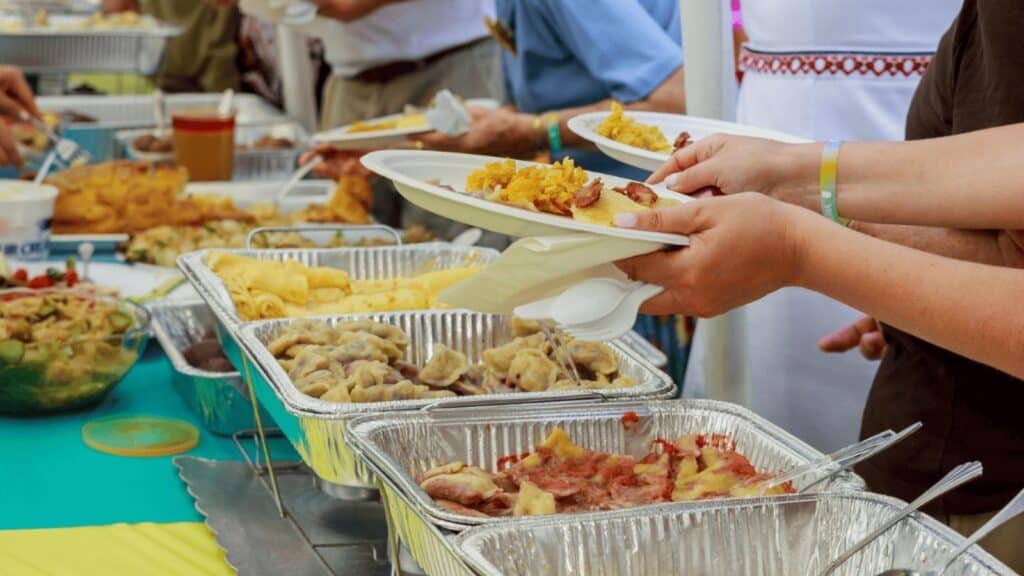
Casual home gatherings are becoming more common across the country, and many hosts are also asking guests to help provide the food. Hosts and guests walk into potluck season without settling a handful of basic questions in advance: how a dish should be labeled, who is expected to bring which part of the meal and whether guests are supposed to take their own leftovers home. None of those questions comes with an instruction manual, which is exactly the problem.
This post may contain affiliate link(s). As an Amazon Associate, I earn from qualifying purchases. See Disclosures.
Home entertaining has been leaning toward casual gatherings, including movie nights, game-day parties, cookouts and potlucks. That casualness is part of the appeal, but it can leave basic details unsettled, from what happens to a container after the food is gone to who is supplying the main course.
The trend backs that up: 57% of Americans hosted a casual, food-and-drink gathering in the past year, up from 47% the year before, according to survey data from the International Housewares Association. A meaningful share of those hosts lean on guests to help supply the meal, with 26% saying guests usually bring about half the food and another 7% relying on guests for most of it. Together, those figures suggest more hosts are dividing responsibility for the meal among their guests, making clear communication more useful.
Reclaiming your dish is not that simple
Whether it is acceptable to grab your own dish and go depends on more than manners. In a Reader’s Digest column, writer Charlotte Hilton Andersen argued that taking back an untouched dish may be reasonable in some circumstances. However, she noted the expectation can change at a small, intimate gathering, where shared leftovers are the norm, or once other guests have already dug in. Etiquette expert Nikesha Tannehill Tyson of the Swann School of Protocol took a stricter view in comments to Chowhound, saying guests should leave leftovers behind unless the host offers or insists.
Food safety leaves less room for interpretation than either opinion, and it is worth checking before the etiquette question comes up at all. The U.S. Department of Agriculture advises discarding perishable food left at room temperature for more than two hours, or more than one hour when the temperature is above 90 degrees Fahrenheit, since that is roughly how long it takes bacteria to reach unsafe levels in an unrefrigerated spread.
Dietary labels need more detail
A sticky note labeled “gluten-free” may not provide guests with enough information. A more useful label lists the dish’s major ingredients and flags common allergens, ideally drawing on the nine foods the FDA classifies as major allergens: milk, eggs, fish, crustacean shellfish, tree nuts, peanuts, wheat, soybeans and sesame. Even then, a handwritten label has limits. Guests managing a severe allergy or celiac disease may still need to ask the cook directly, since cross-contact from shared utensils, cookware or counters is not something a label can rule out.
Who brings what is not random
One common arrangement has the host supplying the main dish and drinks while guests provide sides, salads and desserts, whether through a sign-up sheet or an informal understanding of who is bringing what. Unless the host says otherwise, guests should plan to contribute something, and when a host has assigned categories, swapping in a different dish without checking can leave a table short a main course or stacked with duplicates.
Following a sign-up sheet, where one exists, avoids most of that confusion. Where no sign-up sheet exists, a quick question to the host beats guessing.
None of this became any simpler during America’s Potluck, a campaign marking the country’s 250th anniversary that invited communities to gather on July 5 and set a goal of 25,000 potlucks nationwide, with participating anniversary commissions from all 50 states and Puerto Rico. The event was also part of American Summer, a separate Block Party USA campaign that encouraged neighborhood gatherings from Memorial Day through Labor Day and gave July 5 special attention.
Reaching that scale would place the same practical questions in front of thousands of hosts and guests at once. The dish, the label and the sign-up sheet may be small details, but they often decide whether a potluck feels easy or awkward. With casual hosting becoming more common, as the survey data above shows, the unwritten rulebook does not need to become stricter, just clearer, so the next person deciding whether to take a dish home has an easier answer.
Jennifer Allen is a retired professional chef and long-time writer. Her work appears in dozens of publications, including MSN, Yahoo, The Washington Post and The Seattle Times. These days, she’s busy in the kitchen developing recipes and traveling the world, and you can find all her best creations at Cook What You Love.