
Slapping chili on a hot dog seems like a free-for-all, but it isn’t. A group of grown adults wrote an actual rulebook for exactly which order the toppings go onto a chili dog, and they’ve spent three decades defending it like scripture. Nobody is required to follow it, but July 30, National Chili Dog Day, is a fitting time to find out what the rulebook actually says.
This post may contain affiliate link(s). As an Amazon Associate, I earn from qualifying purchases. See Disclosures.
The National Hot Dog and Sausage Council wrote the rulebook, a Washington-based trade association founded in 1994 as the self-appointed authority on how a hot dog gets dressed, eaten and cleaned up after, right down to the ketchup. Its guidance gets dusted off every year, detailed enough to suggest someone in that office cares about this far more than expected. That guide is specific about order, and chili sits in a different category than most people assume.
The order matters more than the topping
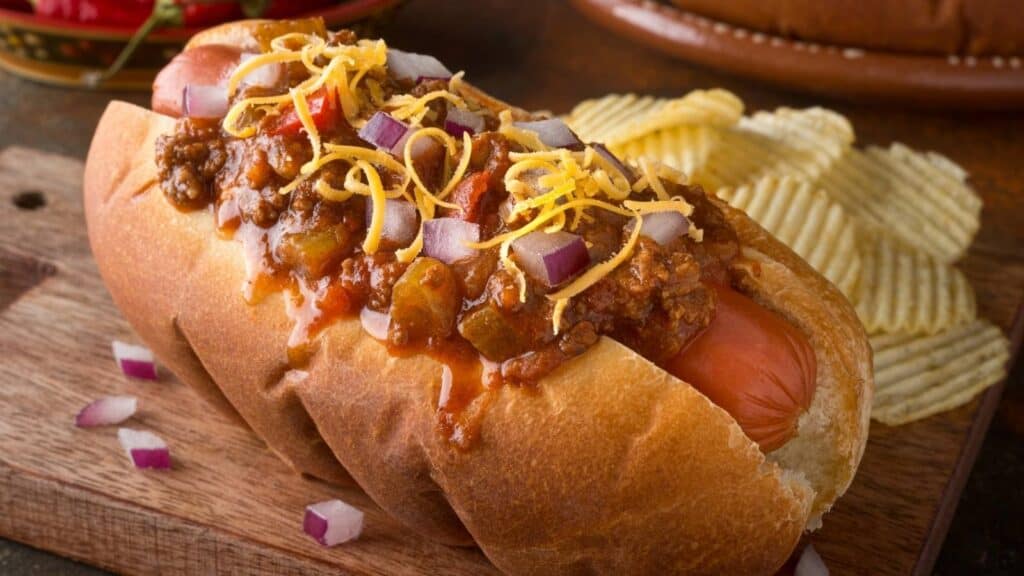
Wet condiments go on a hot dog first, and chili counts as one, right alongside mustard, per the council’s rules. Chunky toppings such as onions and relish come next, then shredded cheese, then any dry seasoning like celery salt or pepper. A chili dog built the usual way, chili spooned on last over cheese and onions, breaks that sequence at nearly every step.
The council’s order is built around how the toppings behave once they hit the hot dog. Wet condiments settle into the meat and give the next layer something to grip, so the toppings that follow stay on instead of sliding off with the first bite. Skip that step and the cheese slides, the onions scatter and half the topping ends up on the plate instead of the dog.
Where the rule already matches real life
Regional hot dog traditions were built this way before the council ever wrote it down. The Cincinnati coney is a hot dog topped with the city’s famous chili and finished with a heaping mound of grated cheddar, chili first, cheese piled on after. The Michigan coney follows a similar shape: a meaty chili sauce paired with mustard and onion, no cheese involved at all. Neither city needed a Washington trade group to work that out.
Regional practice makes the strongest case for the council’s rule. It reads less like an invention and more like a description of what already worked, tested for decades in kitchens that had no reason to consult an etiquette guide before doing it.
Ketchup, bites and napkins
The council’s guide covers more than condiment order, holding that ketchup has no business on a hot dog after age 18, that a regular hot dog should take no more than five bites to finish, and that a foot-long gets a maximum of seven. Paper napkins are the only acceptable option; the guide discourages cloth, and it says to lick any leftover condiment off your fingers rather than wash it away.
These rules carry no legal weight, of course, reading more like a trade group’s version of house style, the kind of thing that shows up on tray liners and old press releases rather than anything enforced at the picnic table. But the council has been making calls like this since it was founded, and the specificity is a large part of why the guide keeps resurfacing every summer.
The chili loophole
The rulebook sounds straightforward until it gets to the chili itself. A smooth, finely ground coney-style sauce behaves like a true wet condiment and spreads like mustard. A chunkier, bean-heavy chili behaves more like the relish and onions that are supposed to come second. The council’s guide does not clarify which version of its wet-condiment rule it is describing, leaving plenty of room for an argument at the next cookout over whether a loaded bowl of five-alarm chili even qualifies for the front of the line.
Whether the chunkier version even counts is unlikely to get settled before this year’s observance. What is clear is that the argument over how to build a hot dog properly is not going anywhere, and every summer it comes back to the same two camps: chili first, or chili on top.
Jennifer Allen is a retired professional chef and long-time writer. Her work appears in dozens of publications, including MSN, Yahoo, The Washington Post and The Seattle Times. These days, she’s busy in the kitchen developing recipes and traveling the world, and you can find all her best creations at Cook What You Love.