
The USDA National School Lunch program has provided nearly 246 billion lunches since the establishment of the federal Food and Nutrition Service, now Food and Nutrition Administration, in 1969. The National School Lunch Program dates back to World War II, but was significantly expanded in the late ‘60s and early ‘70s. This year, the rules and procedures are being rewritten.
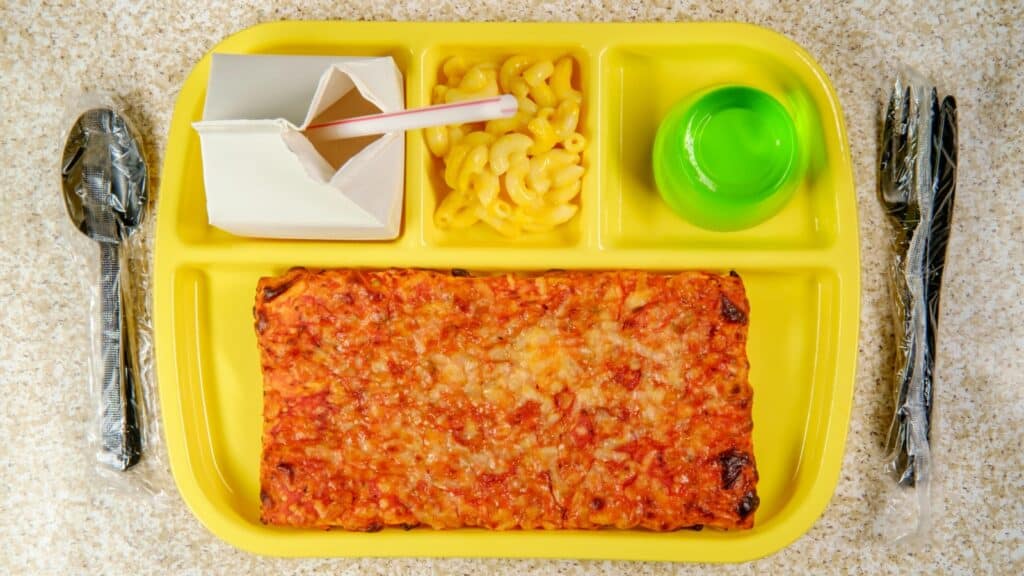
Nobody at your child’s school picks what goes on the lunch tray. That decision runs through a district nutrition director, a set of federal meal patterns written by the USDA and a long line of lobbyists who have spent decades and millions of dollars arguing over things like whether a spoonful of tomato paste counts as a vegetable. The tray is the end of that argument, and it changed again this year when whole milk came back after 13 years off the menu.
3 layers decide what reaches the tray
The authority of the National School Lunch Program is split three ways. Congress writes the law and funds it, the U.S. Department of Agriculture turns the law into meal patterns and state agencies check that local districts follow them. The local school district itself is what the federal government calls a school food authority, meaning the entity with the legal authority to run the meal program. The school food authority buys the food, hires the cooks and gets a meal in front of a student.
Joining the National School Lunch Program is voluntary. A district that signs up for the program agrees to follow the federal meal pattern on every tray it claims for reimbursement, and the government pays it back per meal. That reimbursement is what funds the school food service, so most districts follow the pattern closely.
What the pattern standardizes is the construct of the meal, not just the menu. A cafeteria in Georgia and one in Oregon should both offer five meal components in set portion sizes and stay inside weekly calorie and sodium limits, but one may serve chicken and rice while the other serves a turkey sandwich. However, when federal rules change, they affect everybody at the same time.
Whole milk is back after 13 years
Fat-free and low-fat milk cartons were the only ones legally allowed in school cafeterias starting in 2012, a restriction that came out of the Healthy, Hunger-Free Kids Act of 2010. That changed with the Whole Milk for Healthy Kids Act, which became law on Jan. 14, 2026, and allows participating schools to offer whole and 2% milk again. The USDA issued the final rule implementing it on May 8, putting those cartons back on breakfast lines too.
The law gives districts an option, not an order. Each one still has to figure out what students will actually drink and work out price and supply with a dairy vendor, so the carton mix will be different from region to region. A small district buying from one distributor may end up with fewer choices than a district two counties over that has more choices.
Flavored milk is where this gets complicated. Schools can serve chocolate and strawberry milk, and now they can serve the whole-milk version, but the sugar in those cartons is on a tightening schedule: limits on added sugars in flavored milk, breakfast cereal and yogurt took effect in July 2025, and a cap on added sugars across the whole week’s meals goes into effect in July 2027. Meanwhile, the 2025-2030 Dietary Guidelines point to full-fat dairy with no added sugars at all. Districts have to order milk for next year without knowing how those two positions will be resolved.
The lunch tray started as a farm program
Congress built the National School Lunch Program around farm surplus, not around what children wanted to eat. President Harry Truman signed the National School Lunch Act in 1946 to accomplish two things simultaneously: feed schoolchildren and provide farmers a buyer for extra crops. The nutrition argument and the agriculture argument have been tied together ever since.
That arrangement still runs the supply side, though not as haphazardly as the phrase commodity food suggests. Districts earn USDA Foods entitlement dollars based on how many lunches they served the year before, then order against that balance from a USDA catalog, usually through a survey the state agency collects and aggregates into truckload orders. Prices change between the survey and the actual federal purchase, so a district that ordered 200 cases of chicken at one price may receive fewer.
What survived: Pizza, fries and the tomato paste rule
Pizza and french fries have outlasted every attempt to push them off the menu, and one accounting rule is most of the reason they’re still part of the lunch program. In November 2011, Congress passed a spending bill blocking the USDA from increasing the amount of tomato paste required to count as a vegetable serving. The department had proposed a half cup, but lawmakers kept the standard at 2 tablespoons, which is roughly what fits on a slice of pizza.
Democrats and nutrition advocates spent the following week accusing Congress of declaring pizza a vegetable. The same bill blocked limits on starchy vegetables that would have capped how often schools could serve fries, and it delayed the sodium and whole grain requirements. Potato growers, the salt industry and frozen pizza companies were the driving forces behind these changes.
Follow the money, and the back-and-forth rules for the lunch program make more sense than the nutrition science does. At that time, The New York Times put industry spending against those proposed standards at more than $5.5 million. Schwan, the Minnesota company that was then the largest frozen pizza supplier to American schools, held a 70% stake in market share of the $9.5 billion school service food industry, a not insignificant number when it comes to lobbying clout. Dairy producers ran a longer version of the same effort and spent 13 years pressing Congress on whole milk before they got it.
The ketchup fight of 1981
The USDA raised a similar accounting question 30 years earlier, and that time the department took the blame instead of Congress. The Omnibus Reconciliation Acts of 1980 and 1981 cut the school lunch budget sharply, and in September 1981 the Food and Nutrition Service proposed rules that gave local administrators more flexibility to meet the requirements on less money. Those rules would have allowed condiments, such as pickle relish and ketchup, to count toward the vegetable serving.
However, in today’s equivalent of going viral, Johnny Carson worked the debate into his monologue on “The Tonight Show with Johnny Carson” in 1981. Budget Director David Stockman announced the withdrawal of the proposed rules on Sept. 25, 1981, and Agriculture Secretary John Block pulled the proposal the same day after meeting with President Ronald Reagan.
What vanished: Fryers, trans fats and scratch kitchens
Districts pulled the deep fryers out of most school kitchens well before they removed whole milk. The 2012 standards capped saturated and trans fats, and districts that could not meet those limits while frying bought convection and combi ovens instead. The fried chicken patty became a baked one.
Cooking from scratch disappeared without a rule forcing it out. Kitchen staff shrank, equipment aged out without being replaced and heat-and-serve products allowed a smaller crew to produce the same number of meals. Cooks who once mixed and baked dinner rolls in the school kitchen now open a case of frozen par-baked rolls and just finish them in the oven.
Peanut butter has also been removed from many elementary school menus, pushed out by allergy policies rather than nutrition standards. Many districts that dropped it moved to sunflower seed butter, which spreads similarly but costs more. Cookies, a common lunchroom treat, were changed from scratch-made to pre-baked and wrapped, taking some of the labor out of the kitchen. Purchasing pre-portioned cookies also makes it easier for districts to comply with the cap on added sugar, as a new weekly cap is looming to take effect in July 2027.
The half cup that ends up in the trash
Anybody who has stood near a cafeteria garbage can has watched students drop untouched fruit into it. Federal rules require the school to include a half cup of fruit or vegetables on the tray for the meal to be reimbursed, so the apple goes on whether the student wants it or not. There is a rule that lets students hand some of it back, called offer versus serve, which mandates the school to offer all five meal components and requires the student to take at least three.
Offer versus serve is mandatory at lunch in senior high schools and optional in elementary and middle schools, which is backward from where the waste is. The World Wildlife Fund has found that elementary students waste nearly 40% more food than older students, and its recent pilots measured an average of 21 pounds of unopened milk thrown out per school per day. Without offer versus serve, a child who cannot drink milk still has to take the carton. The USDA has updated its guidance to encourage elementary schools to adopt the rule.
Scratch cooking returns in pockets
A handful of districts have gone the other direction, rebuilding kitchens and hiring cooks, and most of them are doing it on grant money. A 2025 study published in the Journal of School Health by researchers at the University of California’s Nutrition Policy Institute surveyed 430 California school food authorities and found that those awarded grants to buy local produce cooked from scratch 23% more often than those without them.
California has put real money behind that, including $145 million in competitive Kitchen Infrastructure and Training grants awarded in 2025. The same survey indicates that districts that cook more food from scratch often encounter fewer problems with students who avoid the lunch line over taste and freshness.
The next rewrite is already underway
The USDA is writing the next set of standards now, aligning child nutrition programs with the 2025-2030 Dietary Guidelines. The added sugar and sodium limits from the last update keep phasing in while that work happens, and the cap on added sugars across the whole week’s meals is due in July 2027. Potato growers, dairy producers and frozen food manufacturers have all won a version of this argument before, and likely will again.
Lucy Brewer is a professional writer and fourth-generation Southern cook who founded Southern Food and Fun. She’s passionate about preserving classic Southern recipes while creating easy, crowd-pleasing dishes for the modern home cook. Lucy currently lives in Augusta, Georgia.