
Gumbo has been Louisiana’s official state dish for more than 20 years, but the official designation says nothing about how to make it. West African okra, a French roux technique, and Choctaw sassafras leaves all went into the pot at some point over two centuries, and no single tradition ever wrote the final recipe. Oct. 12 is National Gumbo Day, and arguments over what belongs in the bowl are as alive as ever.
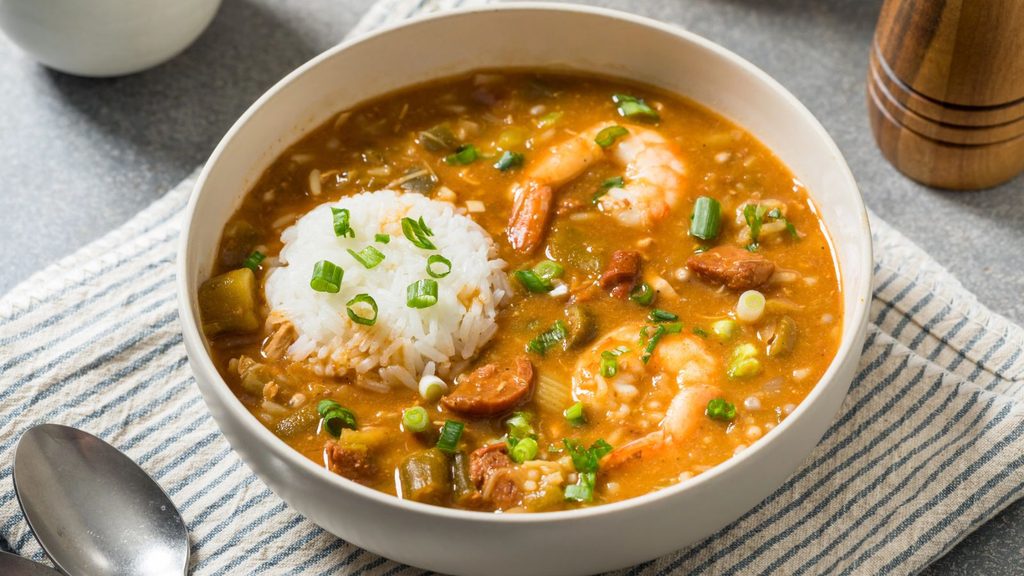
Among the earliest documented references to gumbo is an 1803 account of it being served at a gubernatorial reception in New Orleans, and Louisiana made it official in 2004. By the time the Southern Foodways Alliance began documenting the dish across the South, the contradictions were already well established.
The argument starts with the thickener
The Southern Foodways Alliance found a dish held together almost entirely by contradiction. Its oral history project catalogs the arguments without resolving a single one. Use roux only with poultry and filé only with seafood. Use okra in summer and filé in winter.
Some cooks have never used filé, while others consider it non-negotiable. Chaurice, related to chorizo, is considered essential by some, and andouille by others, and a contingent holds firm that the two are not interchangeable.
Food writer Stanley Dry, who spent years documenting Louisiana gumbo traditions, interviewed competitors at the World Championship Gumbo Cookoff in New Iberia and found the roux-color debate among the most contentious, with answers ranging from the color of a brown paper bag to the color of dark chocolate. Both are considered correct, but neither side concedes a thing.
Roux is not for the faint of heart
Making a dark roux means standing over high heat and stirring constantly, sometimes for just minutes and sometimes for well over an hour, depending on the cook and the method. A burned roux can ruin the batch.
What Louisiana cooks call Cajun napalm earns the name, and one cook in the SFA’s roux-making oral histories is matter-of-fact about clearing the kitchen first, because if it touches skin, it will burn. Some cooks take a dark gumbo roux nearly to black. Others stop it at the color of dark chocolate, the color of peanut butter or somewhere in between.
The tomato debate nobody can settle
Tomatoes are more common in some Creole and okra-based gumbos, while cooks farther west along Bayou Lafourche use them less often. In his writings for the Southern Foodways Alliance, Dry observed that tomatoes tend to appear more often east of Bayou Lafourche, while acknowledging he had no hard evidence for the geographic pattern. The boundary is anything but absolute. Some who grew up in tomato country leave them out on principle. Some cooks farther west have started adding them and would prefer it go unremarked.
Dry’s own view is that he favors tomatoes in okra gumbo and objects to them in roux-based gumbo. He acknowledges that no one asked.
What goes next to the gumbo
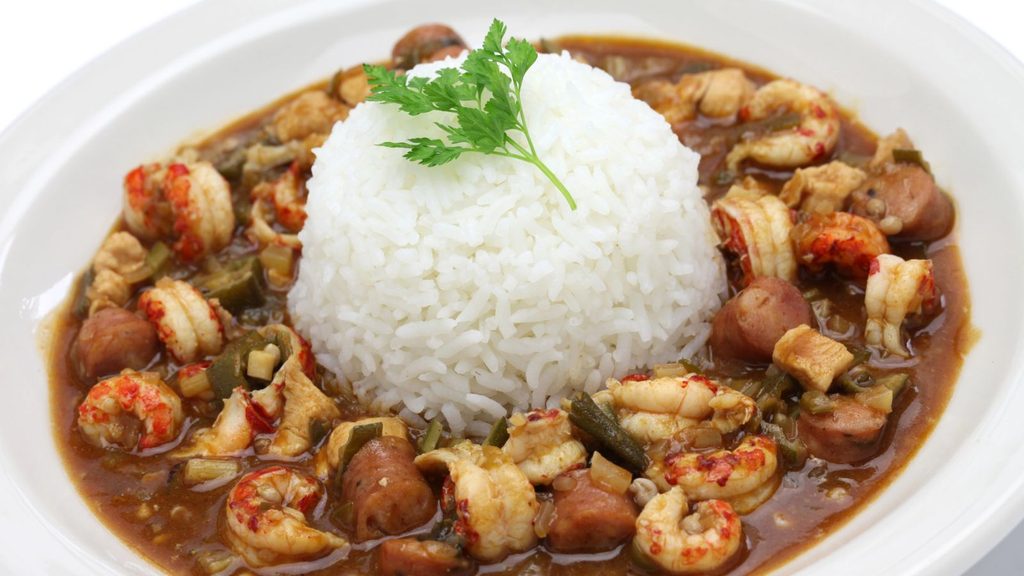
Rice is the most common accompaniment to gumbo today, though it was not always the universal choice. In some households, the bowl does not get rice at all. It gets potato salad, specifically a cold scoop sitting alongside or directly in the hot gumbo.
Potato salad in the gumbo bowl is a sincere and debated preference across parts of Louisiana, argued with the same conviction as the roux color and the tomato question. It surfaces every October, reliably, right alongside everything else.
The arguments keep getting bigger
The World Championship Gumbo Cookoff takes over Bouligny Plaza in downtown New Iberia this weekend, Oct. 10 and 11, with around 100 teams competing across five categories. The competition grew out of a 1989 event that had fewer than a dozen chefs cooking off the backs of pickup trucks. Today the Greater Iberia Chamber of Commerce describes it as a two-day festival drawing more than 30,000 visitors and offering more than 100 different gumbos to try, and the event has yet to produce anything close to a consensus on what the best bowl should taste like.
The Historic New Orleans Collection is hosting a full-day Gumbo Forum on Nov. 7, headlined by food historian Dr. Jessica B. Harris, whose book “High on the Hog” was adapted into a four-part Netflix docuseries in 2021 and who received a James Beard Lifetime Achievement Award in 2020. One of the afternoon panels carries the title “Cajun or Creole?” and among the panelists is Poppy Tooker, a New Orleans food personality and radio host who beat Bobby Flay in a gumbo throwdown in 2008, and the panel is not expected to reach a verdict any more than the dish itself has.
Pick a side
The arguments over gumbo have outlasted every attempt to settle them, and that may be the point. What gets passed down in Louisiana kitchens is never just a recipe. It is a set of strong opinions about roux color, thickener and tomatoes, shaped by family, parish and what was available when someone first learned to cook. The dish stays alive because every generation inherits the debate along with the pot.
Jennifer Allen is a retired professional chef and long-time writer. Her work appears in dozens of publications, including MSN, Yahoo, The Washington Post and The Seattle Times. These days, she’s busy in the kitchen developing recipes and traveling the world, and you can find all her best creations at Cook What You Love.