
Halloween candy aisles always stock candy corn, and plenty of people still can’t say a nice thing about it. That penny-candy origin dates back to the 1880s, when people sold it as a farm-themed treat years before Halloween claimed it. It’s still a divisive Halloween treat, and many continue to buy it even though they don’t like it.
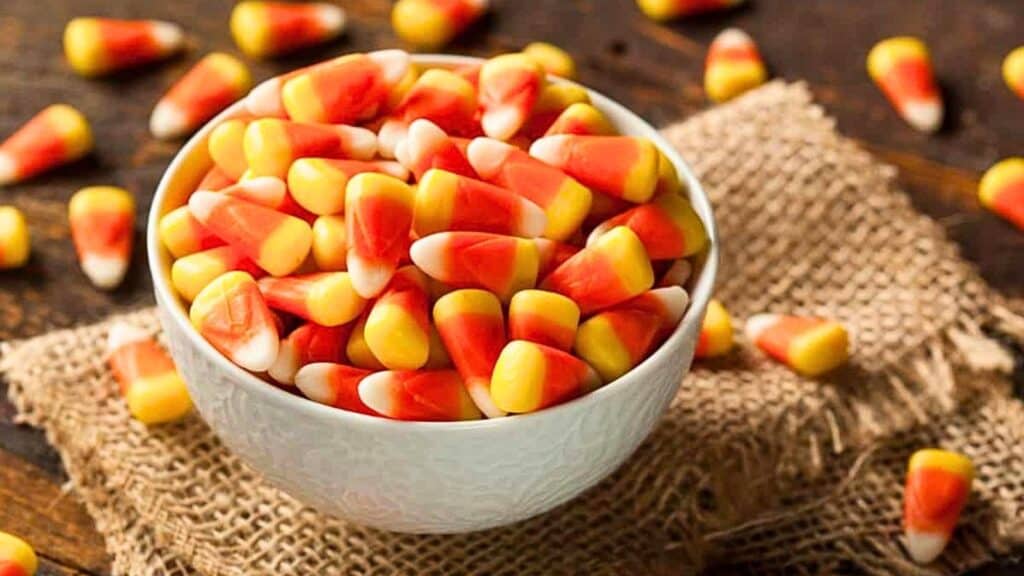
George Renninger usually gets credit for inventing candy corn, a candy maker at Philadelphia’s Wunderle Candy Company in the 1880s, though no one knows for certain. That original version hit the market as a farm-themed penny candy, not a seasonal mascot, sold alongside other harvest shapes of the era.
Workers originally hand-poured a mix of sugar, corn syrup, fondant, vanilla and marshmallow creme into kernel-shaped molds, giving each piece its yellow-orange-white stripe, before mechanizing the process. The Goelitz Confectionery Company took over the recipe in 1898, became the country’s largest producer and marketed it as Chicken Feed, in a box printed with a rooster, alongside other corn-and-harvest shapes such as candy pumpkins, turnips, chestnuts and clover leaves.
Goelitz eventually became the Jelly Belly Candy Company, which still makes candy corn from that same 19th-century recipe. Candy corn had already spun off into reindeer corn for Christmas, cupid corn for Valentine’s Day, bunny corn for Easter and freedom corn for the Fourth of July long before anyone thought to put it in a bottle.
Halloween didn’t claim candy corn right away. The closest explanation is timing. Door-to-door trick-or-treating took off in the late 1940s, once wartime sugar rations lifted, the same stretch when candy corn’s harvest imagery became an easy fit for the holiday. It held on, and it took decades, not a single marketing plan, to become the Halloween fixture people still argue about.
A top seller nobody votes for
Despite all that, candy corn is still projected to rank No. 8 among the best-selling Halloween candies in the country this year, based on 18 years of sales data weighted toward recent seasons, down one place from where it landed in 2024. The kernels also won outright in three states this year, including Maryland, Utah and North Dakota. North Dakota is the new one, swapping in candy corn after Hot Tamales held the state’s top spot in 2024.
Most states didn’t move at all this year, with 38 of the 50 keeping the same favorite they had in 2024, which makes candy corn’s gain look less like a fluke and more like real ground. The ranking is measured in pounds sold, not votes, which is very different from being anyone’s favorite.
CandyStore.com, the company behind that sales map, also ran a separate survey of 3,200 of its own customers this year on their favorite and least favorite Halloween candy, and candy corn finished dead last. On the favorite side of that same survey, Snickers took the top spot for the first time, pushing Reese’s Peanut Butter Cups to second.
Candy corn isn’t new to the bottom spot, either. The same survey crowned it the worst Halloween candy three years running, from 2019 through 2021, before it spent a few years in second and third place, including third worst in 2024. The sales map and the preference survey measure two different things, which explains how a candy can keep selling while still losing taste tests in the same season.
Taking advantage of the hate
Brach’s, which calls itself America’s leading candy corn brand, says its 11-ounce bag is the top-selling fall confection in the seasonal candy aisle. Brach’s parent company, Ferrara Candy, acquired Jelly Belly in 2023, meaning the brand defending candy corn and the brand still using the 19th-century recipe now share an owner. Rather than soften its reputation, Brach’s just leaned further into it. It launched a candy-corn-scented perfume called Ode to Candy Corn, built around a mix of vanilla and spun sugar with a thread of honey underneath, marketed as smelling like the candy itself.
Kelly Peyser, Brach’s director of seasonal marketing at Ferrara Candy Company, said the fragrance gives fans “a new way to express their love for the iconic treat.” The bottle itself undercuts the bit. Its label warns against ingesting the perfume or holding it near an open flame.
Complaints about the smell and the texture of the actual candy do the same job for Brach’s that the perfume does. Both keep candy corn in the conversation during the only month that has ever mattered to it.
The rush happens before Halloween even starts
More than half of a season’s candy corn sales happen before October even starts, and 17% of them ring up before Labor Day, according to Ferrara’s own sales data. Even candy corn has its own official day, National Candy Corn Day, recognized by the National Confectioners Association every Oct. 30. That’s one day before Halloween, and well after most of this year’s buying is already done.
Jennifer Allen is a retired professional chef and long-time writer. Her work appears in dozens of publications, including MSN, Yahoo, The Washington Post and The Seattle Times. These days, she’s busy in the kitchen developing recipes and traveling the world, and you can find all her best creations at Cook What You Love.