
Four European destinations have been named to major international food lists in 2026: Seville, Crete, Wrocław and Czechia beyond Prague. None are new discoveries; all four have deep food cultures built on regional ingredients and local traditions that predate any external recognition. What is new is that recognition has arrived simultaneously within a concentrated window, making this year the right time to go.
This post may contain affiliate links that may earn us a commission. For more information, see our Disclosures.
More than 56% of travelers are interested or very interested in culinary activities as part of their trips, and the destinations that earn recognition have moved away from established dining capitals toward cities with intact local food identities that mass tourism hasn’t yet reached. A major 2026 dining list bypassed traditional heavyweights such as Paris and Rome in favor of destinations only now receiving recognition for their distinct culinary offerings. Each of these four cities fits that description, and each is more accessible and more affordable now than it is likely to be in two or three years.
Seville, Spain: A city that invented the bar crawl
Seville earned its spot on a major 2026 travel dining list not through novelty but through durability. The tapas culture here is one of the most intact social dining traditions in Europe, and a wave of inventive smaller restaurants has opened alongside centuries-old Andalusian taverns without displacing them. Seville also ranked among Europe’s top cities for culinary experiences, alongside Barcelona, reinforcing Spain’s position as one of Europe’s strongest food-focused travel destinations.
The ritual is the point. When in Seville, order the salmorejo, the jamón ibérico and the croquetas, then move to the next bar. Mercado del Barranco, a restored Eiffel-era iron building on the Guadalquivir, is where the traditional and the contemporary converge. Spring and autumn are the right seasons for this because summer temperatures regularly reach 104 degrees Fahrenheit, and Seville’s walk-heavy tapas culture becomes far less forgiving in peak heat. Flights connect through Madrid or London from major United States gateways.
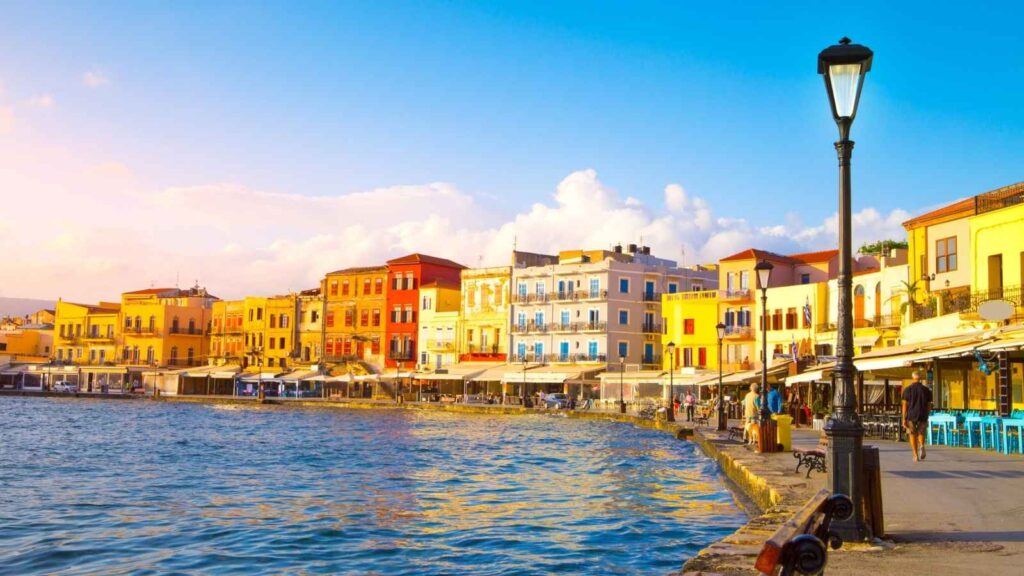
Crete, Greece: The Mediterranean diet, still intact
Crete is the most formally recognized food destination in Europe this year. The island was officially awarded the title of European Region of Gastronomy 2026 by the International Institute of Gastronomy, Culture, Arts and Tourism, following a two-year evaluation by an independent jury of European experts. National Geographic’s Best of the World 2026 named it a top food destination for that same designation, citing the island as a blueprint for the Mediterranean diet.
The cuisine runs on roughly 40 million olive trees, hyper-seasonal produce and dairy traditions that produce cheeses such as graviera, myzithra and pichtogalo that rarely leave the island. Village tavernas in the hills above Chania and Rethymno serve dakos and slow-braised lamb in forms unchanged for generations. Go farther inland, and the table gets even more authentic. May and October offer the best balance of weather and manageable crowds; the new Kastelli Airport outside Heraklion will expand international access once it opens.
Wrocław, Poland: The Michelin pick nobody saw coming
Wrocław appeared on a major 2026 list of top food travel destinations on the strength of what its editor called a “young and vibrant culinary scene.” The city entered the Michelin Guide in 2025 with 22 restaurants included and three immediate Bib Gourmand awards. A recent Michelin expansion announcement for Poland later pointed to Wrocław as one of the clearest examples of the country’s growing culinary depth.
Young chefs reinterpret Silesian heritage, including game meats, fermented vegetables and pierogi, with modern precision. The Hala Targowa, a century-old covered market, still operates as a working food market, and the bar and restaurant district along the Oder River has grown steadily without losing the low prices that made the city worth visiting before it gets more expensive. Direct flights from London, Amsterdam and Frankfurt make it an easy add to a Central European itinerary; May through September is the window to see it at its best.
Czechia: A country-wide revival beyond Prague
Czechia is the only European destination outside Italy to appear on both the Michelin Guide’s top 16 food travel destinations for 2026 and National Geographic’s Best of the World 2026 food list. The catalyst was Czechia’s first nationwide Michelin Guide, launched in December 2025, which covers 79 restaurants across the entire country, including one Two-Star, eight One-Star, and 18 Bib Gourmand establishments.
A generation of Czech chefs has spent years reclaiming slow-roasted meats, dumplings and root vegetables, reinterpreting them with contemporary precision. The Michelin selection maps the full country: Prague, South Moravia’s wine region, Karlovy Vary and Brno. The timing still works in travelers’ favor, with reservations remaining relatively attainable and prices generally lower before peak summer demand fully arrives. Prague has direct transatlantic service, and Brno, with the South Moravia wine region, is roughly 2.5 hours south by train.
Europe’s regional food scene grows
European food travel is becoming less centered on famous capitals and more focused on regions with clear culinary identities. Travelers increasingly want meals connected to geography, climate and local habits instead of restaurants that could exist almost anywhere. That demand gives smaller cities and regional destinations a stronger place in international travel planning than they held even a few years ago.
Mandy is a luxury travel, fine dining and bucket-list-adventure journalist with expert insight from 46 countries. She uncovers unforgettable experiences around the world and brings them to life through immersive storytelling that blends indulgence, culture and discovery, and shares them with a global audience as co-founder of Food Drink Life. Her articles appear on MSN and through the Associated Press wire in major U.S. outlets, including NBC, the Daily News, Boston Herald, the Chicago Sun-Times and many more.