
Philadelphia has earned its place in American food culture over generations of cooks, markets and neighborhood restaurants, and rarely felt the need to advertise it. The city’s food identity runs through immigrant markets that have never closed, a Vietnamese sandwich corridor that gives the cheesesteak a run for its money and a BYOB dining culture that keeps the focus where it belongs: entirely on the plate. Travelers who figure that out tend to come back.
This post may contain affiliate links that may earn us a commission. For more information, see our Disclosures.
Food motivates travel for about 21% of travelers, and Philadelphia tops the list for food-motivated travel, ahead of New York and Chicago. That standing comes from a food culture built on mid-Atlantic seasonal ingredients, layered immigrant traditions spanning Italian, Vietnamese, Cambodian and Mexican communities and a neighborhood restaurant ecosystem that keeps costs low and quality high. With six FIFA World Cup matches coming to the city between June 14 and July 4, global visitors are arriving in numbers Philadelphia has rarely seen, making this an ideal moment to experience what the city does best before the conversation centers on the usual tourist favorites.
Reading Terminal Market
Open since 1893 beneath the iron train shed of the old Reading Railroad, Reading Terminal Market is one of the oldest continuously operating public markets in the United States. It earned the No. 1 spot in the USA Today 10Best Public Market rankings in April 2026.
What makes it essential is the density. Within a single city block, you can eat Amish sticky buns from Beiler’s Bakery, a roast pork sandwich from Tommy DiNic’s, a lamb gyro and a scoop of ice cream from Bassetts, which has occupied the same corner since the market’s first year. The vendors are largely family-run, many of them second- and third-generation. The Pennsylvania Dutch farmers who set up on Wednesdays and Saturdays have driven in from Lancaster County since before most American grocery chains existed.
The 9th Street Italian Market
America’s oldest continuously operating outdoor market occupies 10 city blocks along South 9th Street, and it began the way Philadelphia’s best food institutions always have: with immigrants feeding their own community. Italian families settled the surrounding Bella Vista neighborhood in the 1880s, and the market grew from there, pushcarts to storefronts, produce to prepared food, Italian-American to Mexican, Vietnamese and Cambodian as the neighborhood changed.
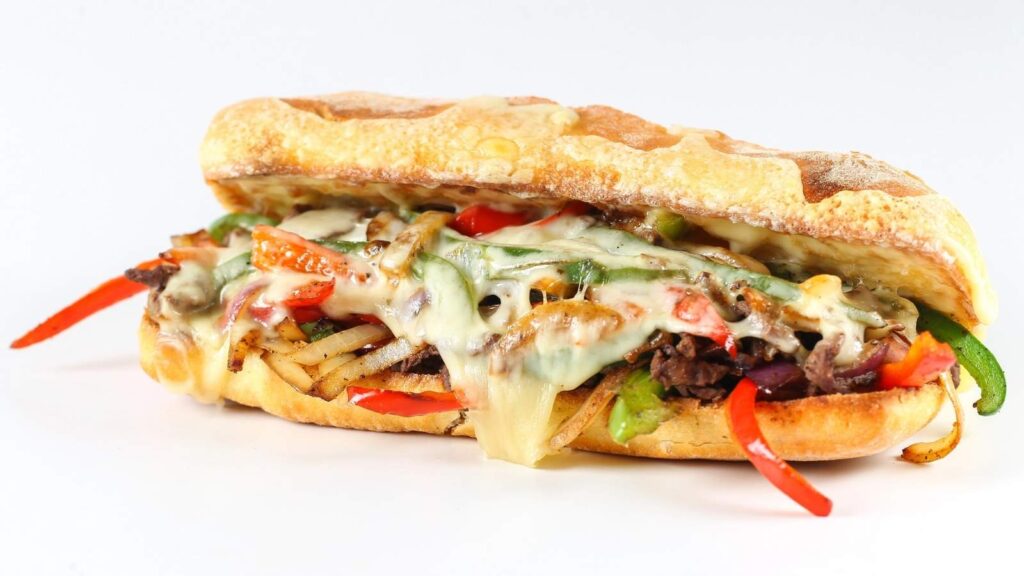
The cheesesteak question gets answered here. Pat’s King of Steaks and Geno’s Steaks face each other at the southern tip of the market, and both are fine for what they are: tourist theater conducted in neon at 2 a.m.
Locals eat their cheesesteaks at John’s Roast Pork on Snyder Avenue, a South Philly institution since 1930, or at Dalessandro’s in Roxborough, which earned a Michelin Bib Gourmand in 2025 and has the kind of decades-long regulars who would notice if anything changed.
Washington Avenue
South Philadelphia’s Washington Avenue is home to one of the largest Vietnamese communities on the East Coast, and its food corridor has been drawing serious eaters for decades. Ba Le Bakery at 606 Washington Ave bakes its own bread and has produced the banh mi against which every other in the city is measured since 1998: a rice-and-wheat baguette with a crackly crust, house-made pâté, pickled daikon and carrot, fresh jalapeño and cilantro.
QT Vietnamese Sandwich in Chinatown offers the same quality in a format that makes immediate sense in a city built on the hoagie. Philadelphia’s banh mi scene does not need a marketing campaign. It just needs to be taken as seriously as everything else the city does with bread and filling.
The Bring-Your-Own-Bottle ecosystem
Pennsylvania’s state-controlled liquor system is notoriously restrictive. Licensing fees are high and licenses are scarce, and Philadelphia’s response has been to build one of the most distinctive restaurant cultures in the country around the absence of a bar program.
More than 300 restaurants across the city follow the BYOB model, allowing diners to bring their own wine or beer without a corkage fee. The model dramatically lowered startup costs for independent chefs and pushed focus entirely onto the food.
Neighborhoods like East Passyunk, Bella Vista and Fishtown are full of small, chef-run rooms that could not exist in the same form with a liquor license requirement. For visitors, the protocol is simple: stop at one of the state wine shops near your destination, pick a bottle and show up. The experience is more intimate and considerably cheaper than comparable dining in New York or Washington.
Philadelphia stands apart from trends
Food tourism often moves in cycles. Attention lands on one city, prices rise, crowds follow and travelers start looking elsewhere. Philadelphia enters the conversation from a different position: as a city whose food culture was already mature before national recognition arrived. That makes it one of the rare destinations where the hype is catching up to the reality rather than the other way around.
Jennifer Allen is a retired chef turned traveler, cookbook author and nationally syndicated journalist; she’s also a co-founder of Food Drink Life, where she shares expert travel tips, cruise insights and luxury destination guides. A recognized cruise expert with a deep passion for high-end experiences and off-the-beaten-path destinations, Jennifer explores the world with curiosity, depth and a storyteller’s perspective. Her articles are regularly featured on the Associated Press Wire, The Washington Post, Seattle Times, MSN and more.