
Every July 4, the grill comes out, the buns get steamed and somewhere between the first firework and the last paper plate, someone bites into a hot dog and remembers why it works. As the nation marks its 250th birthday this summer, the humble frank is having a moment that goes well beyond the backyard.
The hot dog has always been one of America’s most enduring foods, cheap enough for a Depression-era pushcart, popular enough to draw devoted regulars 86 years later. But its reputation is finally catching up to its staying power. Regional traditions are earning James Beard recognition, while century-old institutions are still packing houses on a Tuesday morning. A new wave of chefs is treating the frank as a canvas, and doing it in food cities, because that’s where the frank has always belonged.
On Independence Day alone, Americans put away 150 million hot dogs, enough to stretch from Washington, D.C. to Los Angeles, California, more than five times. July is officially National Hot Dog Month, accounting for 10% of all annual retail sales. That appetite has been quietly funding some of the most interesting regional food stories in the country.
Los Angeles: 86 years and still drawing a line
In 1939, Paul and Betty Pink borrowed $50 from Betty’s mother, bought a pushcart and wheeled it to a scrubby lot at La Brea and Melrose in Hollywood. The Depression was still grinding. Hot dogs were 10 cents. They were lucky to sell 100 a day.
Pink’s Hot Dogs is still on that same corner. The city of Los Angeles has officially designated the intersection Pink’s Square. The stand now moves 1,500 to 2,000 dogs a day, with a menu of more than 40 varieties, many named for the celebrities who have made the pilgrimage: from Orson Welles, who Pink’s says once ate 18 hot dogs in a single sitting, to the Dodgers fans who line up for the Blues Dog during playoff runs. What keeps them coming isn’t novelty. It’s the same chili recipe Betty Pink developed before World War II, largely unchanged since the early years.
Tucson: Where the hot dog earned a James Beard Award
The Sonoran hot dog starts with a bacon-wrapped all-beef frank, grilled until the bacon crisps, then nestled into a warm bolillo-style bun and loaded with chopped tomatoes, griddled onions, pinto beans, mayo, yellow mustard and jalapeno salsa. The format originated in Hermosillo, Mexico, in the 1980s and crossed the border to become the signature street food of Tucson, the first UNESCO City of Gastronomy in the United States.
El Güero Canelo, a family-owned institution serving Sonoran dogs since 1993, won the James Beard Foundation’s “America’s Classics” award in 2018. For visitors who want to make a day of it, Visit Tucson runs an official Sonoran Dog Trail, where visitors eat at participating spots, collect stamps and win prizes. It is the rare food experience that works equally well as a culinary pilgrimage and a travel itinerary.
Macon: 110 years of the spicy red dog
On Feb. 27, 1916, a Greek immigrant named James Mallis opened a hot dog stand on Cotton Avenue in downtown Macon, Georgia. Hot dogs were a nickel. They stayed a nickel until the 1940s.
Nu-Way Weiners is still in Macon, still serving the same secret-recipe chili sauce, still drawing lines at locations across central Georgia. The spicy red dog, a beef-and-pork frank with a distinctive crimson hue and a snap when you bite it, has outlasted everything: fires, recessions, decades of changing American tastes. In October 2007, Oprah Winfrey stopped by while filming in Macon and ate two and a half of them. The state of Georgia has since proclaimed Sept. 29 Nu-Way Weiner Day. More than 200 million weiners served and counting.
Greenville: The hot dog as monthly obsession
Lefty’s West End Tavern opened in Greenville, South Carolina, in 2025 with a concept that is exactly as fun as it sounds: a rotating Tour of Ballpark Hot Dogs, one MLB ballpark-inspired frank per month. Past features have included a Bay Area Brat, a Rallyville beer-braised bratwurst with grilled onions, pico de gallo, arugula and avocado dijonnaise, a Camden Yards-inspired Crab Mac Grand Slam topped with crab mac and cheese and Old Bay-dusted potato chips and a Chicago-spec Windy City Whopper built to Vienna Beef standards, complete with a poppy seed bun and sport peppers. In a food scene as competitive as Greenville’s, a concept that gives diners a reason to return every month is serious play.
Seattle: Cream cheese changed everything
In 1989, a vegetarian bagel vendor in Pioneer Square was widely credited with creating what became known as the Seattle dog, improvising a way to feed post-concert crowds spilling out of the city’s grunge-era music venues. Bialy sticks, cream cheese and hot dogs came together in a combination that stuck.
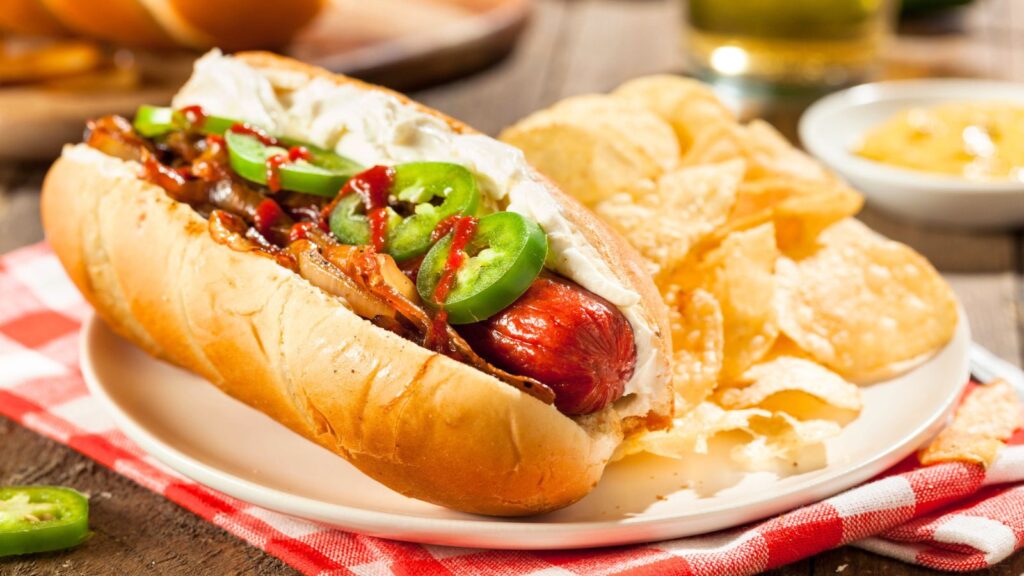
The formula, a grilled frank in a toasted bun slathered with cream cheese and topped with caramelized onions, spread from Pioneer Square to stadiums to late-night carts across the city. Dog in the Park, a family-owned stand that has operated just steps from the Space Needle since 2005, is where most visitors first encounter the style. The reaction is almost always the same: skepticism, followed by a request for another one.
The frank endures
The hot dog has survived every attempt to outgrow it. It has been dressed up, become the signature dish of a James Beard America’s Classics winner, claimed by a UNESCO-designated food city and name-dropped on national television. And it still costs less than a cocktail almost anywhere you find it.
From a Depression-era pushcart in Hollywood to a grunge-born street food in Seattle, the frank has always earned its place by belonging to the people who eat it. This July 4, America’s 250th, is worth more than a little recognition.
Jennifer Allen is a retired chef turned traveler, cookbook author and nationally syndicated journalist; she’s also a co-founder of Food Drink Life, where she shares expert travel tips, cruise insights and luxury destination guides. A recognized cruise expert with a deep passion for high-end experiences and off-the-beaten-path destinations, Jennifer explores the world with curiosity, depth and a storyteller’s perspective. Her articles are regularly featured on the Associated Press Wire, The Washington Post, Seattle Times, MSN and more.