
At the head of an Alaska fjord, a slab of Dawes Glacier breaks loose with a sound between a crack and a thunderclap, drops into the sea and throws up a wall of white water. Hundreds of passengers at the ship’s railing gasp at once. Calving is one of the signature sights of an Alaska cruise, and it is also the glacier breaking apart, which is happening quicker now than it did a generation ago.
From a deck railing, the ice looks permanent, but it is not. Alaska drew about 1.7 million cruise passengers in 2025, and glaciers headline nearly every Inside Passage itinerary. New measurements give a precise sense of how quickly that draw is receding: satellite radar data published in February 2026 found that Alaska’s glaciers melt for roughly three additional weeks for every 1 degree Celsius, about 1.8 degrees Fahrenheit, that average summer temperatures climb. The researchers tracked more than 3,000 glaciers across the state, and calculated that a single heat wave can strip up to 28% more of a glacier’s protective snow cover than an ordinary summer.
The ice a cruise sails to is measurably shrinking
The glaciers on an Alaska itinerary are named, mapped and, in most cases, close enough to a road or a shipping lane that their retreat has been recorded for decades. Mendenhall Glacier, which thousands of cruise passengers reach from Juneau by bus and trail, pulled back about a mile between 1986 and 2024 and lost as much as 2,000 feet of thickness in places, according to NASA satellite records. The Juneau Icefield that feeds it shed 63 of its roughly 1,050 glaciers, and about a tenth of its total ice, in the 14 years to 2019. The decline started centuries ago, long before the current warming, which has since quickened it.
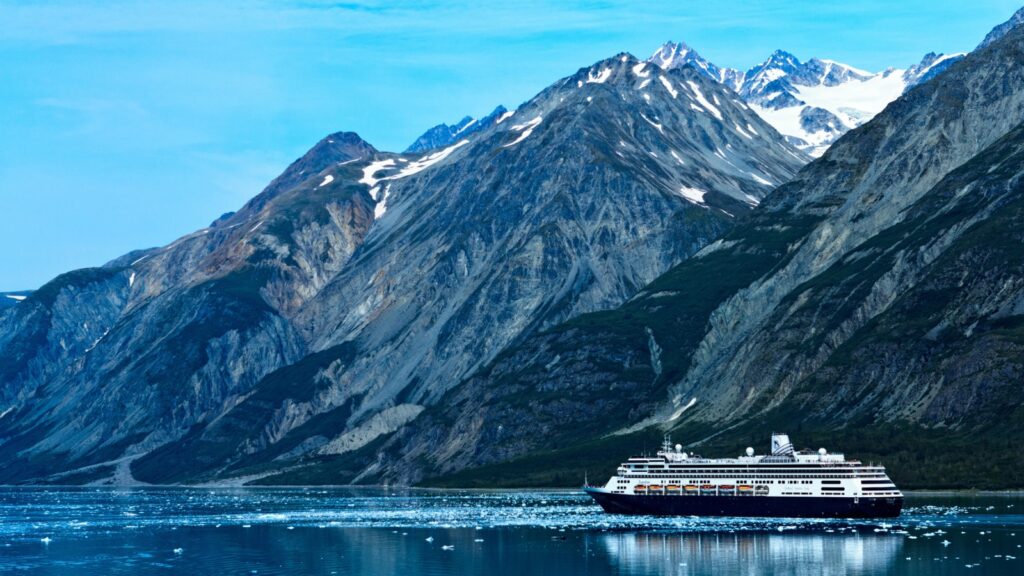
Nowhere is that retreat better documented than Glacier Bay, where the ice has pulled back some 65 miles since Captain George Vancouver charted a single frozen inlet in 1794, what the National Park Service calls the most dramatic documented glacial retreat in the world. The Park Service caps cruise traffic there at two ships a day, and Holland America is one of only two lines that hold historical rights to bring passengers in. The Koningsdam, sailing roundtrip from Vancouver, is among the ships that carry travelers to the head of the bay, where park rangers come aboard to narrate what the ice is doing and why.
The show is getting more dramatic
Thinner ice tends to calve more, not less. As a glacier loses mass and its front grows unstable, the collapses come more often and hit harder, which is part of why a morning at Dawes delivers the noise and the drama it does. The instability carries a second consequence that reaches past the ice. A glacier can act as a buttress against the mountainside beside it, and when it melts back, the slope it once held can start to slide.
Southeast Alaska has already seen what that looks like in August 2025 when a landslide at the retreating South Sawyer Glacier drove a wave nearly 1,600 feet up the far wall of Tracy Arm, a fjord north of Dawes. By the 2026 season, the cruise lines had rerouted those sailings south to Endicott Arm and Dawes Glacier. The same warming that fills the fjords with ice for passengers to photograph is also making some of them too dangerous to enter.
What travelers are really watching
The blue of glacier ice is worth the trip, a deep color that comes from centuries of pressure squeezing out the trapped air, and it shows best under the low grey cloud that sits over the fjords most days. A good calving still stops a shipful of people in mid-sentence. Each of those collapses is also the ice doing what the February data measured, giving back weeks of melt for every degree the summer’s warm.
The glaciers that pull these cruises north are receding, and the routes built to reach them are already being redrawn as a result. For a traveler, the takeaway is plain: the window to see Alaska’s tidewater ice calving into the sea is narrower than the brochures let on, and closing.
Mandy Applegate is a food and travel writer whose work has appeared in outlets including NBC, the Chicago Sun-Times and the Boston Herald. She has traveled to 47 countries, writing about food, drink and the places behind them. She is co-founder of Food Drink Life.