
Order a tagine in most Marrakech restaurants, and you get the version built for visitors. The dishes a Marrakchi family would actually cook had been disappearing from menus for years, until some of the city’s kitchens started putting them back. For American travelers, the catch was always getting there; this year that changed.
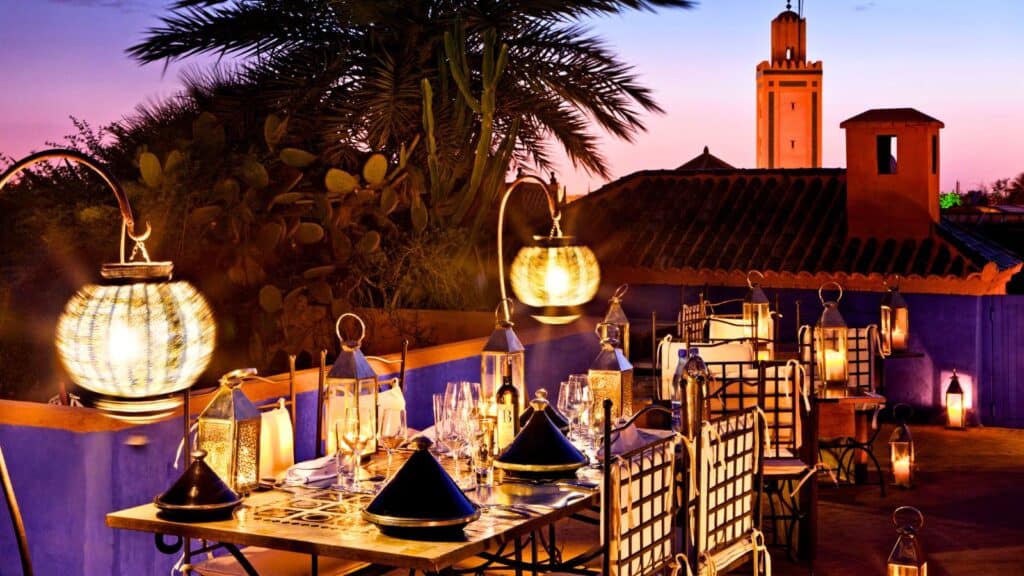
Reaching Marrakech from a U.S. airport used to mean a European layover, landing in Paris, Madrid or Lisbon first and losing the better part of a day. Royal Air Maroc, the national carrier, had long flown from a few U.S. cities to Casablanca, but the red city itself sat behind Europe.
Two U.S. carriers fly into Marrakech now. United was the first to try it and has since put more seats on the route. Delta added Atlanta last fall, and in June, Royal Air Maroc opened Los Angeles to Casablanca, the first nonstop link between the American West Coast and the African continent.
Morocco ranked among the trending summer destinations in this year’s U.S. search data, and the interest reads less like a cheaper stand-in for Europe than like an appetite for the food and the history.
5 of the Middle East and North Africa’s best restaurants are here
Five Marrakech restaurants made this year’s 50 best list, more than Cairo, Abu Dhabi or Beirut, and only Dubai placed more. The ranking is voted for by an academy of 250 chefs, critics and writers spread across 19 countries. La Grande Table Marocaine at the Royal Mansour came in at 19th place and took the year’s hospitality award, and its team spends part of every year traveling the country to track down old palace recipes and family cooking, then puts them on the menu.
Three of the five sit in Guéliz, the modern quarter north of the medina walls, and they are less interested in old recipes than in building something new. Farmers placed 49th and won the sustainability prize, cooking since 2024 out of a converted Art Deco gallery and sourcing from a permaculture farm on the city’s edge. Chef-owner Erwann Lance runs Le Petit Cornichon at 21st place, and +61, an Australian-style bistro named after the country’s dialing code, took the 31st spot.
2 medina riads and a mountain kasbah
In the Marrakech medina, Le Farnatchi is a 10-suite riad that British hotelier Jonathan Wix built from several old houses two decades ago and his son James now runs. It is expanding to 15 rooms, and its restaurant, Le Trou au Mur, cooks the traditional dishes that had fallen off Marrakech menus, the home food a local family would recognize.
Also in the medina, Palais Beit Al Noor opened at the end of 2025 inside a restored 18th-century residence, the newest of the three. Its Franco-Lebanese owners rebuilt it around three courtyards as a private home rather than a hotel, with 12 rooms each named after a Lebanese cultural figure. The chef works an open kitchen that serves guests only, and the tagines coming out of it are artichoke or quince, not the version on the tourist menu.
Less than an hour from Marrakech, Kasbah Bab Ourika sits on a hilltop at the head of the Ourika Valley. It is the one property here that is not historic, built from scratch in the 2000s to resemble an old kasbah, using pise, the rammed-earth technique Berber builders have worked in for centuries. Its kitchen uses produce from the property’s organic gardens, with a menu that changes daily and seasonally.
More US gateways, and a farm hotel taking bookings next month
Visitors are also spending more per head than they used to. Morocco’s tourism receipts reached 53.8 billion dirhams, about $5.8 billion, by the end of May, growing faster than arrivals and working out at roughly $743 per visitor.
For now, the nonstop map is narrow: United and Delta fly to Marrakech from Newark and Atlanta, and Royal Air Maroc reaches Casablanca from New York, Washington, Miami and, since June, Los Angeles. Much of that demand runs on diaspora travel and Morocco’s build-up to co-hosting the 2030 World Cup rather than food tourism alone. The effect for an American planning a trip is the same: the European connection is now optional.
Virgin Limited Edition is putting a 37-suite hotel on a working farm 25 minutes from Marrakech, with three restaurants fed by its own citrus groves and vegetable gardens. Reservations open next month, with the first 22 suites due early in 2027 and the rest a year later.
Morocco set itself a target of 26 million visitors by 2030 and now looks likely to hit it two years early, with a draft roadmap for 2027 to 2030 reaching for 30 million instead. More visitors means more competition for them, and the kitchens that stand out will be the ones cooking something a traveler cannot order at home.
Mandy is a luxury travel, fine dining and bucket-list-adventure journalist with expert insight from 47 countries. She uncovers unforgettable experiences around the world and brings them to life through immersive storytelling that blends indulgence, culture and discovery, and shares them with a global audience as co-founder of Food Drink Life. Her articles appear on MSN and through the Associated Press wire in major U.S. outlets, including NBC, the Daily News, Boston Herald, the Chicago Sun-Times and many more.