
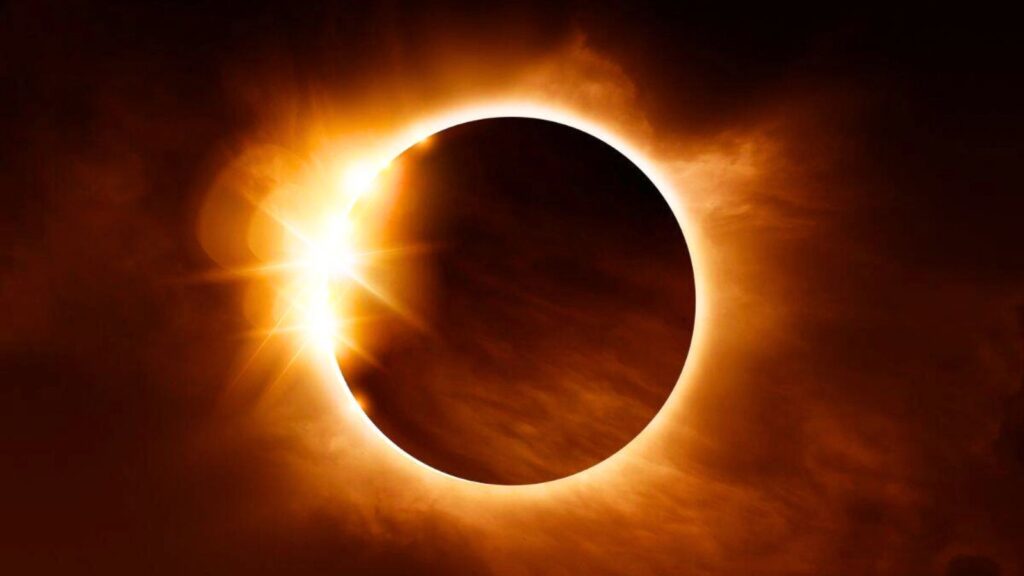
Spain’s first total solar eclipse since 1905 crossed the country Wednesday evening, and the shadow ran clean across the north, from the Galician coast out over the Balearics; Madrid and Barcelona both missed it, and the band passed between them. Everywhere south of that line, Andalucía included, the afternoon was spent watching the cloud forecast, because whatever was coming would happen low in the west, minutes from sunset. Anyone clouded out down here has an unusually short wait for another go, and anyone watching from the United States has until 2044.
This post may contain affiliate links that may earn us a commission. For more information, see our Disclosures.
I watched from a family property near Canillas de Aceituno, a village in the hills above the Costa del Sol in Málaga province, well outside the band. Rather than join the crowds climbing toward higher ground, our group settled in among the property’s grapevines, and the sky cleared just in time after a cloudy afternoon. Eclipse glasses stayed on the whole time because even a sliver of uncovered sun is too bright to look at directly.
Málaga reached 94.5% obscuration around 8:38 p.m. local time, and nothing at this end of the country came close to totality. The light drained slowly and unevenly all the same, and the air turned noticeably colder as the hillside went quiet. The partial phase began at 7:43 p.m. and never finished where we could see it, because the sun set still eclipsed, just after 9 p.m.
Spain’s last-minute travel scramble
Flight bookings ran 25% ahead of last year into airports along the eclipse path for arrivals between Aug. 7 and 12. Hotel occupancy across Spain and Iceland rose 16%, and average daily rates were 36% higher. Short stays of one to five days rose 57%, and solo travel jumped 48%.
Bilbao and Asturias take the traffic
Bilbao saw bookings surge by 366% and Asturias 292%, the sharpest increases anywhere along the path. Valencia, at the Mediterranean end of the same band, saw a 137% increase as the shadow swept from the Atlantic coast out to the islands.
Where the shadow actually landed
The band crossed provincial capitals from A Coruña to Palma, taking in Oviedo, León, Bilbao, Zaragoza and Valencia on the way. Totality lasted between roughly 1 minute 27 seconds and 1 minute 43 seconds at the best-known viewing sites, among them the Picos de Europa, the Javalambre observatory in Teruel and Majorca. A Coruña, first in the path, got about 1 minute 15 seconds with the sun almost down.
Madrid and Barcelona’s near miss
Madrid’s own eclipse guidance put obscuration at 99.9% or better at 8:32 p.m., and Barcelona reached just over 99.8% at 8:29 p.m. Numbers that close sound like totality on paper. They aren’t.
A partial eclipse, even at 99.9%, never produces the darkness, the corona or the diamond ring of a total one. Spain’s two largest metropolitan areas spent the evening a fraction of a percent short of the thing other people had flown in for.
Spain’s next eclipse is already taking names
On Aug. 2, 2027, totality returns to the south, running roughly 2 minutes 56 seconds over Cádiz. Gibraltar, the British territory further along the coast, gets 4 minutes 27 seconds. It will be the longest total eclipse over easily accessible land this century, though the maximum of 6 minutes 23 seconds falls over Egypt, not Spain.
New Scientist Discovery Tours has opened registration for a five-day Southern Spain short break built around it, departing July 31, 2027. The company launched the trip after its Nile River eclipse cruise sold out and its Morocco itinerary approached capacity.
Guests get a private, fully catered viewing site on a beachfront hotel terrace in Andalucía, four nights at a four-star hotel, eight meals, two English-speaking tour leaders, a pre-eclipse briefing and coach transport from Seville Airport, plus excursions to Cádiz, Gibraltar and the Roman ruins of Baelo Claudia. Pricing has not been set. For 2028, the same company runs two trips to the eclipse crossing Australia and New Zealand, a 12-day Kimberley cruise and a seven-day New Zealand trip.
What Americans are actually waiting for
Anyone in the United States who chased the 2024 eclipse and wants another has a long gap ahead. The next total solar eclipse over the Lower 48 is Aug. 23, 2044, and totality clips only Montana, North Dakota and South Dakota. The first coast-to-coast one since 2017 comes on Aug. 12, 2045, running from California to Florida.
That is 18 years of nothing, which is the real reason Bilbao hotel rooms went the way they did this week. Totality is not rare on the planet; it is rare where you happen to live.
The 2027 queue has already started
Wednesday was the trial run. In under a year, the country gets nearly 3 minutes over Cádiz instead of 94% and a sunset, and the operators are positioned for it: the Nile cruise for that eclipse has sold out, and the Andalucía terrace is taking names before it has a price. Registration costs nothing, which currently makes it the cheapest way to get in front of the only total eclipse most Americans can reach before 2044.
Mandy is a luxury travel, fine dining and bucket-list-adventure journalist with expert insight from 47 countries. She uncovers unforgettable experiences around the world and brings them to life through immersive storytelling that blends indulgence, culture and discovery, and shares them with a global audience as co-founder of Food Drink Life. Her articles appear on MSN and through the Associated Press wire in major U.S. outlets, including NBC, the Daily News, Boston Herald, the Chicago Sun-Times and many more.