
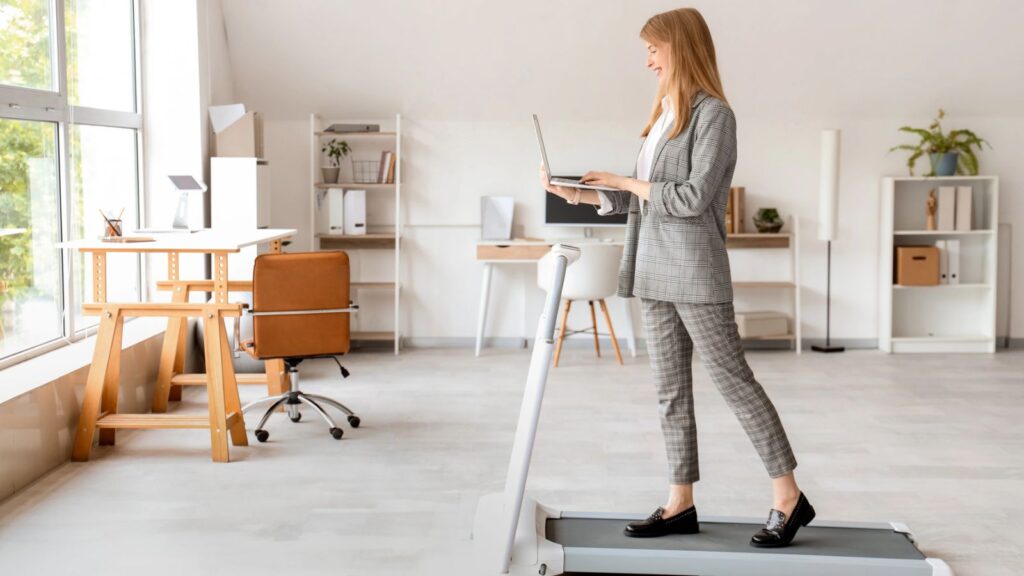
The under-desk treadmill started as a pandemic-era impulse buy and became something remote workers structured their entire days around. They logged thousands of steps between conference calls and email without leaving home, and the walking pad stayed underfoot long after the novelty wore off. Now in-office mandates are ordering workers back into buildings with desks and chairs, and no plan for anyone who got used to moving.
This post may contain affiliate link(s). As an Amazon Associate, I earn from qualifying purchases. See Disclosures.
The walking pad that made those daily miles possible was barely noticeable. At 1.5 mph, the device sat flat under a standing desk, ran quieter than a dishwasher and folded against a wall at the end of the day. It asked for nothing except a power outlet and a pair of sneakers, and that low friction is exactly what corporate offices, with their fixed furniture and shared floor plans, are not built to replicate.
The 5-day office is now the majority rule
A year ago, only about 1 in 10 employees at Fortune 100 companies were subject to five-day office requirements. That share now exceeds half, making full-time attendance the majority position among the country’s largest employers. For workers who spent the remote years building walking-desk habits at home, the office they are returning to is not the one they left.
The mandates landing this summer
California’s state government moved more than 100,000 workers from two in-office days to four when an executive order took effect July 1, drawing union protests at the Capitol the same morning the mandate began. Workers cited childcare costs, commute disruptions and office space shortages as immediate pain points, and the policy made California stricter on public-employee telework than most other states.
PNC Financial required corporate employees to return to the office five days a week starting May 4, and within days employees were venting on social media about the mandate. Fidelity Investments followed weeks later, announcing in late April that more than 21,000 U.S. employees at four locations would return five days a week beginning in September, ending a hybrid arrangement that had allowed remote work for half of each month.
What the research says about walking while working
A 2021 meta-analysis published in BMC Public Health pooled 13 studies covering 351 participants and found that treadmill desk users burned an additional 105 calories per hour compared with sitting, while workplace studies showed a reduction in seated time of nearly two minutes per hour across a 24-hour measurement period.
The cognitive trade-offs are smaller than most people expect. In a 45-minute laboratory session, researchers at Brigham Young University split 75 adults between treadmill desks at 1.5 mph and standard seated desks and found only modest differences between the two groups. Walkers saw a 9% dip in cognitive processing measures and a 13-word-per-minute typing reduction, but the researchers concluded the health gains outweighed those small trade-offs.
Mayo Clinic’s Dan Abraham Healthy Living Center put the question to a randomized clinical trial in 2024. Forty-four participants tested four different active workstation setups including walking pads, bikes, steppers and standing desks. The results showed improved reasoning scores during active use compared to sitting, with no loss in typing accuracy, though typing speed slowed slightly.
The cubicle problem
Corporate offices introduce a different set of constraints than the spare bedroom. Shared space means shared noise. Fixed furniture, electrical capacity and open-plan layouts all complicate the kind of setup that felt effortless at home.
Many consumer-grade walking pads were built for lighter use, with narrower belts, shorter duty cycles and frames designed for one person walking a couple of hours a day. Office environments demand something sturdier, and commercial-grade units designed for shared daily use exist but require employer investment, facilities coordination and a wellness budget that most companies have not created.
The gap between “I had one at home” and “I can use one at work” has less to do with the technology itself and more to do with whether the employer treats movement as part of the workspace.
For decades, workplace wellness meant a gym discount and a step-count challenge, benefits that existed outside the workday. Walking desks change that equation by putting the movement inside the work itself. Whether traditional offices make room for that idea or dismiss it as a home-office novelty will say less about fitness equipment and more about what kind of return these mandates were designed to produce.
Jennifer Allen is a retired professional chef and long-time writer. Her work appears in dozens of publications, including MSN, Yahoo, The Washington Post and The Seattle Times. These days, she’s busy in the kitchen developing recipes and traveling the world, and you can find all her best creations at Cook What You Love.