
To the people who built Luxor, the sun was the force that held the world in order, and they followed it across the sky, setting their calendar and their festivals by its path. When it went dark over their city, they left almost no record of what they saw. In August 2027, it will happen again, right over Luxor.
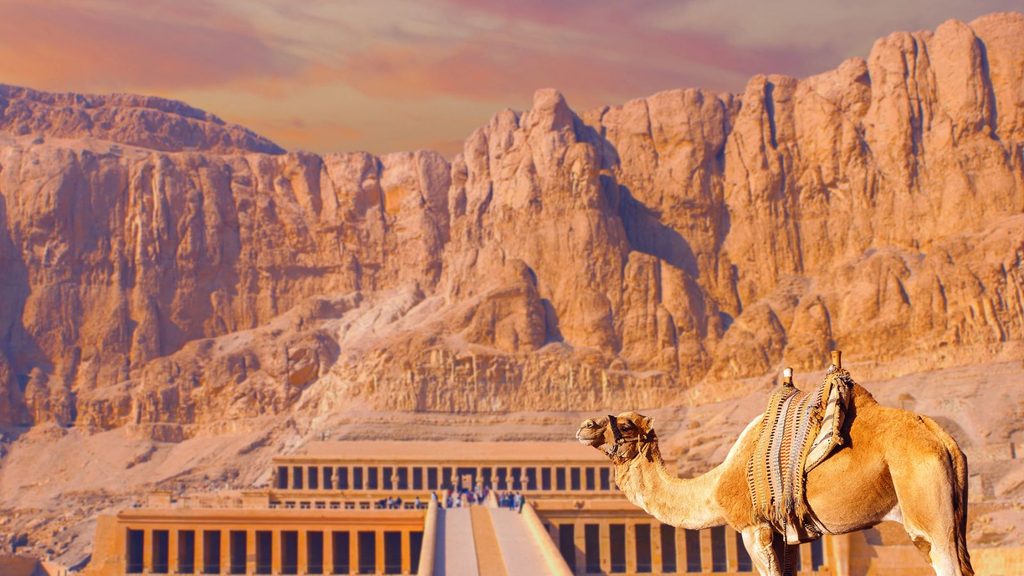
In the Egyptian telling of the world, the sun god Ra sailed across the sky by day and sank at night into a dark underworld, where a giant serpent lay waiting to swallow him whole, and only his escape before dawn brought the morning back. A people who told that story, and who aligned their temples to the sun, might be expected to have left a great deal about the afternoons when the sun itself went out, and yet the record is nearly silent.
The eclipse that crosses Luxor
On Aug. 2, 2027, the moon’s shadow will sweep across North Africa, and over Luxor the sun will vanish completely for 6 minutes and 22 seconds, from about 1:02 to 1:08 p.m. local time, deepest at 1:05. The partial phases bracket it, from late morning to mid afternoon. Most total eclipses bring only two or three minutes of darkness, and no eclipse will run as long again until 2114.
On April 8, 2024, a total eclipse crossed the United States from Texas to Maine and pulled millions of Americans outdoors to watch. The 2027 eclipse lasts longer and falls half a world away. For Americans, seeing it means a trip to Egypt, and a spot inside the narrow band where the sun fully disappears.
A civilization that barely wrote eclipses down
Egyptologist John Ray and astronomer Gerry Gilmore noted that records of eclipses are almost entirely absent from ancient Egyptian texts, and that the reason is unknown. The archaeoastronomer Giulio Magli reached a similar conclusion more recently, finding no known text that clearly and unmistakably describes an eclipse. Ray and Gilmore offered two possibilities: that eclipses were ill omens, too dangerous to set in temples or tombs, or that any records were kept on papyrus in archives that did not survive.
Some researchers suspect the Egyptians did describe an eclipse, in disguise. The Egyptologist Gyula Priskin reads a passage in the “Coffin Texts,” a set of funerary spells written around 4,000 years ago, as a solar eclipse told in myth, with the moon becoming a serpent that halts the sun god. The reading is far from settled, and Magli cautions that interpretations like it rest on much later sources. The tombs of the Valley of the Kings, though, are painted with the sun’s nightly passage through the underworld, hour by hour, the very voyage their faith depended on.
Luxor is the place to stand
Luxor sits squarely under the path of totality, and on Aug. 2 the skies over the city have been clear every year since 2000. Karnak, the enormous temple on the east bank, was aligned to the midwinter sunrise by builders who ordered their holiest places by the sun’s position.
Art In Voyage, a luxury travel company, is building a trip around the six minutes of totality, and its guests plan to watch from a privately chartered ship on the Nile rather than from the crowds on shore. “There’s something wonderfully poetic about witnessing a total solar eclipse from the Nile,” said Mikael Audebert, the company’s founder, “a river that has been at the heart of Egyptian civilization for thousands of years.”
What to know before you go
Luxor in early August is punishing. Afternoon highs average about 40.5 degrees Celsius or 105 degrees Fahrenheit, and the eclipse peaks in the heat of the afternoon.
Looking at the sun during the partial phases requires glasses or handheld viewers that meet the ISO 12312-2 standard. Astronomers say the only moment it is safe to look without them is the total phase, those few minutes just after 1 p.m.
Egypt’s tourism ministry set up a committee in May 2026 to prepare for the eclipse, and officials have since discussed viewing sites and possible changes to visiting hours in Luxor, though nothing has been finalized. Whether the Valley of the Kings and Karnak will be open to visitors during the eclipse itself has not been announced, so travelers should not assume access to any particular monument at totality. Several specialist tours have already sold out.
6 minutes of darkness
At Luxor, the sun will be almost directly overhead when it goes out, 82 degrees up, its corona ringing the black disk of the moon. Almost nowhere on Earth will the darkness last longer than it does here. And by chance, it is the city the pharaohs built around the sun. A few minutes later it will come back, the way they always believed it must.
Mandy is a luxury travel, fine dining and bucket-list-adventure journalist with expert insight from 48 countries. She uncovers unforgettable experiences around the world and brings them to life through immersive storytelling that blends indulgence, culture and discovery, and shares them with a global audience as co-founder of Food Drink Life. Her articles appear on MSN and through the Associated Press wire in major U.S. outlets, including NBC, the Daily News, Boston Herald, the Chicago Sun-Times and many more.