
Not every apple deserves a spot inside a shell of melted caramel. Crisp, not-too-sweet varieties hold up to the heat, while soft, bland ones turn mealy. This Oct. 31, National Caramel Apple Day, orchards across the country are finally catching up to what candy-apple makers have known all along.
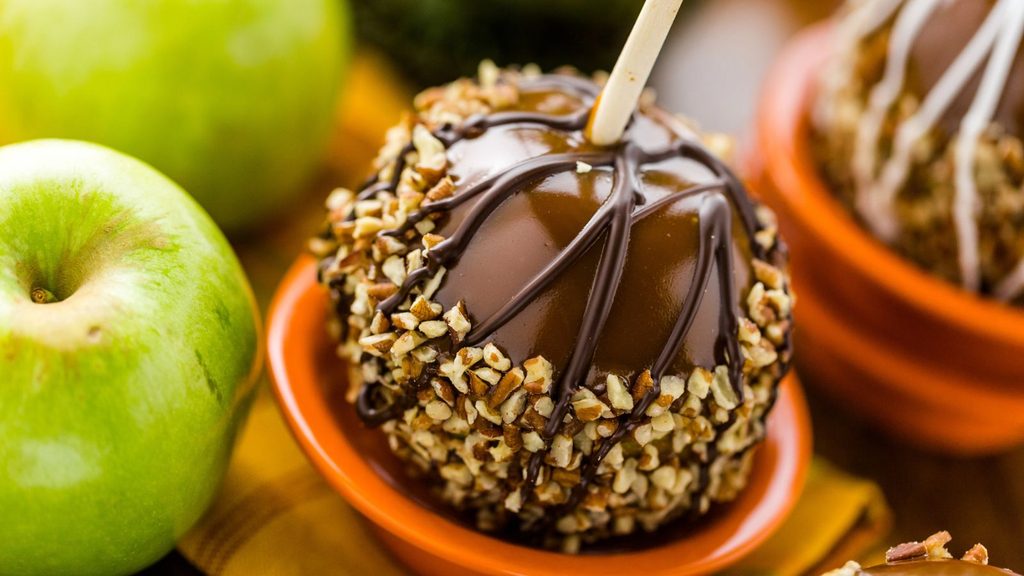
Some trace the first caramel apple to Hunter’s Candy, a small sweet shop in Moscow, Idaho, where owners Ray and Anna Hunter are said to have started dipping apples in caramel in 1936. A local history account says archived photographs show the shop’s caramel-coated Jonathans and Winesaps being shipped to American soldiers in Korea, England and Japan during World War II.
A competing claim traces back to Chicago, where a bookkeeper named Edna Kastrup developed a caramel recipe for dipping tart apples while working at a candy company called Windy City Confections in 1948. She and her husband took over that company in 1952 and opened a taffy-apple shop in the Rogers Park neighborhood, eventually building the recipe into Affy Tapple. The company still uses that same recipe in its stores today.
Growers are favoring different apples
This year’s apple crop is estimated at about 263 million bushels, roughly 7% below last year’s total. Underneath that overall decline, the variety mix is moving in a specific direction.
Honeycrisp, at about 27 million bushels, and Granny Smith, at about 30 million, have both climbed for five straight years. Gala is still the largest variety by volume, at about 42 million bushels, though its share has slipped over that same period, along with Fuji and Red Delicious. The split determines exactly which apples are worth grabbing for a caramel coating.
Granny Smith keeps climbing
Candy-apple sellers across the country say Granny Smith is exactly the apple they reach for first. Tartness is usually the reason, since the apple’s sourness cuts through caramel’s sweetness and its crisp bite keeps it from breaking down once it meets hot caramel.
A northern Michigan candy shop says it ships the largest Granny Smiths it can find, since no local grower can supply that size in the quantity it needs. A pastry chef at a Las Vegas resort uses nothing but Granny Smiths for the same reason, even slicing miniature versions from larger apples rather than switching varieties. People who make these treats for a living already knew all of that. It only recently became visible in the orchard data, too.
Honeycrisp’s popularity has a catch
Honeycrisp is moving in the opposite direction, with demand climbing even as growers call it one of the hardest apples to grow well. Cold storage holdings of the variety more than doubled from about 1.24 million bushels to 2.72 million compared with the same point last year.
A candy shop in Empire, Michigan, sources its Honeycrisps from a nearby orchard because the fruit stays crisp through the dipping process. Few large growers take that same risk, since Honeycrisp’s thin skin punctures easily and the fruit bruises long before it reaches a dipping line. The tree also tends to overproduce, forcing growers to thin the crop by hand every season.
Red Delicious is losing on 2 fronts
Red Delicious has declined for five straight years, and its fresh holdings now sit 34% below the five-year average, the steepest drop of any major variety. It held the title of the country’s most-produced apple for at least five decades before Gala took over in 2018, and it has kept sliding since. Gala has held the top spot ever since.
At least one culinary director in Las Vegas has said plainly that Red Delicious is not the right pick for dipping, since it tends to turn bland and mealy once caramel sets around it. The same director reaches for Granny Smith mainly for convenience and prefers harder-to-find pippins or Jonathans when they are in season.
A newer apple is already the biggest name in storage
Cosmic Crisp is a Washington State University-bred variety first sold commercially in 2019, and growers say it was bred dense enough to stay crisp in commercial controlled-atmosphere storage for up to a year, long after most apples would have gone soft. Washington growers funded the apple’s development and hold exclusive rights to sell it for its first decade on the market. As of this August, it was already the single largest apple variety held in cold storage nationwide, at about 4.9 million bushels, surpassing both Honeycrisp and Granny Smith.
Pink Lady has also grown steadily over the past five years, even though its cold storage holdings dipped slightly this past month. Neither Cosmic Crisp nor Pink Lady has built the same reputation among candy-apple makers as Granny Smith and Honeycrisp, at least not yet.
Some regions had a much rougher year
This year’s national apple decline hit some states much harder than others. Pennsylvania’s apple crop fell 58% this year and Virginia’s fell 48%, both after spring freezes damaged blossoms before the fruit ever set. Washington, the country’s largest producer at roughly two-thirds of the national crop, lost only 2%. For anyone picking out apples for a caramel apple this week, the variety in the bin may matter as much as the state it came from.
Mandy Applegate is the creator behind Splash of Taste and seven other high-profile food and travel blogs. She’s also the co-founder of Food Drink Life Inc., a unique and highly rewarding collaborative blogger project. Her articles appear frequently on major online news sites, and she always has her eyes open to spot the next big trend.