
Personal growth is an intentional part of how people approach travel today, according to Hilton’s 2027 Trends Report. Forty-two percent of respondents say travel helps them discover new interests or passions. Thirty-four percent travel to get a new perspective that changes how they view their everyday life.
Travelers leave home to find something intangible they can bring back with them. “These findings tell us that travelers are looking for more meaningful connections to destinations. Hotels are responding by creating experiences rooted in local culture, traditions and expertise,” said Jess Petitt, senior vice president, strategy, insights & full service brands, Hilton.
In line with the report’s findings, one hotel group crafts a cultural journey through Austria and Bavaria, guiding guests through curated activities and stays across three cities. The result is a tour through hundreds of years of tradition led by the people keeping them alive today.
Hand-crafted heritage goods
Blocks of contemporary luxury shopping in the Old Town give way to one of Europe’s best Christmas markets each winter. Year-round, heritage brands in Vienna quietly continue a tradition dating back hundreds of years. Start the day with a tour of world-famous glassmakers J. & L. Lobmeyr.
The Rosewood Vienna organizes tours for its guests at the company’s crystal workshop. Visitors see how crystal is cut and engraved by hand before being crafted into the chandeliers that hang in the Metropolitan Opera House in New York, the Kennedy Center in Washington, D.C. and the Kremlin in Moscow.
Despite its commitment to tradition as a sixth-generation, family-owned company, J. & L. Lobmeyr is responsible for several meaningful innovations, including the first electric-powered crystal chandelier in partnership with Thomas Edison. More festively, they invented the martini glass in 1925.
Around the corner, Wilhelm Jungmann & Neffe has been sourcing fine fabrics for bespoke garments since 1836. If you don’t have time for a custom suit, pick up a silk tie, headband or pocket square as a memento of the visit.
Beyond these businesses, the city is full of families carrying on their ancestors’ crafts. Pare back on travel gadgets to leave room for souvenirs you can’t get anywhere else.
Visit Jarosinski & Vaugoin for handcrafted silver, Augarten Porzellan for hand-cast, hand-painted porcelain, Ludwig Reiter for handmade shoes and Scheer should you wish to spend roughly $11,200 or more on a pair of custom-fitted boots. These names, unknown to many American travelers, embody quiet luxury with their commitment to craftsmanship and lack of logos.
Hotel or private portal
End the day at the Rosewood Vienna hotel, where the hand-crafted theme continues with personally monogrammed pillowcases for each guest. Velvet, brass, lacquer and tweed create a calming symphony in the spacious guest rooms, while rooftop views and fringed lighting add to the atmosphere at Neue Hoheit Restaurant. Don’t be surprised if even the public bathrooms have you mentally redecorating your home.
Though not considered a traditional boutique hotel brand, Rosewood properties each have a strong connection to the local area. In Vienna, the hotel uses its local ties to develop guest experiences they can’t find elsewhere. Request a private tour of the Secession, the name of both an art movement and the building that has housed it since 1897.
Founded by Gustav Klimt and 18 other artists, the Vienna Secession sought freedom from the Association of Austrian Artists and its preference for historical norms. Today, it preserves Klimt’s Beethoven Frieze and features a rotating selection of contemporary artists showcasing everything from sound installations to glass works that co-opt the building’s floors and ceilings into the display.
Back at the hotel, contemporary art takes the shape of inventive cocktails at THE1835. Try the Twisted Peanut for a salty-sweet take on a tequila-based drink. Catch a glimpse of Vienna’s historic skyline from the bar’s rooftop patio as a fitting contrast to the boundary-pushing mixology.
A feast of music and art
A 2.5-hour train ride from Vienna, Salzburg offers more ways to experience local traditions. Americans know it as the setting for “The Sound of Music,” and a new museum journeys through the film, the Broadway musical and the real-life von Trapp family. Residents are prouder of its other musical claim to fame as Mozart’s birthplace.
Guests of nearby Rosewood Schloss Fuschl have access to a private, after-hours tour of the home where Mozart was born and raised. A remarkable private concert follows the tour, played on an 18th-century fortepiano by one of two master pianists permitted to touch the instrument.
The music transports guests into the past, ringing out from the apartment below the Mozarts’. History no longer feels static when you experience it by sitting on period furniture and listening to Mozart just steps from where he composed from age 5.
While in Salzburg, learn about the art of traditional dressmaking, or Tracht. The Salzburger Heimatwerk is a cooperative store and workshop that has offered custom and off-the-rack handmade dirndls and lederhosen for 80 years.
Lest you feel like an interloper shopping for traditional Austro-Bavarian clothing, shopkeepers from Salzburg to Munich assure visitors that Tracht is still worn regularly. Locals and foreigners wear Tracht to Oktoberfest, and locals choose it for parties, social events, holidays and weddings.
In Salzburg, dirndls are often worn casually. A stroll through the farmers market on a sunny day shows how alive this tradition remains.
Tranquil tour back in time
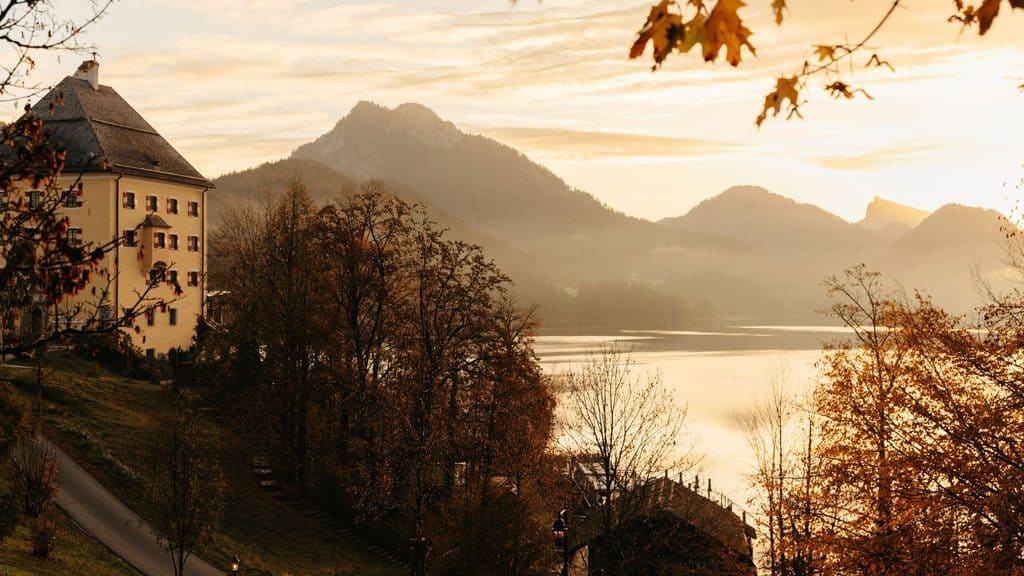
Jutting out into the turquoise waters of Lake Fuschl, Rosewood Schloss Fuschl welcomes guests into its own historical journey. Built in 1461 for the Archbishops of Salzburg, the hunting lodge was masterfully converted into a luxury hotel. Though just 25 minutes from Salzburg, Lake Fuschl feels like a different side of Austria entirely.
The castle hotel transports travelers back in time with its original floors, beams and beautifully restored plaster emblems depicting hunting scenes. The historic tower, now under government cultural protection, cannot be renovated or materially changed.
The rest of the property, though newer, becomes a backdrop for history. The hotel houses the largest collection of Old Masters paintings outside a museum, all on display for guests.
Walking the halls is an education in light, detail and symbolism. Each room is graced with a guidebook explaining the paintings and their stories, though not their locations, making finding them a treasure hunt.
Turndown service continues the cultural immersion. Nightly “bedtime stories” left in the rooms share information on regional products, local legends and culinary traditions.
Where life resembles art
A scant two-hour drive brings visitors from Lake Fuschl to Munich, Germany, where living tradition abounds. Two festivals, both hundreds of years old, bring visitors to Munich by the thousands. Oktoberfest, started in 1810 to celebrate the wedding of Crown Prince Ludwig of Bavaria, is dwarfed by the history of the Christmas markets, the oldest of which dates to the 14th century.
Visitors traveling outside these festive times still find a city celebrating the present while preserving its past. Stroll through Viktualienmarkt, a 200-year-old food market, where tourists and residents mingle while shopping for fresh vegetables, cheese, handicrafts or meat from one of several butchers.
Order lunch like a local at Zum Franziskaner, a Bavarian restaurant since 1363. Skip the table service and walk straight to the back, where a line of locals hugs the wall. They wait to order a leberkäse on a pretzel roll, slathered in sweet mustard, straight from the kitchen. The meatloaf’s fluffiness comes from mixing in ice cubes, which melt during baking and leave air pockets in the loaf.
If you have room for dessert, head for the Rosewood Munich hotel, where afternoon tea brings art to life. Pastry chef Shinas Shahida crafts delicacies that mimic the art lining the hotel walls with such accuracy that the information sheet matching pastry to artwork is unnecessary.
Staff at Rosewood Munich, including clienteling manager Victoria Asbach, serve as cultural ambassadors for visitors. Asbach takes guests to the Marienplatz, one of Munich’s most famous squares. The Glockenspiel begins its song, and she shares that the barrel-makers’ dance depicted by the clock is still performed today, every seven years.
The tradition began in Munich in 1517 to bring hope and joy after a plague, and it continues more than 500 years later. The dance has expanded beyond Munich, but since it already happened in 2026, travelers will have to wait until 2033 for another glimpse.
Asbach can also arrange a private viewing of experimental art by notable artist Angelika Maria Stiegler. Her piece “Let Them Eat Cake,” a focal point in the hotel’s restaurant, exaggerates the Baroque style in a ceramic that pays homage to Nymphenburg porcelain. If you’d like a private tour of the Nymphenburg factory, Rosewood Munich can also arrange one.
Travel that means more
Travelers seek more than relaxation. They want learning, growth and a deeper understanding of the places they visit. Austria and Munich offer art, craftsmanship and culinary innovation that honor history while remaining relevant for today.
Ashley Wali is a Seattle-based travel journalist and owner of Wanderlux, writing about luxury, family, culinary and wellness travel. Her work has appeared in The Seattle Times, Boston Herald, San Francisco Weekly, Sun Sentinel and more. Recent assignments have had her exploring small-town Croatia and boutique hotels in Italy.