
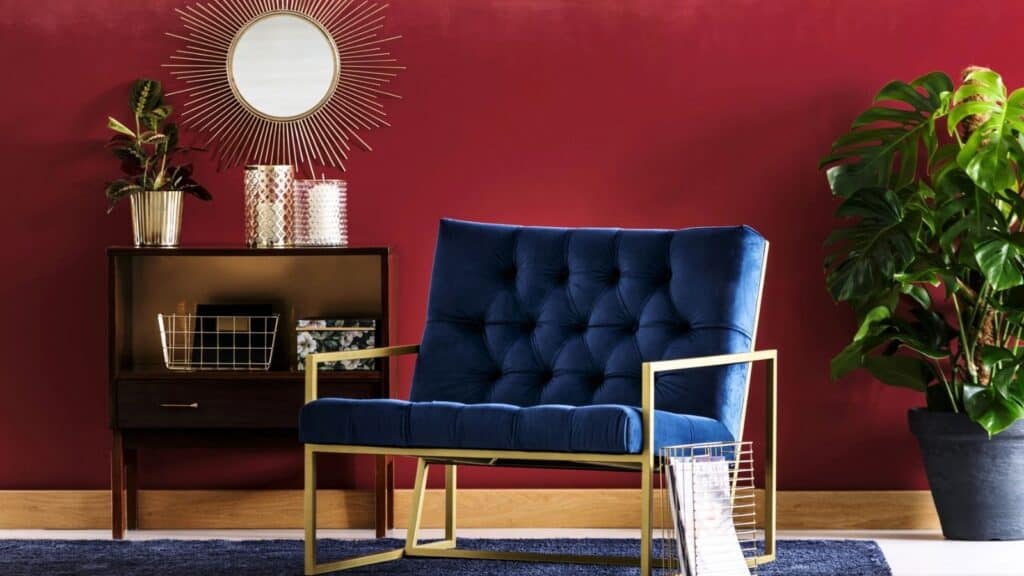
Brass hardware, velvet seating and rooms dressed in burgundy and deep jewel tones are emerging as prominent directions in American home design this fall. Trend forecasters call the look Neo Deco, and recent search data shows it growing at one of the fastest rates in home design right now. Think 1920s Art Deco glamour, minus the part where you’re afraid to sit on your own sofa.
This post may contain affiliate link(s). As an Amazon Associate, I earn from qualifying purchases. See Disclosures.
The original Art Deco movement gave the world the Chrysler Building, the Paris Exposition of 1925 and a design language that treated bold geometry and rich materials as serious design. The style has resurfaced in interiors before, but this time it’s showing up in consumer search data and home listings alongside the design industry, reaching an audience far broader than previous revivals.
The numbers behind the aesthetic
Neo Deco search interest grew 210% year over year in the latest fall and winter home decor forecast, making it one of the fastest-accelerating aesthetics in current tracking. A separate forecast based on global search data had already named Neo Deco as one of 2026’s defining home trends late last year, with searches for brass aesthetics up 35%, red marble bathrooms up 80% and antique bar carts up 100%. Gen X and millennials were identified as the generations driving early adoption.
What it actually looks like in a room
The elements that define a Neo Deco space share a common design grammar. Fluted detailing shows up on cabinet fronts, furniture legs and lighting fixtures. Geometric tile in chevron and fan-arch patterns is showing up in spaces where subway tile dominated for the past decade. Rich textiles, velvet cushions, boucle chairs and channel-tufted seating bring color and texture back to surfaces that spent years being neutral.
In a recent designer survey, 79% chose brass over chrome for the year ahead, and warm metallic finishes like brushed gold and bronze are becoming more prominent in 2026 interiors. Sculptural pendants and tiered chandeliers with geometric silhouettes have become one of the more visible entry points into the aesthetic. What holds the look together is that every piece earns its presence by what it communicates, not by how well it disappears.
Milan confirmed the direction this spring
At the 64th Salone del Mobile, held in Milan this past April, Art Deco-influenced design emerged as one of the fair’s prominent stories. Designers showed lacquered finishes, brushed brass, velvet upholstery and sculptural furniture built on geometric forms. The departure from the pale woods and restrained silhouettes that had dominated recent fairs drew dedicated coverage from InteriorDaily and Yanko Design, both of which framed the Neo Deco direction as a major story from the fair.
Collections featured game tables with brass accents and ebony detailing and lacquer-framed reissues of mid-century seating. The aesthetic showed up across price points from heritage luxury houses to younger studio-scale brands.
1 color, everywhere
Not every fall room is built on geometry and contrast. Color drenching takes the opposite approach, committing to a single saturated hue across walls, trim, ceiling and sometimes even the furniture. Examples include a dining room entirely in moss green, a bedroom painted floor to ceiling in warm cocoa, a bathroom where the tile, the vanity and the walls are all the same deep navy.
Zillow’s listing data shows mentions of the technique up 149% in listing descriptions year over year, and designers surveyed for a separate 2026 forecast chose color drenching over pattern drenching by a 2-to-1 margin. Where Neo Deco fills a room with layers of material and texture, color drenching fills it with a single mood. The appeal is that the room tells you how it feels the moment you walk in.
Rooms built for one thing
Another direction showing up in fall 2026 data has less to do with materials and more to do with how a space is used. Reading nooks appeared 48% more often in Zillow listings year over year. Designers surveyed by Apartment Therapy named alcoves, niches and built-in millwork among their architectural recommendations for the year ahead.
The common thread is homeowners carving single-purpose corners out of rooms that were designed to do everything at once: a window seat built specifically for morning coffee, a closet converted into a library nook, a hallway alcove fitted with a bench and shelving. After years of spaces designed to do a little of everything, the appeal of a room that does one thing well and feels like it was made for you is turning out to be its own kind of luxury.
What comes next
If the search data and the global design industry are reading the same signals, the next period in American home design will favor bold geometry, saturated color and spaces designed around intention rather than flexibility. Neo Deco, color drenching and purpose-built rooms are three different answers to the same question this fall. A room should feel like it belongs to the person living in it.
Mandy writes about food, home and the kind of everyday life that feels anything but ordinary. She has traveled extensively, and those experiences have shaped everything, from comforting meals to small lifestyle upgrades that make a big difference. You’ll find all her favorite recipes over at Hungry Cooks Kitchen.