
Basque cheesecake has become one of the fastest-growing cheesecake styles on American restaurant menus, and it isn’t slowing down. Ahead of National Cheesecake Day, restaurants nationwide are piling bakery cases high with a crustless, caramel-topped style that looks nothing like the dense classic that built Brooklyn’s Junior’s into a national name. It isn’t the only challenger crashing the argument, and another contender barely resembles a traditional cheesecake in texture.
This post may contain affiliate link(s). As an Amazon Associate, I earn from qualifying purchases. See Disclosures.
New York-style cheesecake earned its reputation as a decadent dessert over decades: dense, tangy and heavy on cream cheese, it’s the version most Americans still picture first. Basque and Japanese cotton styles spent years as regional curiosities before chefs outside their home countries started putting them on menus in earnest, and diners followed.
Heading into National Cheesecake Day on July 30 this year, many menus now feature three distinct regional cheesecake styles rather than relying almost exclusively on the New York classic. What began with a handful of restaurants experimenting has turned into a genuinely diverse category, with each style carving out its own following.
Restaurant menus now feature a much wider range of cheesecake styles than they did a decade ago, and there’s hard data behind that change in selection rather than just internet chatter and Instagram grids. Basque cheesecake, the caramelized, crustless style that originated in Spain, has climbed 357% on U.S. dessert menus over the past four years, and forecasts point to another 98% growth over the next four. That’s not a niche uptick but one of the fastest-growing cheesecake styles on U.S. restaurant menus right now.
New York-style: The original still setting the standard
New York-style cheesecake is still the dessert most Americans picture first: dense, rich, tangy from cream cheese and sour cream, usually cradled in a graham cracker crust. Its reputation was built in Brooklyn, where Junior’s has been baking its version since 1950, when founder Harry Rosen opened the restaurant and, alongside baker Eigel Peterson, spent months developing the recipe that became Junior’s signature cheesecake.
What started as a neighborhood institution has become a genuinely national operation. Junior’s now ships cheesecakes across the country and stocks shelves at grocery chains including Kroger, Wegmans and Costco. The “New York” label still carries weight, but the cheesecake itself hasn’t stayed in New York for a long time.
Basque cheesecake: The style rewriting the menu data
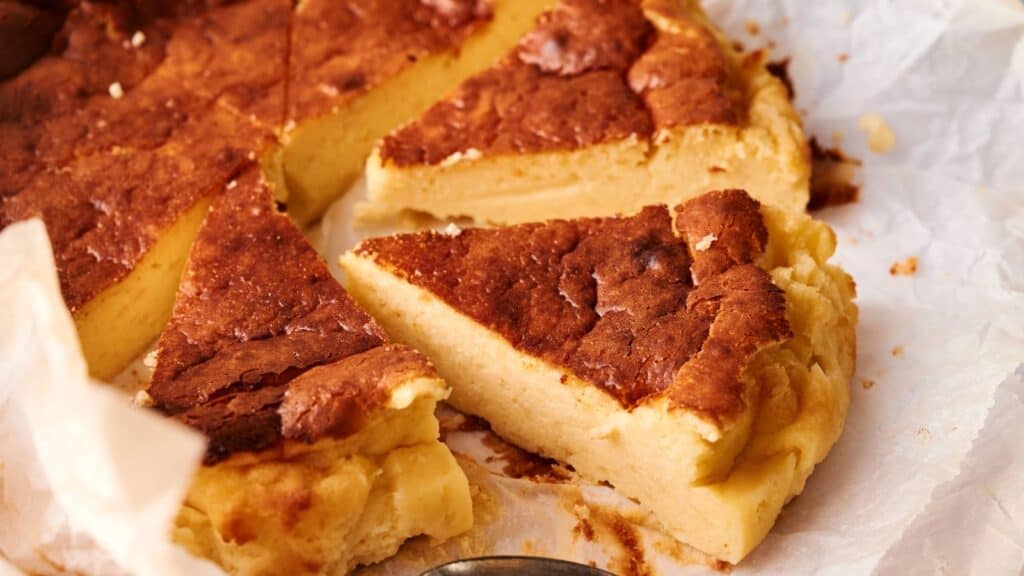
The origin story of Basque cheesecake is almost accidental. Chef Santiago Rivera developed it around 1990 at La Viña, his pintxo bar in San Sebastián, Spain, while looking for something simpler and less fussy than a traditional cheesecake. He skipped the crust entirely and baked it at high heat, producing a deep caramelized top and a loose, custardy center. That rustic imperfection turned out to be the whole appeal. It’s since crossed the Atlantic and reached large restaurant chains such as The Cheesecake Factory, and the momentum shows no sign of slowing heading into 2026.
Japanese cotton cheesecake: The featherweight contender
If New York-style is dense and Basque is bold, Japanese cotton cheesecake is the opposite of both. Created in 1969 by chef Tomotaro Kuzuno, who drew inspiration from German kasekuchen during a trip to Berlin, the cake relies on whipped egg whites to achieve its signature souffle-like bounce. It’s lighter and airier than traditional cheesecake, with a texture closer to a delicate sponge than a dense custard, and it skips the crust altogether. For diners drawn to lighter desserts without sacrificing the tang of cream cheese, it’s become the style worth seeking out.
The numbers behind the growth
Consumer appetite backs up the menu data, with 63% of consumers saying they’re interested in trying Basque cheesecake and another 13% saying they already have. That’s a meaningful share of the dessert-eating public actively seeking out a style that, a decade ago, most Americans had never heard of.
Cheesecake has always existed in many regional forms, but American menus are reflecting that diversity more than they did even a decade ago. Whichever style wins out this July 30, the map of American cheesecake looks nothing like it did even five years ago. If those menu forecasts hold, next year’s version of this story will look different again.
Jennifer Allen is a retired professional chef and long-time writer. Her work appears in dozens of publications, including MSN, Yahoo, The Washington Post and The Seattle Times. These days, she’s busy in the kitchen developing recipes and traveling the world, and you can find all her best creations at Cook What You Love.