
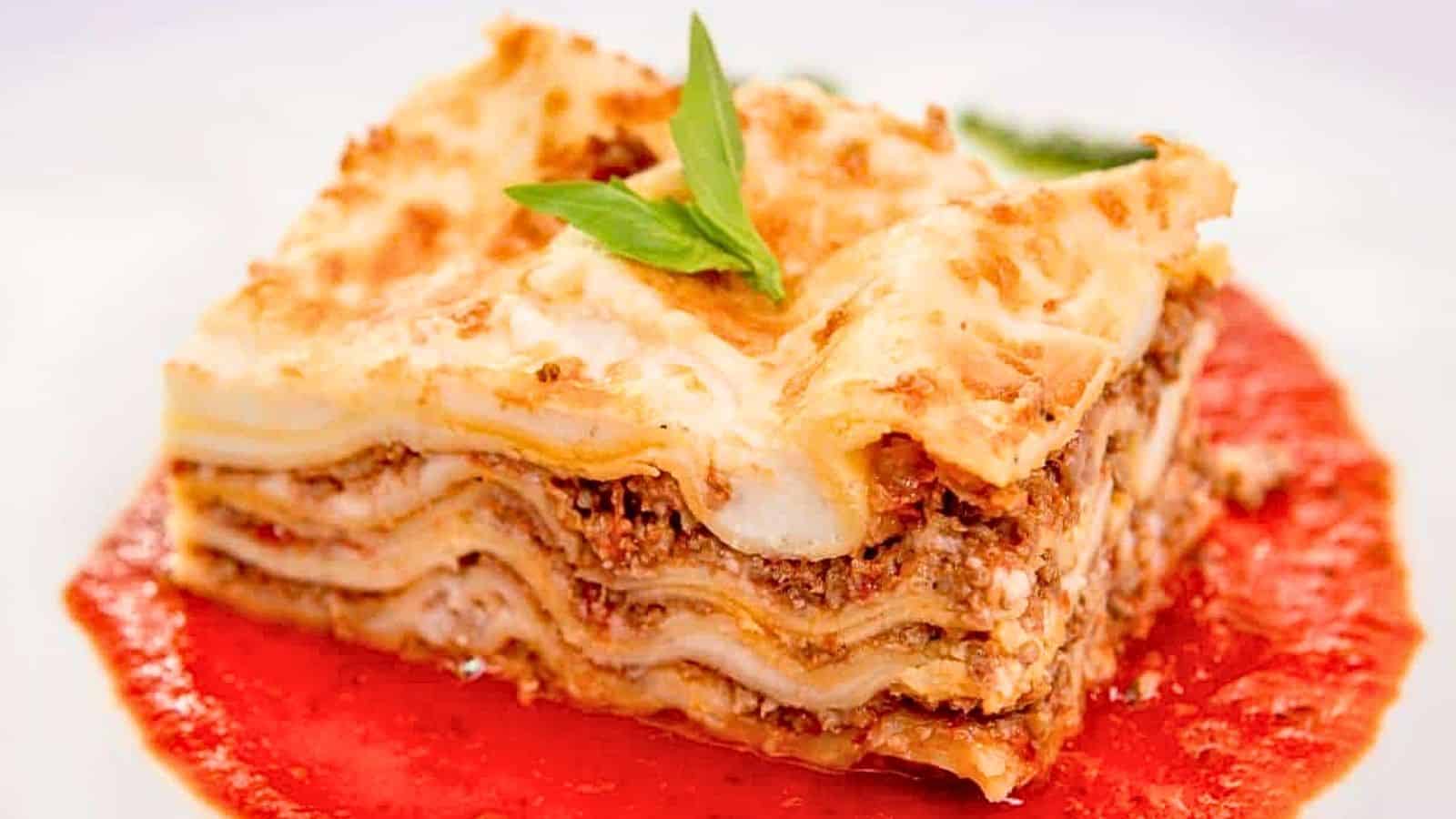
Lasagna currently runs on two clocks: all day, or 20 minutes. Some kitchens are still hand-rolling the pasta and guarding the sauce pot, while others have found that a wonton wrapper gets you there just as fast. National Lasagna Day doesn’t ask which one’s right.
This post may contain affiliate link(s). As an Amazon Associate, I earn from qualifying purchases. See Disclosures.
The all-day version usually traces back to a recipe from someone’s grandmother, refined over decades until nobody in the family would dare cut a corner, and a handful of restaurants have kept it that way on purpose. The 20-minute version exists because most people don’t have that recipe, that grandmother, or three free hours to guard a pot of simmering sauce, so cooks online started building the same idea out of whatever was faster. On July 29, National Lasagna Day, neither side is backing down, and neither has to.
Where lasagna never left the pan
In Providence’s Federal Hill, the same family has run Angelo’s Civita Farnese since Angelo Mastrodicasa opened it in 1924. The restaurant’s current menu still lists lasagna layered with beef Bolognese, ricotta, mozzarella and pecorino romano.
In St. Louis’ Hill neighborhood, two friends, John Riganti and Lou Aiazzi, opened Rigazzi’s in 1957. Toasted ravioli gets most of the national attention, but the current menu lists a six-layer Lasagna Pavarotti, built from pork, beef, a trio of Italian cheeses and their house-made marinara.
In San Francisco’s North Beach, Tommaso’s has cooked out of the same oak-burning brick oven since the Cantalupo family lit the first fire in 1935. The restaurant has had only four owners in 90 years, and through all of them, the northern Italian lasagna has stayed on the menu alongside the wood-fired pizza.
The wrapper and the broth take over
Not everyone is rolling fresh noodles this year. Earlier this year, TikTok creator @april_eatz shared a version of the dish that swaps pasta sheets for wonton wrappers, stacking them with a seasoned pork filling and steaming the whole thing instead of baking it. The dish spread fast, and other cooks adapted it further, keeping the same wrapper-filling-wrapper structure while swapping in tofu, chicken and vegetable fillings of their own. It looks nothing like a Sunday casserole, but it runs on the same logic Angelo’s uses: layer something rich between something starchy and let heat pull it together.
Another version skips the oven altogether, thinning the dish into a soup. The format traces to a TikTok recipe from a creator known as @dannylovespasta, whose lasagna soup took off after singer SZA asked him for the recipe in the comments. In his version, broken lasagna noodles simmer in a mix of marinara sauce and chicken broth with sausage and ground beef, finished with a swirl of heavy cream, parmesan and mozzarella.
Nobody agrees on what the word even means
None of this settles what actually counts as lasagna, and it turns out that argument is older than any restaurant or recipe involved. Even etymologists still disagree about the word itself: some trace it to a Latin word for a cooking pot, itself pulled from a Greek word for a stand or trivet, while others point to a separate Greek word for a flat sheet of dough. Neither theory has fully won out. If nobody can agree on what the name was pointing at in the first place, deciding which version of the dish gets to keep it looks like a losing argument to pick.
The word itself has been argued over since before Italy existed, so a soup and a ramekin of wonton wrappers were never going to settle it for good. The more interesting question isn’t which version counts as real lasagna. It’s what gets layered into that name next, because something always does.
Mandy Applegate is the creator behind Splash of Taste and seven other high-profile food and travel blogs. She’s also the co-founder of Food Drink Life Inc., a unique and highly rewarding collaborative blogger project. Her articles appear frequently on major online news sites, and she always has her eyes open to spot the next big trend.