
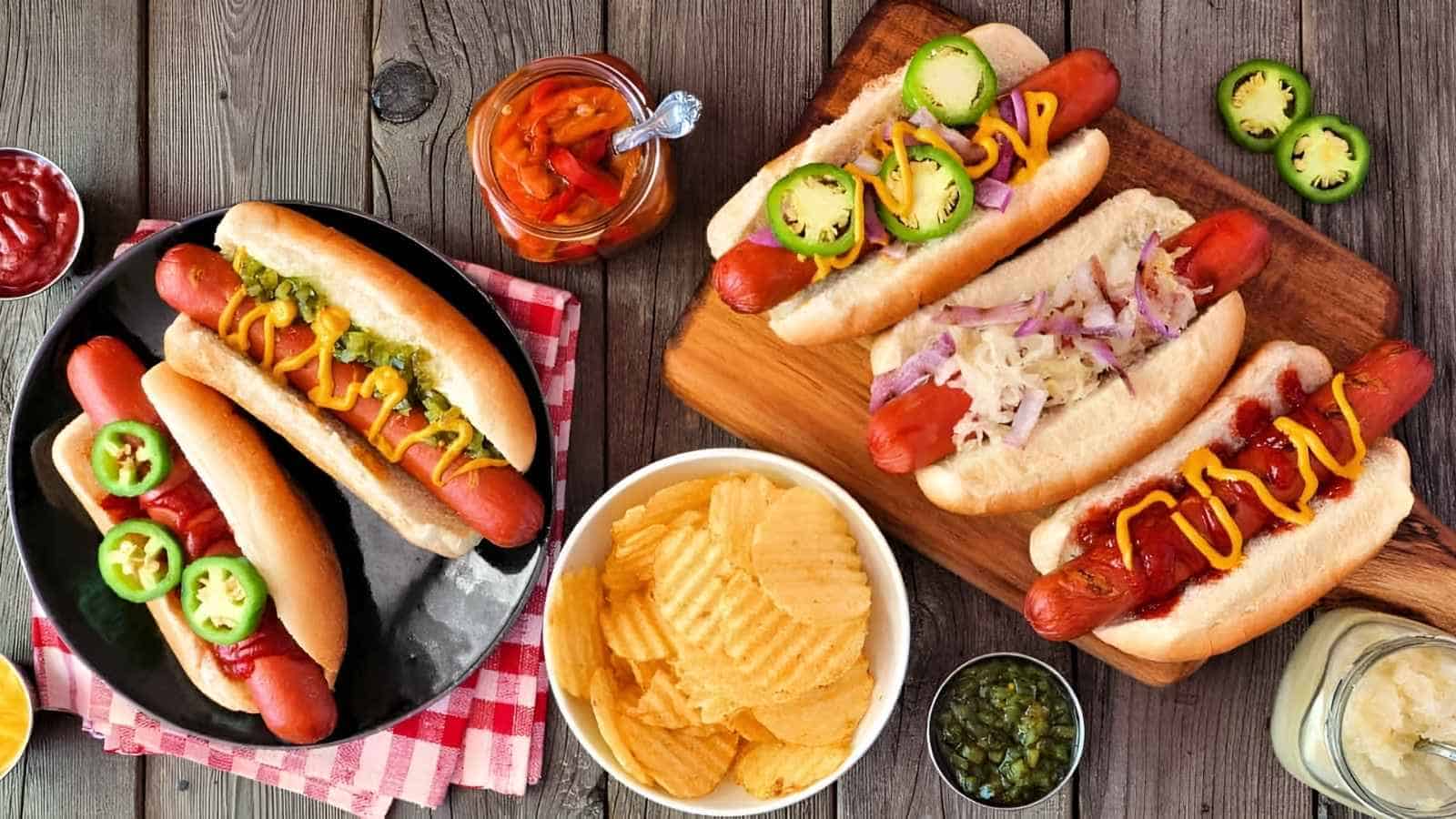
America keeps its most famous hot dogs in a handful of loud cities, each armed with a big-league ballpark and a signature dog worth arguing about. The map of where the country actually eats them is far wider than that. The bacon-wrapped Sonoran, the dressed Chicago dog, the plain New York cart frank and the chili-slaw dog of the South all stake a claim, and this July 15, National Hot Dog Day, is a fitting moment to notice how much of the story falls outside the usual lines.
This post may contain affiliate link(s). As an Amazon Associate, I earn from qualifying purchases. See Disclosures.
Regional loyalty runs deeper with hot dogs than almost any other American food. A doguero in Tucson, a counterman in Chicago and a cart vendor in Manhattan work from rulebooks that share almost nothing, and each treats the local build as doctrine. Ketchup can start a fight in one city and pass without comment in another. The toppings are not garnishes so much as borders, and the old stands have turned their version into a point of civic pride.
The scale underneath all that pride is enormous. The National Hot Dog and Sausage Council reports that Americans spent more than $11 billion on hot dogs and sausages at United States supermarkets in 2025, and hot dogs alone accounted for 905 million pounds sold at retail. Los Angeles residents eat more of them than any other city, but the more revealing number is who buys the most per person.
On that 2025 list, the council ranks Oklahoma City first, then the combined Paducah and Cape Girardeau market straddling Kentucky and Missouri, then Greensboro in North Carolina, the Albany, Schenectady and Troy market in upstate New York, and finally Oahu.
Tucson made a border legend
The Sonoran hot dog is generally traced to Sonora, Mexico, with Hermosillo often named as its birthplace. The Southwestern build is a grilled, bacon-wrapped frank on a sturdy bun, layered with pinto beans, grilled onions and green peppers, chopped tomatoes, a tomatillo jalapeno salsa, mayonnaise, mustard and sometimes shredded cheese. Daniel Contreras started El Güero Canelo as a cart in 1993 and grew it into a small group of restaurants recognized by the James Beard Foundation.
Chicago polices its recipe like law
Few cities guard a food the way Chicago guards its hot dog. The canonical build starts with an all-beef Vienna Beef frank on a poppy seed bun, then gets dragged through the garden with yellow mustard, dark green relish, chopped raw onion, tomato slices, a pickle spear, sport peppers and a dash of celery salt. Many traditional stands discourage ketchup, and some refuse to stock it at all. Vienna Beef still works from family recipes dating to 1893, though the fully dressed version the city is known for came together in the decades that followed.
New York keeps it gloriously plain
The New York cart dog is the anti-Chicago, served with little more than steamed onions and a pale yellow mustard, the frank warmed in a cart’s water bath and known around town as the dirty water dog. The city’s papaya stands built a separate stripped-down tradition around griddled franks and tropical fruit drinks. Gray’s Papaya still sells its Recession Special, two franks and a medium tropical drink for under $10, a survivor of decades of rising Manhattan rents.
The South buries its dog
Head south and the frank disappears under its toppings. The West Virginia dog comes buried in chili, mustard and coleslaw on a steamed bun, and around Atlanta and across the South, the coleslaw is standard issue. In the Carolinas, the frank itself is often a startling red. Carolina Packers has made its Bright Leaf hot dog in Smithfield, North Carolina, since 1941, and the company calls it the original red dog of North Carolina.
Craft makers chase new territory
While the classics hold their ground, a wave of small producers is treating the hot dog as something worth obsessing over. Heritage Foods sells franks and sausages made from heritage-breed meats raised on pasture, crafted by artisan butchers rather than factories. Its roster runs from a Kansas City butchery producing 100% heritage-pork frankfurters to The Mayor, a small-batch operation in Richmond, Virginia. In Cincinnati’s historic Porkopolis meat district, Queen City Sausage describes itself as the last independent producer standing in a neighborhood that once defined American pork.
The map is bigger than the legends
The per capita rankings make the point plainly. The cities that eat the most hot dogs relative to their size are not the ones with the celebrated stands, but a scattered set of markets reaching from Oklahoma to upstate New York to Hawaii. That gap between reputation and appetite suggests the country’s hot dog culture is far wider than its handful of household names.
The craft producers push in the same direction, treating a food long dismissed as cheap fuel as regional heritage. None of it crowns a single winner, which is rather the point.
Chicago, Tucson and New York still own some of the country’s most recognizable hot dog traditions. They do not own the whole appetite, which belongs to a much larger map than the one most people carry around.
Mandy Applegate is the creator behind Splash of Taste and seven other high-profile food and travel blogs. She’s also the co-founder of Food Drink Life Inc., a unique and highly rewarding collaborative blogger project. Her articles appear frequently on major online news sites, and she always has her eyes open to spot the next big trend.