
Every June, farmers markets fill back up and the tote bags come out, but most people leave with produce that underdelivers at home. The difference between a great haul and an expensive disappointment is almost always timing, and a trained chef knows exactly what that means. She’s shopping with a specific list built around what’s at the actual peak right now and what won’t be there in two weeks.
This post may contain affiliate link(s). As an Amazon Associate, I earn from qualifying purchases. See Disclosures.
More than 80% of Americans have attended a farmers market at least once, drawn primarily by the promise of fresh food and quality they can’t find elsewhere. That promise is real, but it’s seasonal and specific. U.S. grocery prices have risen nearly 30% over the past five years, above historic norms, which means every dollar spent at a farmers market needs to count more than it once did. June sits at an inflection point in the growing calendar, where the last of the cool-season crops overlap with the first true arrivals of summer. Know the window, and you come home with a few ingredients that justify every dollar.
Garlic scapes
Garlic scapes are the curling green shoots cut from hardneck garlic plants once a year, in June, so the plant directs energy into forming the bulb below ground. They taste like mild, grassy garlic. In contrast, commercial garlic is almost always softneck, a variety bred without a scape, which means a farmers market stall is essentially the only place to find it. Grill them whole until charred, or blitz them into a pesto that outperforms anything made with basil alone. They’re gone by mid-July, so you should buy more than you think you need.
Fresh shell peas
Fresh shell peas are one of the most time-sensitive buys at a June market, and most shoppers walk past them for the snap peas. These come in a pod you open yourself, and the flavor gap between a shell pea eaten the day it was picked and anything sold in a frozen bag is huge. Heat turns their sugars to starch fast, and the window is genuinely short. Buy them in the morning, shell them that afternoon, eat them that night.
Strawberries
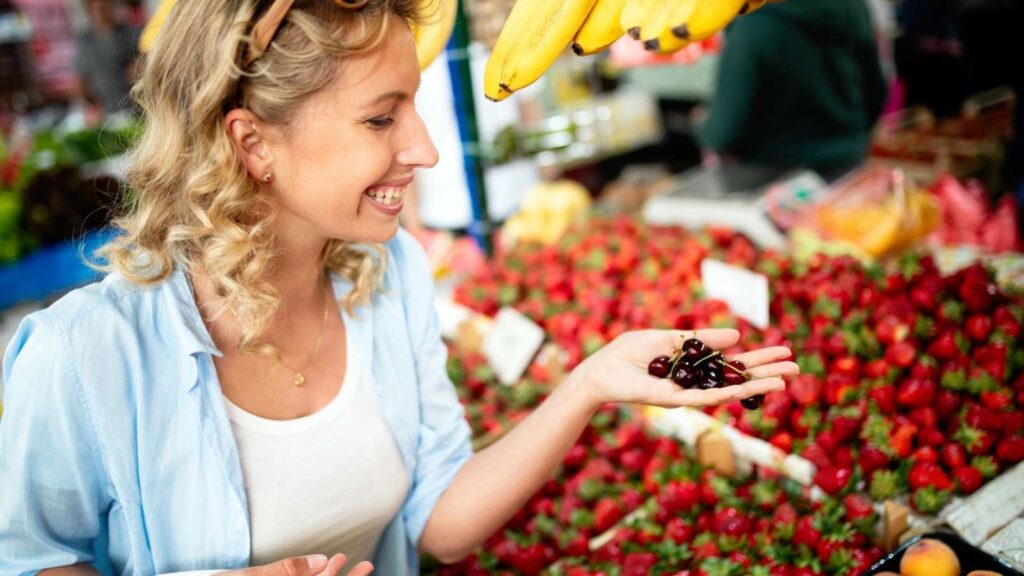
The strawberries worth buying at a June farmers market are the ones that look slightly wrong. Small, irregular, deeply colored, no white shoulder at the stem end. Uniform, glossy, perfectly shaped berries were grown for shelf life over flavor, the same way supermarket varieties are, and finding them on a market table doesn’t change that.
The kinds that stain your fingers and look almost too ripe are the ones worth paying for. A same-day farmers market strawberry requires no preparation; it is already the best version of itself.
Cherries
Cherries at a farmers market and cherries at a grocery store are not the same product. Market cherries are tree-ripened and sold within days of harvest, while grocery store cherries are picked early to survive shipping and storage, which means they’re firmer but less flavorful. June is when the first sweet varieties arrive at most markets, Bing, Rainier and Lapins among them, and the period is roughly six weeks. The variety name matters. Ask the vendor what’s ripe now, not what’s available.
Summer squash
The summer squash worth buying is not the largest on the table. Finger-length zucchini and pattypan squash, no bigger than a golf ball, have a flavor and texture the overgrown versions simply don’t. Most vendors let squash run large because it sells by weight, but the undersized ones, often priced lower or bundled together, are what a chef actually reaches for. Sauté them whole in butter with salt; they don’t need anything else.
“Skip the pretty stuff. Don’t let the heirloom ingredients distract you; that’s the farmers market trap. What you’re actually there for is what’s ugly, abundant and cheap. That’s what’s in season. That’s what the chef is buying,” said Chef Jenn Allen of Cook What You Love. “A pile of misshapen squash, a flat of ripe berries, bundles of herbs still damp from the morning. That’s your dinner. Season tells you what to cook; you just have to listen.”
Basil
Buy the whole plant, not the cut bunch. A living basil plant from a farmers market vendor will stay productive on a sunny windowsill for weeks and cost about the same as a bruised plastic clamshell that turns black in three days. June is when basil hits its stride, with full leaves, high oil content and the sharp green scent that comes only from a plant that was never refrigerated. Cut what you need and leave the rest growing. Chefs have done this for years, so it is not a secret.
What to come back for next week
The 2025-2030 Dietary Guidelines for Americans are direct about it: households should prioritize diets built on whole, nutrient-dense foods, protein, dairy, vegetables, fruits, healthy fats and whole grains, paired with a significant reduction in highly processed foods high in refined carbohydrates, added sugars, excess sodium and unhealthy fats.
Farmers markets are getting more sophisticated, not less, with more vendors, more variety and more of exactly what that guidance calls for. The chefs who shop them best don’t arrive with an open mind, but with a list built from knowing what the calendar actually delivers in a given week. That instinct is learnable, and June is a good place to start building it.
Zuzana Paar is the visionary behind five inspiring websites: Amazing Travel Life, Low Carb No Carb, Best Clean Eating, Tiny Batch Cooking and Sustainable Life Ideas. As a content creator, recipe developer, blogger and photographer, Zuzana shares her diverse skills through breathtaking travel adventures, healthy recipes and eco-friendly living tips. Her work inspires readers to live their best, healthiest and most sustainable lives.