
June 21 is the longest day of the year in the Northern Hemisphere, and an increasing number of travelers are planning trips around it. What began as an astronomical event has become a travel occasion in its own right, with people building itineraries around sunrise hikes, late-night outdoor experiences and destinations known for extended daylight. The idea of choosing a trip around a specific moment rather than a destination is no longer niche, and the data behind it has become difficult to overlook.
Nearly 39% of travelers factor lunar and solstice timing into their vacation plans. Gen Z and millennials drive it most visibly: 53% of Gen Z travelers and 46% of millennials said they feel especially attuned to spiritual exploration when they travel. Meanwhile, Google’s 2026 travel data found search interest in slow travel reached a record peak this year, reinforcing that the solstice draws travelers who want depth over distance.
Sedona’s Forbes-rated resort celebrates the season with intention
At Mii amo in Sedona’s Boynton Canyon, the guest experience changes with the seasons. North America’s only Forbes Five-Star wellness resort structures its programming around the natural seasons, and June is built around personal alignment and reflective practice. Guests work with practitioners across movement, bodywork and contemplative sessions within the resort’s multi-day all-inclusive program; an itinerary that treats timing as part of the experience, not incidental to it.
Mii amo earned its Five-Star designation in February 2026, the first wellness resort in North America to receive one. Its approach to seasonal programming follows the same philosophy that has defined the property for years: that where you go and when you go matters.
New Mexico ruins offer a rare, free solstice sunrise
Chaco Culture National Historical Park in northwestern New Mexico holds one of the most documented solstice alignments in North America. Each June 21, park rangers lead a sunrise observation at Casa Rinconada’s great kiva, where ancestral Puebloan architecture channels the rising sun through a stone window, pouring light into a niche for a few minutes before moving on. The event is free and requires no reservation. Few places in the country have the solstice built into their physical structure for over a thousand years.
Los Cabos resort takes the solstice into the water
Grand Velas Boutique Los Cabos marks the solstice with a floating sound bath in its resort pool, sound frequencies moving through the water as participants face the Sea of Cortez. The experience is part of Velas Resorts’ 2026 Wellnessing Getaway, a program that runs across three properties in Mexico through June. It’s organized around fire, air, water and earth as a wellness framework. The emphasis is sensory rather than ceremonial, and for travelers who want something intentional without a ritual component, it is one of the more accessible entry points on this list.
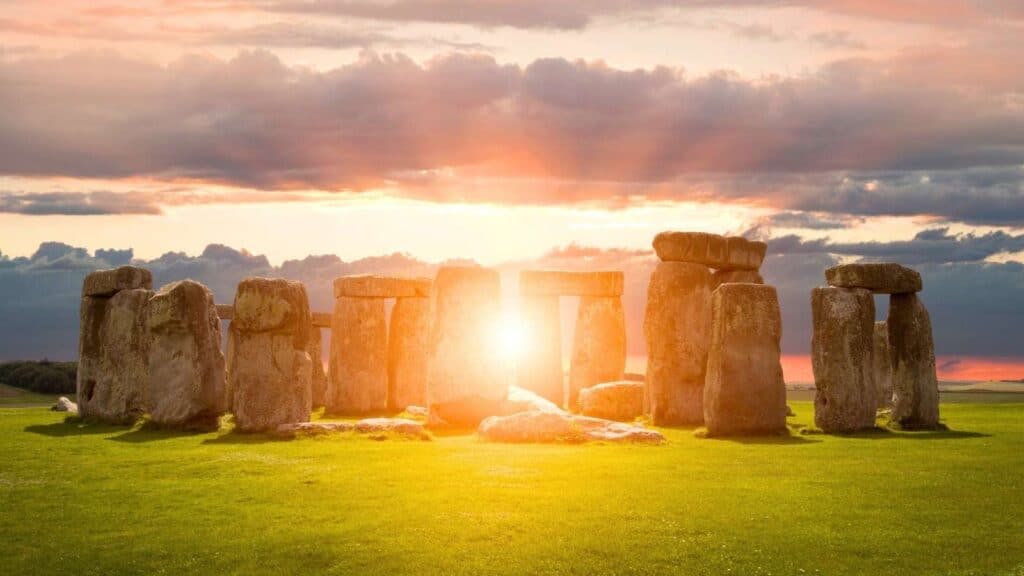
Stonehenge opens the circle once a year for the solstice
The alignment at Stonehenge was engineered into the monument roughly 5,000 years ago: on June 21, the sun rises behind the Heel Stone, and its first rays travel directly into the heart of the circle. English Heritage grants free managed open access for the occasion, with sunrise at 4:52 a.m. and thousands gathering on Salisbury Plain to watch.
No ticket is required, though parking must be pre-booked, and public transport from Salisbury is strongly advised. For a site that charges admission every other day of the year, the solstice is the one morning it belongs to anyone who shows up.
Sweden’s Midsommar is the solstice made into a national holiday
Sweden observes Midsommar on the nearest Friday to the solstice, placing it on June 19 in 2026. The calendar adjustment is a modern one; the tradition descends directly from pre-Christian solstice observance, and Sweden treats it with the weight of a second Christmas.
Dalarna, the lake district north of Stockholm, hosts the most traditional celebrations: maypole raising, folk costumes, ring dancing and communal meals under nearly 20 hours of daylight. Accommodation in the region books months out. For travelers who want the solstice as a full cultural immersion rather than a single event, Midsommar in Dalarna is as close as travel gets to a country organized around the light.
Iceland turns the midnight sun into a slow travel point
Iceland draws a particular kind of solstice traveler, one who books around the astronomical event itself. Around June 21, Reykjavik sees more than 21 hours of daylight, a condition that changes what a travel day can hold. Restaurants stay full past midnight. Trails are walkable at 1 a.m.
The extended light removes the urgency that compresses most itineraries, and travelers who arrive for the solstice tend to stay longer because the light itself becomes the reason. Iceland fits the slow travel pattern confirmed by Google search data precisely because the solstice creates conditions where rushing feels beside the point.
What the data reveals about where this is heading
Travelers are increasingly treating timing with the same care they apply to destination choice, asking not just where to go but when, and whether the moment itself carries meaning. The summer solstice is one example of a broader preference for experiences connected to a specific date, season or natural phenomenon.
As timing becomes a more important factor in travel planning, destinations and travel brands have a greater incentive to create occasion-specific programming rather than relying solely on seasonal demand. What travelers increasingly want is not just access to a place, but a reason to be there at that particular moment.
Jennifer Allen is a retired chef turned traveler, cookbook author and nationally syndicated journalist; she’s also a co-founder of Food Drink Life, where she shares expert travel tips, cruise insights and luxury destination guides. A recognized cruise expert with a deep passion for high-end experiences and off-the-beaten-path destinations, Jennifer explores the world with curiosity, depth and a storyteller’s perspective. Her articles are regularly featured on the Associated Press Wire, The Washington Post, Seattle Times, MSN and more.