
According to a new consumer survey commissioned by McCain Foods, more than 12,000 adults across 11 countries ranked fries as their favorite potato dish, beating out every local and traditional potato option on the menu. The way Americans eat them, though, looks almost nothing like what the rest of the world puts on the plate. The gap isn’t the fry, but everything that goes on top of it.
The cut comes first
McCain Foods, whose fries are available coast to coast and whose culinary team tracks global fry culture as closely as any in the business, makes 1 in 4 fries eaten worldwide. That foundation matters because the cut isn’t decorative.
A waffle fry or curly fry has a surface texture that catches a lighter sauce and holds it in place. A thick, straight-cut steak fry is built for weight, the kind of loaded preparation where toppings are piled high and a fork is not optional. Start with the wrong cut and the whole dish falls apart, literally. What the rest of the world has figured out is that once the cut is right, the fry becomes a canvas.
America: Disco fries and chili fries
America has its own loaded fry traditions, and they run deeper than ketchup. Disco fries are a New Jersey diner staple, a late-night institution built on crinkle-cut fries topped with brown gravy and melted mozzarella. The dish is generally believed to have emerged from late-night diner culture in New Jersey during the disco era, and it has held its place on menus across the state ever since.
Chili fries take a different approach, piling seasoned beef chili over a classic cut fry, sometimes finished with shredded cheddar and raw onion. Both dishes make the case that America was doing loaded fries long before the trend had a name.
Canada: Poutine
Canada’s contribution to global fry culture is also its most exported culinary idea. Poutine layers fresh cheese curds and hot gravy over a thick-cut fry, and the gravy’s heat is what makes it work, softening the curds just enough without melting them completely. The dish originated in rural Quebec in the late 1950s and has since spread across the country and well beyond. The fry underneath needs to be sturdy. Anything too thin buckles under the gravy, and the dish becomes a soup.
Argentina: Chimichurri fries
In Argentina, chimichurri is the condiment that goes on everything, and fries are no exception. The sauce, a loose mix of parsley, garlic, olive oil, red wine vinegar and red pepper flakes, is bright and herbaceous rather than heavy. That matters for the fry underneath it. A waffle or curly fry gives the sauce something to cling to, pulling flavor into every bite rather than letting it pool at the bottom of the basket. The preparation is straightforward: fries first, chimichurri spooned over the top. No cheese, no protein, no layering. The sauce is the point.
Spain: Patatas bravas
Spain’s version doesn’t use a traditional fry at all. Patatas bravas are potato cubes, fried until the outside is crisp and the inside stays soft, then topped with salsa brava, a smoky paprika-based sauce with enough heat to justify the name, which translates roughly to fierce potatoes.
Some bars in Madrid serve them with garlic aioli alongside the brava sauce, while others keep it strictly to the red. Either way, patatas bravas are among Spain’s most common tapas dishes and have been for decades. The cube cut is what separates them from everything else on this list, and it’s a distinction worth respecting.
The Netherlands: Patatje oorlog
The Dutch name translates to war fries, which gives some indication of what arrives at the table. A thick steak fry base goes under a combination of mayonnaise, raw diced onions and Indonesian-influenced peanut satay sauce, all of it piled on in a volume that requires a fork and some commitment.
The peanut sauce connection traces back to Indonesia’s long history as a Dutch colony, and the flavor it brings to the dish is rich, savory and layered in a way that lighter condiments don’t approach. Anything thinner than a steak fry collapses under the weight of the toppings, and the whole construction loses the integrity that makes the dish work.
South Korea: Kimchi fries
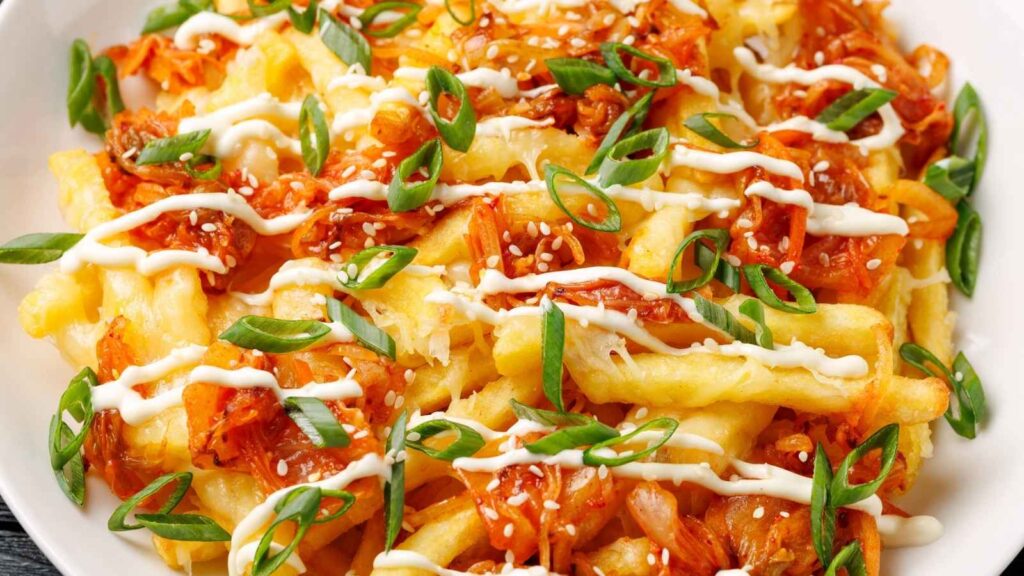
Kimchi fries have already made inroads into American food truck menus, but the home-kitchen version remains underexplored. Born from Korean-American fusion cooking, the preparation layers fermented kimchi over hot fries, and the combination works quickly. The acid cuts through the fat of the fry, and the heat builds slowly. The result tastes more complex than its two core components suggest, which is exactly why it has traveled as far as it has.
McCain’s global riffs worth trying at home
The dishes above come from documented culinary traditions. But the current World Cup has also sparked a wave of globally inspired fry creations worth exploring at home, and McCain’s culinary team has been developing some of the most interesting ones. Mark Slutzky, director of culinary at McCain Foods North America, says the pantry has caught up to the appetite. “Grocery stores offer far more global ingredients than they did even a few years ago, so many of these dishes are easier to recreate than people think.”
Slutzky points to two combinations Americans haven’t discovered yet but should. The first draws from Central Africa. “I’d point to the peanut-based sauces found in parts of Africa, particularly the Congo-inspired combination of peanut, tomato and spices,” he said. He describes those flavors as poised to be a breakout favorite because they feel both familiar and new, drawing on the peanut sauce traditions Americans already know from Southeast Asian, Chinese and Japanese cuisines while taking them in a different direction.
“The sauce is typically cooked down with peanut butter, oil, garlic, tomato sauce and spices, creating something that’s rich, savory, layered and pairs perfectly with fries,” Slutzky said.
The second comes from North Africa, an Algerian chermoula-inspired profile combining lemon, garlic, cilantro and cumin that reads Mediterranean in its foundation but leans distinctly North African in its finish.
On the question of which fry to use, Slutzky is precise. “For chimichurri fries, I like a waffle fry or curly fry because the texture helps hold the sauce and capture more flavor,” he said. Since chimichurri is a lighter sauce, he layers the fries first and spoons it over the top.
For heavier preparations, the calculus changes. “Patatje oorlog is a much saucier, loaded-style dish with mayonnaise, onions and sauce piled on top, so a thicker, straight-cut fry or steak fry works best,” he said. “It’s closer to the European ‘chip’ tradition, and it’s the kind of dish you’ll probably want to eat with a fork because all those toppings are meant to come together in every bite.” McCain’s full global fry guide is a useful starting point for anyone ready to move past ketchup.
The accessible version
Slutzky makes the case that these dishes are more achievable at home than they appear. “Patatje oorlog is probably the most accessible because its core ingredients are things most shoppers already have on hand, like mayonnaise, ketchup or sauce and onions,” he said. Once cilantro, garlic and a few key spices are in the pantry, he adds, several of these regional traditions become weeknight options.
The American appetite for global flavors has outpaced the average fry order for years. The ingredients are there. The fry has always been the easy part.
Jennifer Allen is a retired professional chef and long-time writer. Her work appears in dozens of publications, including MSN, Yahoo, The Washington Post and The Seattle Times. These days, she’s busy in the kitchen developing recipes and traveling the world, and you can find all her best creations at Cook What You Love.