
The hotel rooms Americans pay the most to sleep in this year are the ones that should frighten them off. They are pinned to cliff faces, sunk beneath the sea, carved from river ice and parked in the path of polar bears. As most of the country quietly cancels its travel plans, a small band of Americans spends more than ever to wake up somewhere that should not be possible.
The divide is real, and the numbers behind it are stark. This year, the share of Americans planning a vacation with paid lodging fell to 45%, the lowest in six years, while those who still traveled raised their budgets by about 17% from the year before. It breaks down sharply by income. More than half of Americans earning under $100,000 say travel is one of the first things they cut when money is tight, against about a quarter of those earning $200,000 or more. The people least troubled by the squeeze spend on rooms most Americans will never see.
Engineered to defy the drop
Some of these places put a bed exactly where a bed should not go. The boldest is The Muraka at Conrad Maldives Rangali Island, where the master bedroom sits about 16 feet underwater inside a curved acrylic dome, the reef drifting past the glass as you sleep.
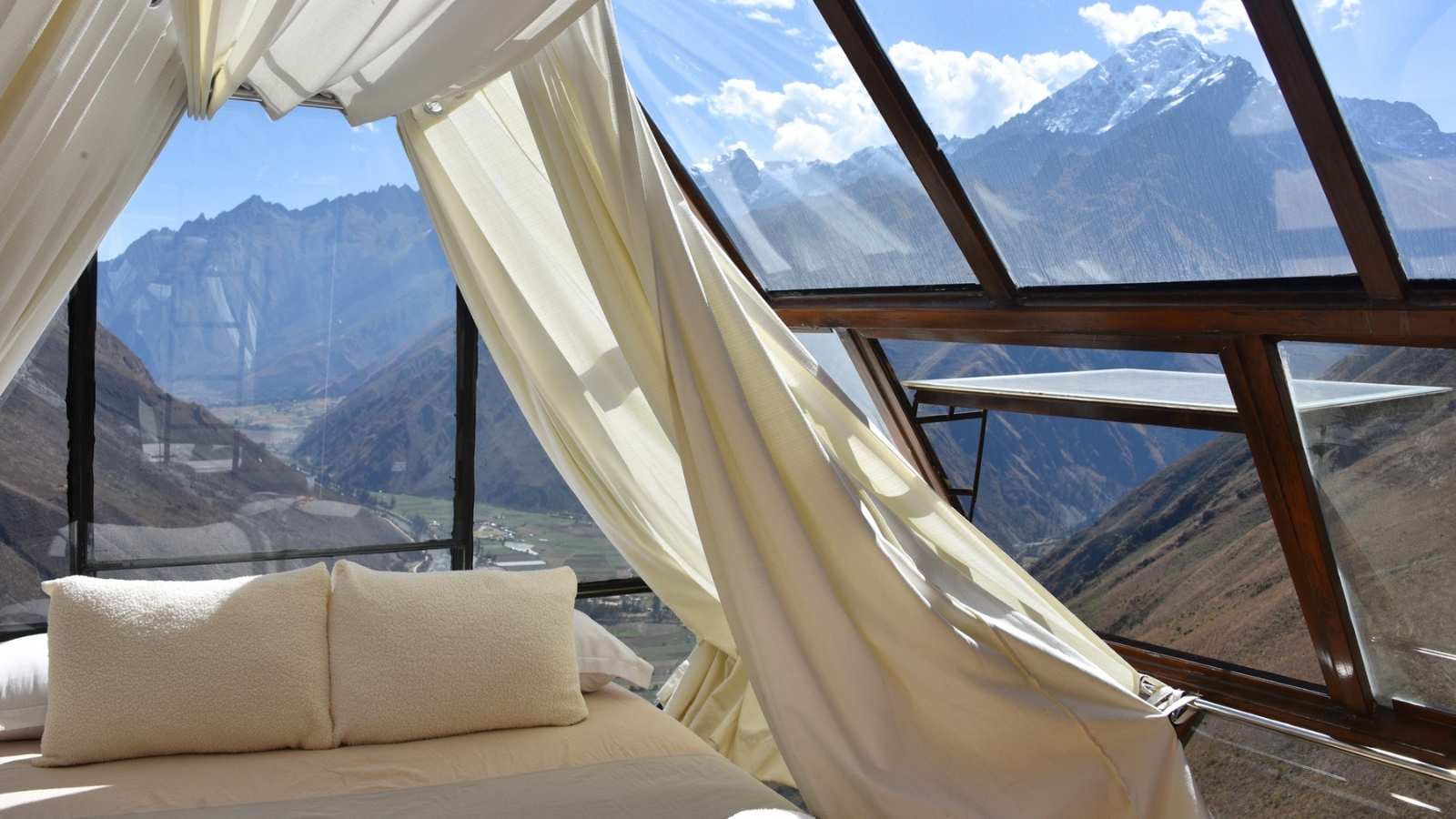
Peru’s Sacred Valley takes the same nerve in the opposite direction. Skylodge Adventure Suites is a transparent capsule fixed to a sheer rock face hundreds of feet up, reached only by climbing a via ferrata route or hiking a trail strung with ziplines. Condors pass at eye level, and dinner arrives on the back of a guide who carries it up the mountain.
Where the setting is the real room
Other stays barely register as architecture because the surrounding wilderness is the draw. At Sorrisniva Igloo Hotel near Alta in northern Norway, the rooms are rebuilt each winter from 250 tons of ice cut from the Alta River, then melt away every spring. Guests sleep on reindeer hides inside thermal bags while the air holds a few degrees below freezing.
Sweden’s Treehotel, in the village of Harads, lifts its rooms as high as 10 meters into a pine forest, each one built by a different architect. They range from a mirrored cube that nearly vanishes among the trunks to a cabin clad in hundreds of bird nests.
Closer to home, on Manitoba’s Hudson Bay coast, Churchill Wild sets its remote lodges directly in the path of migrating polar bears. Picture windows run the length of the walls, and fenced compounds let guests watch one of the world’s largest land predators from a few feet away. Two of its lodges, Seal River Heritage Lodge and Nanuk Polar Bear Lodge, hold National Geographic’s Unique Lodges of the World designation.
Neither runs all year. Sorrisniva opens only from late December to early April, and the polar bears reach the Hudson Bay coast from late summer into fall, with a second showing in late winter.
A front-row seat to something dangerous
For the traveler who wants the drama without the passport stamps, the most extreme room on this list is also the most reachable. Volcano House sits on the rim of the Kīlauea caldera, the only hotel inside Hawaiʻi Volcanoes National Park, its crater-view rooms facing the steaming Halemaʻumaʻu. When Kīlauea erupts, the glow joins the view. When it is quiet, the crater is still there, smoking.
Who’s actually paying for all this
Separate research tracking affluent American travelers found the wealthiest 10% of U.S. households now drive more than half of all consumer spending, with their leisure travel alone projected to reach $544 billion in 2026.
What the wealthiest travelers buy is not quite danger but proximity to it from the comfortable side of the glass: the shark a few feet from the bed, the crater steaming below the window, the polar bear on the other side of the pane. The risk is mostly engineered out, the spectacle left in, and that combination is what the money at the top is increasingly chasing.
Mandy is a luxury travel, fine dining and bucket-list-adventure journalist with expert insight from 47 countries. She uncovers unforgettable experiences around the world and brings them to life through immersive storytelling that blends indulgence, culture and discovery, and shares them with a global audience as co-founder of Food Drink Life. Her articles appear on MSN and through the Associated Press wire in major U.S. outlets, including NBC, the Daily News, Boston Herald, the Chicago Sun-Times and many more.