
Basque cheesecake features a soft, custardy, crustless center and a caramelized top. That contrast won Americans over to this dessert that’s turned up on restaurant menus and even landed in the freezer section at Trader Joe’s, sold two-for-a-box. The cheesecake made it across the Atlantic, but the cooking it comes from, a cuisine of sauces and stews built around what’s in season, is far less familiar.
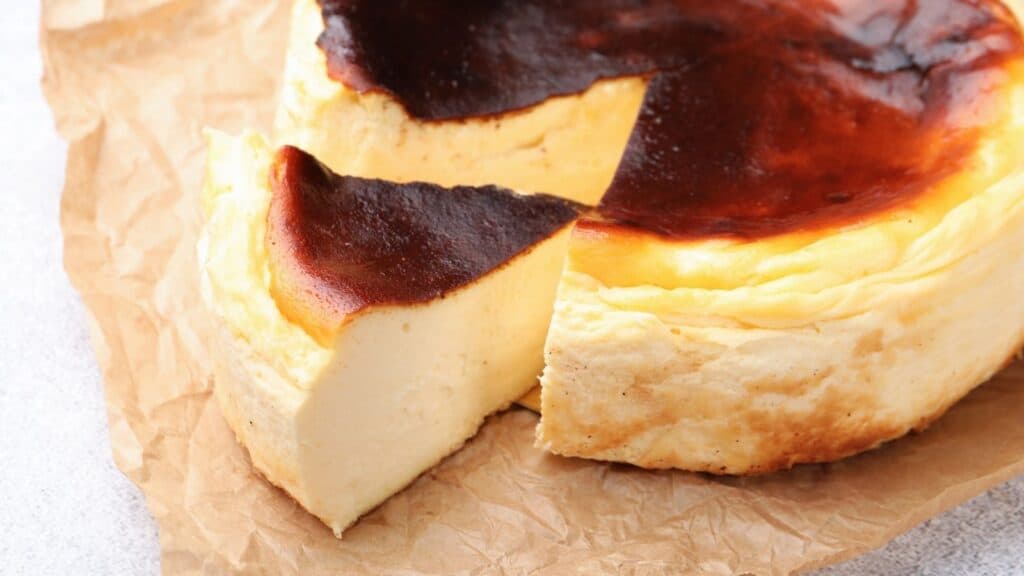
The cheesecake traces back more than three decades to San Sebastián, a coastal city east of Bilbao in Spain’s Basque Country. It’s a simple dessert, and interest in it keeps climbing, up 16.1% over the past year. But Basque cuisine is so much more, and most people never taste anything more than the famous cheesecake.
Basque cuisine is so much more than cheesecake
The Basque Country straddles the border between Spain and France at the western end of the Pyrenees, where the mountains meet the Bay of Biscay. Its people speak a language that’s among the oldest in Europe. Their cooking draws on both the coast and the mountains, with fish and shellfish from the bay and sheep’s milk cheese from the Pyrenees foothills.
But Americans don’t need a passport for a first look at it. Boise, Idaho, is home to one of the country’s largest Basque communities, and its downtown Basque Block puts Basque restaurants next to the Basque Museum and Cultural Center. Every five years, the city hosts Jaialdi, billed as the world’s largest celebration of Basque culture.
In Spain, Basque cuisine is showcased in Bilbao at one-Michelin-star Nerua Guggenheim Bilbao, where the entrance sits on the riverside promenade near “Maman,” Louise Bourgeois’ giant spider sculpture. The nondescript door is up a few concrete stairs and is marked by a small, discreet sign. Inside, the cool, comfortable room is a blank canvas that lets the food be the art. Chef Josean Alija has cooked at the Guggenheim since the museum’s early years.
Nerua and the Guggenheim share more than a building
The museum drew more than 1.3 million visitors in 2025, and 6% came from the United States. Nerua sits beside the gallery holding Richard Serra’s “The Matter of Time,” and museum visitors can enter from there.
Even the name ties it to the site. Nerua is the ancient Latin name for the Nervión estuary the restaurant faces. The museum has had a fine-dining restaurant since it opened, and when Nerua launched in 2011, the Guggenheim’s director general called it the culmination of 13 years of work. The restaurant earned its Michelin star within months, and for Americans who fly or sail in for the art, lunch at Nerua completes the visit.
Josean Alija’s kitchen keeps the old sauces
Alija talks about Basque food in terms of tradition first. “Our tradition has defined the identity of Basque cuisine: seasonality, product from the territory, a cooking tied to sauces like pil pil, bizkaina, salsa verde and salsa negra, seafood and meat stews, and the exclusivity of seasonal products,” he said. “We keep those sauces, evolved, and we cook with them.”
“Nerua’s cuisine is one of product, sauces and seasonality, a truly calm cuisine that evolves every year. But above all, it’s a cuisine that tells a story through its products without losing respect for tradition. The added value is the vision, the lightness, an apparently simple appearance and a composition based on very few elements: one, two, three maximum. Its complexity builds its discourse.” Alija added.
Muina keeps every plate to a few elements
Muina is the tasting menu, and Nerua’s own site calls it “the soul of our cuisine.” In Basque, “muina” means core or essence. “Muina shows the essence of our cooking in each season, concisely, in product and in ideas,” Alija said. “The truth of a cuisine and the flavor of the territory.”
In late August, Muina ran 10 courses. It opened with cherry tomatoes in herb sauce that burst with flavor, then lettuce in green sauce, one of the classic sauces Alija names. Grilled sea snails came with green bean juice, and cod turned up in an omelet. Later plates paired pochas beans with barnacles and tuna belly with a spider crab Russian salad.
The dishes led with color and flavor, and played with texture and surprise. Iberian pork belly arrived with pickled vegetables and blood sausage pate. Dessert wasn’t cheesecake. Strawberries came with lemon cream and violets, and a bollo de mantequilla closed the meal.
Diners can pair the menu with wine or with house-made “esencias,” alcohol-free drinks such as melon with white tea or tamarind with spices. The idea came from the kitchen’s research and development team in 2012, Alija said, “to offer an alternative to those who, for different reasons, couldn’t drink wine.” Nerua has since created more than 100 different esencias.
An easy stop for cruise passengers
Bilbao works for cruisers, too. Windstar’s small ships call at Getxo, Bilbao’s cruise port, where a shuttle runs into the city. A full day in port leaves time for the museum in the morning and lunch at Nerua.
The line is adding ships, and its new 224-passenger Star Explorer has Bilbao on its 2027 Iberian sailings. Until then, Alija’s 2013 book, “Muina,” which shares its name with the tasting menu, offers a first look at his cooking from home.
Jennifer Allen is a retired chef turned traveler, cookbook author and nationally syndicated journalist; she’s also a co-founder of Food Drink Life, where she shares expert travel tips, cruise insights and luxury destination guides. A recognized cruise expert with a deep passion for high-end experiences and off-the-beaten-path destinations, Jennifer explores the world with curiosity, depth and a storyteller’s perspective. Her articles are regularly featured on the Associated Press Wire, The Washington Post, Seattle Times, MSN and more.