
If you’re looking for a destination that truly feels like you ended up in an apple-cider-filled, orange-and-golden-hued fall landscape, the Adirondacks can now claim that title with impunity. According to newly released data from Priceline, the upstate New York region is the top U.S. scenic area for leaf peeping in 2026, ahead of the Columbia River Gorge, Aspen and Stowe. Yet the leaves are only half the reason a family would drive up.
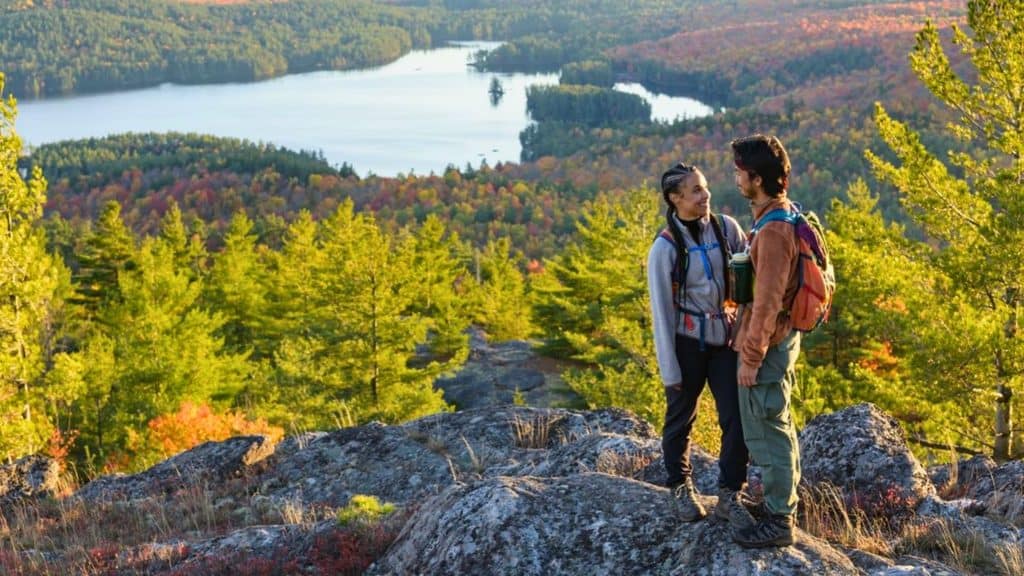
A leaf-peeping trip usually means a scenic drive and a few photo stops. Here it means a farm dinner in the Champlain Valley, a two-century-old tavern in Elizabethtown, a short hike to a restored fire tower and a night sky dark enough to show the Milky Way. The foliage determines when to go, while the itinerary takes care of itself.
Of course, timing is the hard part. Leaf peeping depends on a narrow window, and getting the timing wrong can mean missing peak color, so a destination that offers a full slate of activities makes the gamble safer. In the Adirondacks, the foliage is the reason to book, but rarely the only thing on the itinerary.
A fall season measured in elevations
The park covers roughly 6.2 million acres, which makes it the largest publicly protected area in the contiguous United States. According to the Adirondack Park Agency, the Adirondacks is larger than Yellowstone, Everglades, Glacier and Grand Canyon national parks combined.
Inside that boundary sit more than 3,000 lakes, some 30,000 miles of rivers and streams and 101 towns and villages where about 123,000 people live year-round. The park also has more than 2,000 miles of hiking trails, putting mountains, lakes and waterways within reach throughout the region.
A park that big does not turn on a single weekend. The Adirondack region has elevations, temperatures, landscapes and weather patterns that vary widely, said Jane Hooper, communications manager for the Regional Office of Sustainable Tourism, which is based in Lake Placid.
“Generally speaking, the most abundant, beautiful color happens within a 2-3 week window beginning the last week in September through Columbus Day,” Hooper said. “Higher elevations reach peak first, while the warmer valleys along Lake Champlain and toward the south reach peak just before mid-October.”
This means arriving on the wrong weekend is not the disaster it would be elsewhere; the color is usually still somewhere within reach. Travelers who arrive too early for the valleys can climb, and those who arrive late in the High Peaks can drive east toward Lake Champlain. The practical result is a destination where families can build an entire trip around the foliage rather than drive through to glimpse it.
Family travel is moving beyond school breaks
Peak color does not wait for a school holiday, and families are increasingly willing to work around it. A study by the booking platform Omio found that 67% of U.S. parents of school-age children have already pulled their children out of class for a trip, while another 24% would consider doing so. Better availability, lower costs and a desire to avoid extreme weather topped the list of reasons.
Those families are mostly getting there by car, which suits the Adirondacks. Hertz survey data show that 46% of U.S. adults plan to travel this fall, with road trips outpacing flights. Millennials and Gen Z are the most willing to spend on experiences worth remembering. All of which favors the Adirondacks, as it is five hours north of New York City and an hour south of the Canadian border, with no gate and no admission fee.
Farms and small towns give families another reason to visit
The Lake Champlain region shows how a foliage trip can offer more than just scenic views. Within an hour’s drive, travelers can sit down to dinner at the farm that raised the pork, sleep in a hamlet that has barely changed since the 1850s and walk a trail between the two. The best part? None of them requires a summit or a full day.
A valley full of farms
Farms have multiplied across the valley in recent years, feeding local households through CSA arrangements and supplying area restaurants directly, which makes farm-to-table a description of the supply chain rather than a mere slogan. Essex Farm, Full & By Farm, Juniper Hill Farm, Tangleroot Farm and Echo Farm all operate within a short drive of one another.
Reber Rock Farm in Essex is the clearest example of how visitors plug into that network. The draft-powered farm raises pastured chicken, pork and grass-fed beef, and offers tours and hosts dinners that bring neighboring growers to the same table as guests. This format turns a meal into an introduction to the people who produce it. The farm is also building glamping sites for travelers who want to stay on site.
A tavern that has been open since 1808
The farms sell to restaurants too, and one of the best is located half an hour away in Elizabethtown. The Deer’s Head Inn sources from those same Champlain Valley producers, so a fall menu often includes meat, cheese and vegetables harvested that morning. It opened in 1808, during Thomas Jefferson’s presidency, and has been feeding travelers ever since.
The history since then is unusually well documented for a country tavern. The inn housed troops wounded in the War of 1812 and hid bootleg liquor during Prohibition. Mary Brown, widow of the abolitionist John Brown, stayed here while her husband’s casket lay at the county courthouse across the street. Its guest books carry entries from Presidents Benjamin Harrison and Grover Cleveland.
There’s also plenty to do nearby. Pleasant Valley Café is a few doors down Court Street for breakfast, and the Belfry Mountain trailhead is a short drive east. This makes Elizabethtown an easy overnight between the valley farms and the High Peaks.
The same farms show up at the source. The Keene Valley Farmers’ Market sets up on Sundays at Marcy Field on Route 73, ringed by summits and sharing its ground with a working airfield, so small planes land behind the produce stands. The same Essex County farms that stock the market also supply the Deer’s Head Inn’s kitchen half an hour away, and the farmers who sell here sometimes turn up at the restaurant’s tables themselves.
Historic hamlets and low-elevation trails
Essex itself makes the case for the region’s small towns. The entire hamlet is listed on the National Register of Historic Places and holds one of the most intact collections of pre-Civil War architecture in the country. Nothing rises above two and a half stories, and the oldest documented structure, Dower House, predates 1793.
Families who want to travel between those villages on foot can use Champlain Area Trails. The nonprofit has built roughly 78 miles of easy-to-moderate paths through farmland and low ridges. It is a long-running work toward a hamlet-to-hamlet network, giving visitors access to the landscape without the elevation gain the High Peaks demand.
Adventure at every level
The park’s most popular activities are hiking and paddling, and they come in any difficulty level you want. The High Peaks draw hikers chasing all 46 summits above 4,000 feet, but that is a small share of what the region offers. Severance Mountain, outside Schroon Lake, runs 2.4 miles round trip with 700 feet of elevation gain, and dozens of similar peaks offer views without an all-day commitment.
Fire towers may be the best value of all. The towers were built for forest rangers watching for wildfires, and several have since been restored for climbing. Belfry Mountain in Moriah is a short walk to a tower with Lake Champlain to the east and the state’s highest peaks to the west, putting a summit view within reach of a child who would quit on a real climb.
Keene Valley shows how families with different ages can share a single base. Most of the High Peaks are accessible from the area, so don’t forget to grab some essential hiking gear. Ambitious hikers can tackle a trail in the morning, while those who prefer a slower start can explore nearby spots before everyone meets for lunch.
Some of that adventure happens without even leaving the property. Elk Lake Lodge in North Hudson sits inside a 12,000-acre private preserve with 40 miles of trails and guest-only access to Elk Lake and Clear Pond, which means a paddle or a short hike starts at the door. The Lodge at Schroon Lake works the same way on 36 lakefront acres, with trails, a dock, boat rentals and an indoor pool, plus the Brown Swan restaurant when the weather turns.
Both are on Route 9 near Schroon Lake, where the Severance Mountain trailhead and Paradox Brewery are also located. The brewery pours craft beer and turns out pizza, including gluten-free options, that is good enough to make a stop worthwhile, especially if a hike ends early or the rain starts.
History and culture round out the outdoors
Weather is the variable nobody can control in October, so it helps to have a plan on rainy days that is not just a gift shop. Luckily, the region has attractions that are not conventional indoor museums.
The Adirondack Experience on Blue Mountain Lake spreads across 121 acres and two dozen buildings, where visitors can row a guide boat, break up a logjam, climb a fire tower, feed the trout and hike to Minnow Pond. Families can easily spend several hours exploring the grounds, with the lakefront cafe offering a place to stop between activities.
The park’s vacation culture is an exhibit itself. The word “vacation” entered common use as the region grew in popularity in the early 1800s, when wealthy families would leave the heat of the city for the cool mountain air. Soon after, the Great Camps followed, as the Rockefeller, Durant, Post and Carnegie families built wilderness compounds along the lakes.
Great Camp Sagamore near Raquette Lake is one of the few still taking guests. It preserves 27 National Historic Landmark buildings that served as the Vanderbilt family’s wilderness estate from 1901 to 1954. Today, it is the only Great Camp run as a nonprofit education institution, offering overnight stays with meals, kayaks, guided paddles, historic tours and a one-of-a-kind open-air bowling alley. However, the camp is built around education and history, and hospitality is secondary to its mission. Evening programming runs through the season, including stargazing, which lands well here.
The foliage itself becomes the finale
The leaves are still the headline attraction, but some of the best ways to experience them involve getting out into the landscape rather than stopping for a photo.
Raquette Lake Navigation Co. runs narrated cruises aboard the W.W. Durant, a family-built vessel named for William West Durant, the developer behind the Great Camps. The company offers a full weekend schedule in September and October. Raquette Lake has the longest shoreline of any lake in the park, and most of the surrounding area is forest preserve rather than development.
From the deck, the color reads as a continuous wall rather than a row of trees along a highway. Historic camps appear at the water’s edge, several of them invisible from any road, which folds the region’s history into the same hour as its foliage. It is a rare leaf-peeping activity that works equally well for a restless 8-year-old and a grandparent who would rather sit. Although the foliage is what brings visitors to the Adirondacks, the farms, trails, museums, and lodges are what keep them together for the weekend.
Plan your Adirondacks fall foliage trip
Peak color runs from the last week of September through Columbus Day, with higher elevations turning first, followed by the Champlain Valley just before mid-October. An interactive fall foliage prediction map using NOAA data helps narrow down a weekend, though weather can shift timing by days.
Harvest weekends fill first, so book lodging early and reserve dinner tables before arriving. Great Camp Sagamore closes for the season in mid-October, while the Raquette Lake cruises run a weekend schedule through the fall.
Drive times are short, but winding roads can make them longer than expected. Elizabethtown to Blue Mountain Lake takes about an hour, while Blue Mountain Lake to Lake Placid takes closer to two hours. Travelers heading north can add the Whiteface Veterans’ Memorial Highway, a toll road to the summit of the state’s fifth-highest peak. Those bound for Montreal can stop at Buttermilk Falls or Chef Darrell’s Blue Mountain Lake Diner.
Ksenia Prints is a food and travel writer from Montreal, Canada. She blogs over at We Travel We Bond, writing about family travel off the beaten path.