
Sauna bathing and cold plunging have roots that trace back thousands of years in Northern Europe. Nordic communities did not invent these rituals as wellness products; they built them into daily life, and because the landscape demanded it. Now, travelers chase them across continents, from volcanic Iceland to the Austrian Alps to the Canadian Rockies, and the destinations meeting that demand are multiplying.
What many travel companies now market as Viking wellness combines longstanding Nordic traditions of sauna bathing, cold-water immersion, outdoor living and communal ritual. Built on the practice of cycling between extremes, such as intense heat, cold water, open air and rest, it was never designed as a luxury experience. It was daily life.
The Norwegian concept of “friluftsliv,” often translated as open-air living, animates the best of these experiences. It is the opposite of the wellness industry’s usual promises. No technology, supplements or optimization. Just heat, cold, rest and the particular clarity that follows.
A tradition going mainstream
The appeal reaches well beyond Scandinavia. The Global Wellness Institute’s 2026 Wellness Tourism Initiative Trends report identifies traditional bathing cultures as undergoing a renaissance, with sauna evolving from a solitary health ritual into a guided social ceremony with genuine emotional payoff. What began as a reason to visit Iceland is becoming a reason to visit almost anywhere.
Iceland: One of the world’s most visible Nordic wellness destinations
Iceland has become one of the world’s most visible destinations for Nordic-style wellness travel. For travelers who want these traditions in their most authentic form, three experiences stand apart. Icelandair offers regular service from gateways across North America, making all these locations accessible without complex routing.
At Eleven Deplar Farm on the remote Troll Peninsula, contrast therapy is structured as a guided ritual: guests move through a sequence of heat, cold and rest led by staff trained in breathing techniques designed to prepare the mind and body for the cold plunge. Geothermal pools, indoor and outdoor saunas and flotation tanks sit against a landscape of rolling pastures and dramatic peaks.
In Hafnarfjörður’s Viking Village, Iceland Viking Yoga blends Hatha yoga with sauna sessions and mindful movement in an intimate setting grounded in culture rather than spectacle. And for travelers drawn to the full arc of Nordic winter, the Winter Wellness Retreat with Viking Women combines yoga, geothermal bathing, gentle hikes, snorkeling between tectonic plates at Þingvellir National Park, Nordic meals and northern lights viewing across Iceland’s winter landscapes.
Hotel Rangá: Living like an Icelander
On Iceland’s South Coast, Hotel Rangá takes a different approach. Rather than formalizing the contrast therapy ritual, it asks guests to inhabit Icelandic life directly. The property’s Live Like an Icelander package pairs a local guide with a self-drive itinerary that takes you through turf houses where farming practices date back to medieval times, a legendary well believed by locals to promote long life, and a meditation stop in moss beside South Coast waterfalls. Hydrotherapy is woven in naturally: a cold plunge in the Rangá River, a geothermally heated hot tub steps from the property.
For those who want to go further, the hotel’s private Feast Like a Viking cave dinner is available as an add-on. This is wellness, not as a program but as a way of living that a community in this part of Iceland has practiced for centuries.
Basecamp Explorer: The Arctic standard
At 78 degrees North, Basecamp Explorer‘s Isfjord Radio sets the standard for how far these traditions extend in their native environment. The property, a former Arctic Ocean radio outpost accessible only by boat or snowmobile, operates as a 22-room boutique hotel where the floor-to-ceiling windowed sauna overlooks open water before guests take a cold plunge in the Arctic Ocean itself.
The five-day Remote Horizons journey that centers on Isfjord Radio begins in Longyearbyen and crosses Isfjorden under the midnight sun, with days filled with tundra hikes, RIB wildlife safaris in search of walrus, Arctic foxes and polar bears, and the specific stillness of a place genuinely far from everything else.
Canvas Telemark: Friluftsliv in practice
In Norway’s Telemark region, Norrøna Adventure’s Canvas Telemark operates without road access. Guests arrive to find wood-fired saunas, glacial lake cold plunges, 75 miles of mountain-biking trails and fire-lit communal meals. The philosophy is friluftsliv, expressed as a full operating principle rather than a scheduled program. Guests move naturally through heat, cold, movement and rest because the landscape and rhythm of the place invite nothing else. For travelers who find conventional spa culture too managed, it is among the most persuasive arguments for why these traditions have endured.
Hotel Böglerhof: Nordic wellness crosses the Alps
Hotel Böglerhof, a five-star property, sits in Austria’s Alpbachtal, and this summer it demonstrates how far from Scandinavia these traditions have traveled. The hotel launches Learn to Sauna this season, a guided program for families with teenagers aged 12 to 15, led by resident sauna master Andreas Moser.
The 30-minute sessions cover heat sequencing, cold immersion, contrast therapy and sauna etiquette, passing on a practice that Nordic and Alpine communities have shared for centuries. The program runs July 2 through Aug. 28, with introductory yoga sessions and screen-free programming throughout.
For travelers building a broader Nordic wellness itinerary across Britain, operators such as Routescape design bespoke Scottish journeys incorporating wilderness sauna experiences on the River Dee and in the Cairngorms.
Kananaskis Nordic Spa: The North American anchor
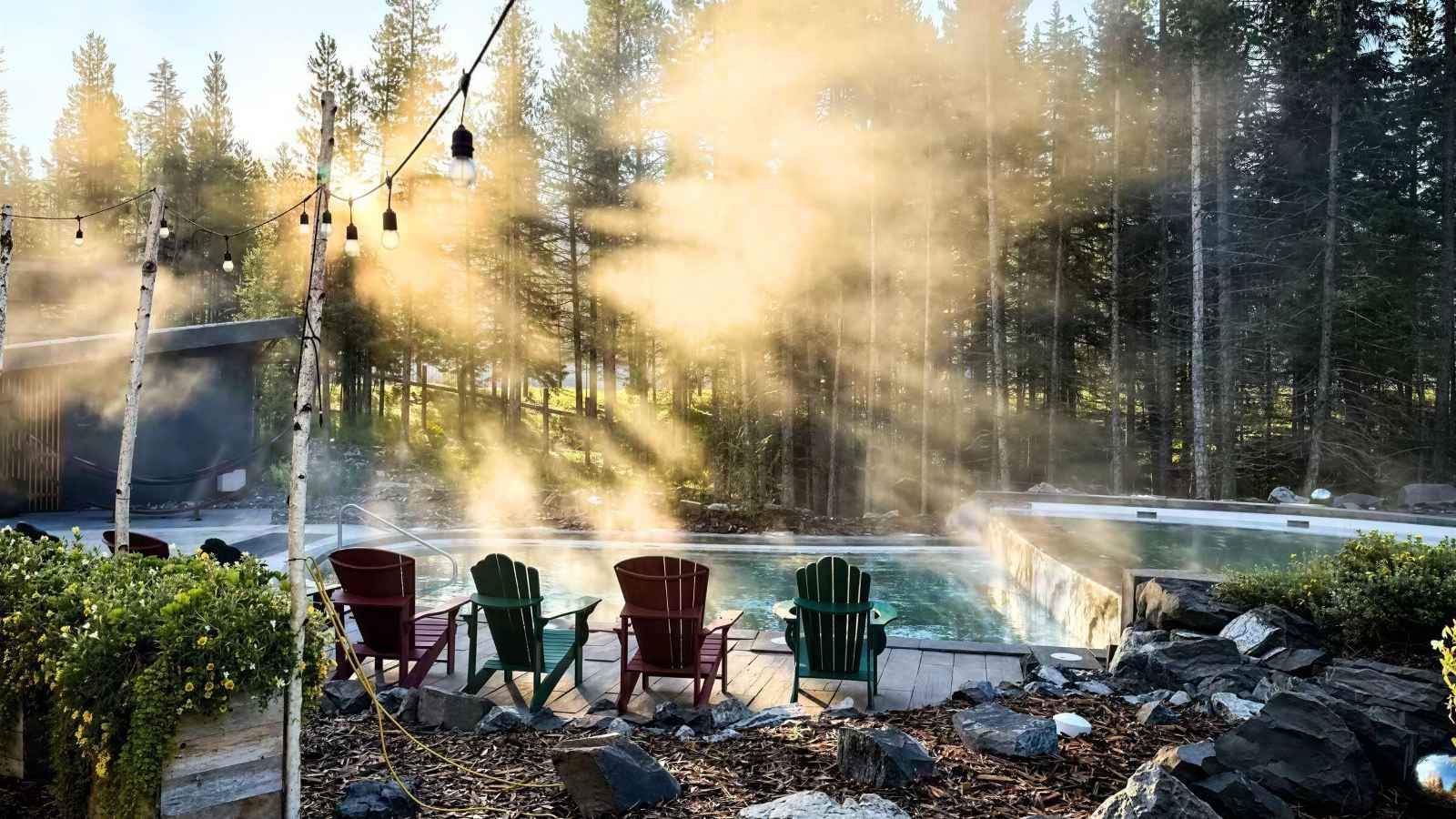
An hour west of Calgary in the Kananaskis Valley, the Kananaskis Nordic Spa has built the contrast therapy circuit into an experience that reads as distinctly Canadian without losing the Nordic logic behind it. Multiple outdoor pools operate at varying temperatures alongside steam and sauna cabins, an exfoliation cabin, fireside lounges and hammocks strung between the trees.
The spa provides robes and slippers at check-in, which prove essential for navigating the circuit between pools at different temperatures. The transitions through open mountain air are as much a part of the experience as the heat or cold itself. Anchored by the Pomeroy Kananaskis Mountain Lodge, the setting, spruce forest and Rocky Mountain peaks in every direction do the rest.
Where the tradition is heading
What the Global Wellness Institute is tracking is not a passing moment. Governments and tourism boards now invest in thermal bathing infrastructure as a destination strategy rather than a hotel amenity, recognizing that the emotional and physical payoff of these rituals is something travelers will plan a trip around.
In Seattle, Washington, the National Nordic Museum in the Ballard neighborhood, home to the only congressionally designated national Nordic museum in the United States, hosts its second annual Sauna Festival this Nov. 7 and 8, an indication that the tradition is finding a permanent footing on American soil.
The question for the travel industry is no longer whether Nordic wellness has an audience. It is whether destinations can build the kind of authentic experience that centuries of practice actually require.
Correction July 1, 2026: The original article stated that Isfjord Radio is accessible by boat, snowmobile or helicopter. The property is accessible only by boat or snowmobile. The article has been corrected to reflect the accurate access methods.
Jennifer Allen is a retired chef turned traveler, cookbook author and nationally syndicated journalist; she’s also a co-founder of Food Drink Life, where she shares expert travel tips, cruise insights and luxury destination guides. A recognized cruise expert with a deep passion for high-end experiences and off-the-beaten-path destinations, Jennifer explores the world with curiosity, depth and a storyteller’s perspective. Her articles are regularly featured on the Associated Press Wire, The Washington Post, Seattle Times, MSN and more.