
America’s road trip revival has a destination: the Carolinas. Seventy-one percent of Americans plan to drive on their next vacation, and the two-state stretch between the North Carolina coast and the South Carolina Midlands emerges as one of the country’s most compelling food drives. The barbecue changes dramatically every hundred miles, and the argument over whose is better has been running for generations.
This post may contain affiliate links that may earn us a commission. For more information, see our Disclosures.
A route built around barbecue rewards exactly the kind of travel many people want right now. About 76% of global car travelers choose road trips over flying for the spontaneity and the freedom to stop where the smoke leads. That instinct fits a Carolina barbecue circuit perfectly, because the best stops are not in airports or city centers. They are in Ayden, Holly Hill and Lexington, small towns where whole hogs go onto oak pits the night before service and pitmasters have been doing it the same way for decades.
Eastern North Carolina: The whole hog standard
Start in Ayden, about an hour and a half east of Raleigh, and go to Skylight Inn BBQ. You’ll see the replica of the U.S. Capitol dome on the roof before you smell the smoke, and you’ll smell the smoke before you reach the parking lot. The Jones family has been cooking whole hogs over oak pits since Pete Jones opened this place in 1947. Pete’s son Bruce, nephew Jeff and grandson Sam now run the pits, and the operation hasn’t drifted.
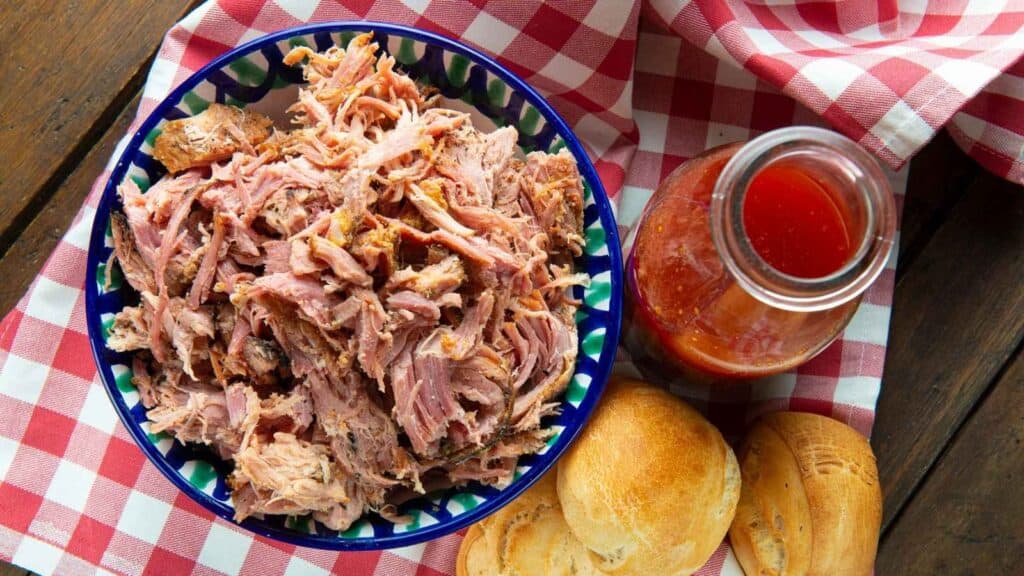
What arrives on your tray is a hand-chopped pork with crispy bits of skin folded through it. The sauce is vinegar and red pepper, added with restraint. There is no ketchup, tomato or sweetness. The smoke and the acid do the work together, and the result tastes like something that took great skill and most of the night to produce because it did. This is the oldest unbroken barbecue tradition in America, and Ayden is worth the detour.
Lexington style: When the Piedmont went its own way
Drive west on U.S.-64 toward the Piedmont, and the sauce changes. Around Lexington, the tomato comes in, not much, this isn’t Kansas City, but enough to soften the vinegar into something Eastern North Carolina would consider an act of heresy. Locals don’t call it sauce, but a dip.
The cut changes, too. Lexington-style uses pork shoulder, not the whole hog, and the red slaw on the side, colored by that same tomato-kissed dip, indicates you’ve crossed an invisible but very real culinary line. The historical record traces this to the early 20th century, when German-descended pitmasters in the Piedmont began cooking shoulder over hickory and adding ketchup to their vinegar base. Lexington Barbecue, opened by Wayne Monk in 1962 and named the best barbecue in North Carolina by Southern Living in 2025, is the clearest expression of what that tradition became.
Charlotte: The crossroads plate
Charlotte sits at the geographic hinge of this road trip, an hour from Lexington, three hours from the coast and right on the edge of South Carolina, which is exactly why Midwood Smokehouse matters. Frank Scibelli opened the original location on Central Avenue in 2011 with one principle: burn North Carolina hickory hardwood around the clock, no exceptions.
The smoker never goes cold. Midwood serves Eastern North Carolina chopped pork in vinegar sauce next to Texas-style brisket and South Carolina chicken, so you can eat your way through the entire regional argument in one visit.
The staff clearly loves the food, and our server, Drew, pointed everyone toward the burnt ends. The sides matter as much as the meat here, all of it scratch made. Order the beans, which come studded with smoked pork, and note that even the pickles are housemade. The banana pudding has earned its loyal following; it is the best I’ve ever tasted.
Across the state line: Where the sauce turns gold
Cross into South Carolina, and the sauce is yellow; bright, unambiguous, mustard-yellow. The Midlands mustard tradition goes back to German settlers who arrived in the 1700s and brought their preference for mustard into a region already cooking whole hogs over open pits. The Bessinger family codified it commercially in 1939, when Joe Bessinger opened the Holly Hill Café. At least five of his sons learned the sauce there, and each went on to open their own joints, spreading it from the Midlands to the coast. German surnames, including Bessinger, Hite, Zeigler and Sweatman, still appear on barbecue joints across the Midlands today.
Among South Carolinians who eat pork barbecue, 70% prefer it pulled rather than chopped, while mustard sauce has expanded well beyond its historic Midlands stronghold. Hash and rice changes here, too. The thick, savory pork gravy served over white rice has no real equivalent anywhere else.
Sweatman’s BBQ in Holly Hill, open since 1977 in a converted farmhouse north of Orangeburg, is where this tradition took the shape most people recognize. Scott’s Bar-B-Que in Hemingway is where to find it cooking right now. The Scott family has been running wood-burning pits overnight since 1972 and was named the most talked-about barbecue restaurant in South Carolina in the 2025 statewide survey.
What low and slow actually means
A whole hog at Skylight Inn goes onto the pit the night before service. Pitmasters feed wood through the night, monitor the heat by feel and pull the hog when it’s ready, not when a timer says so. That skill, built over years of reading a wood pit across 10 or 12 hours, cannot be replicated with gas or pellets without losing what makes the ‘cue worth eating.
The number of pitmasters in the Carolinas who still cook over wood every day is smaller now than it was a generation ago. Skylight, Lexington Barbecue, Midwood and Scott’s in Hemingway are worth visiting with some urgency because the craft they represent took generations to build and is not automatically replaced.
The road is the whole point
A barbecue road trip through the Carolinas is not a tour of one tradition. It is an argument conducted in smoke and sauce across several hundred miles, where the food changes every time you cross a county line. You drive east and west and south, eat at the places that have been doing it longest and let the differences speak for themselves. That is what makes the trip worth it.
Jennifer Allen is a retired chef turned traveler, cookbook author and nationally syndicated journalist; she’s also a co-founder of Food Drink Life, where she shares expert travel tips, cruise insights and luxury destination guides. A recognized cruise expert with a deep passion for high-end experiences and off-the-beaten-path destinations, Jennifer explores the world with curiosity, depth and a storyteller’s perspective. Her articles are regularly featured on the Associated Press Wire, The Washington Post, Seattle Times, MSN and more.