
It’s true. Modern dishwashers are federally regulated to use no more than 3½ gallons of water per wash, while hand-washing can waste nearly 30 gallons of H20. Dishwashers are in 73% of all homes, so why do more than 17 million American homeowners still run the faucet?
This post may contain affiliate link(s). As an Amazon Associate, I earn from qualifying purchases. See Disclosures.
Blame it on habit, minor technophobia and the persistent memory of inefficient dishwashing machines that squandered gallons of water and still left dishes caked with leftover food. Even folks who use their dishwashers regularly often make them less effective by rinsing everything before loading, which can still waste water.
Old ways aren’t always best practices
Think about it, no one’s going to say that communicating is better with their 25-year-old Blackberry than it is with the iPhone 16. Technology changes and develops, and so do we. Imagine washing your clothes with a washboard and rocks. Twenty-five years ago, most Americans were barely concerned with sustainability, and now it’s the buzzword of the day.
Believe it or not, mechanical dishwashers date back to the 1850s. The earliest designs operated with hand cranks and scrubbers. In 1886, Josephine Cochrane received a U.S. patent for the first machine to use water pressure. Her machines slowly built in popularity. However, it wasn’t until the establishment of standardized plumbing codes in the 1940s that installing automated water heaters, and subsequently dishwashers, became possible in homes. By the 1970s, a drying feature was added, and dishwashers became standard kitchen appliances along with refrigerators and stovetops.
Over the past 25-30 years, dishwashers have radically advanced. Older models tended to gobble up electricity and water. However, the Energy Policy and Conservation Act, passed by Congress in 1987, forced some changes. Newer models, even with smart controls, LED screens and longer wash cycles, use an estimated 50% less of both. The current federal standard, introduced in 2012, limits dishwashers to 3.5 gallons per wash. They’re also quieter.
Many dishwashers now include turbidity sensors that detect the cloudiness of the water during the pre-rinse cycle to determine how dirty the dishes are. Some dishwashers will automatically extend the wash cycle based on these results. Improved water filtration systems also ensure cleaner dishes, along with precision spray arms. Adjustable racks and tines allow more customization in arranging the dishes in the machine, hopefully leading to better results.
But not everyone is convinced. “Our dishwasher stopped working over a year ago, and we haven’t replaced it. My husband washes our dishes by hand two or three times every day. Our water bill has not gone up, so I’m not really convinced anymore,” explains Heidi Bender from Tons of Thanks. She admits, though, “Perhaps this data applies to newer dishwashers, as our broken dishwasher is more than 20 years old.”
Impacting the environment
Using a newer dishwasher isn’t just good for your household’s bottom line. It also helps save the planet. The American Council for an Energy-Efficient Economy estimates that if everyone who hand-washes their dishes switched to modern dishwashers, over 30 years, they’d save 2.63 trillion gallons of water, and 0.35 quads of energy. That’s roughly enough energy to power a house. For 200,000 years.
Less water used means newer dishwashers also use less detergent. That’s good for the environment as fewer chemicals are pumped back into the water table.
Healthy and sanitized
Regardless of the detergent you use, for dishes to be sanitized from a health perspective, they should be washed in water that exceeds 140 degrees Fahrenheit. Most dishwashers run water at 145 degrees. That’s not only too hot for your hands, but it takes a while for the water to heat up, while you pour it down the drain. The dishwasher heats the water it needs faster and more efficiently than your in-home water heater.
Of course, it’s not enough to just look clean. Dishes need to be sanitized to kill or inactivate most or all disease-causing microorganisms that may remain on plates after cleaning.
One more health threat that lurks out of sight when hand-washing is the surface of a kitchen sponge. Studies found nearly 400 bacterial species on a single household sponge used for washing dishes. That’s 45 billion bacteria per square centimeter. Not only is handwashing inefficient, but it might be making dishes dirtier. Then there’s the cleanup. You need to disinfect the sink using more soap and water.
But family meals don’t have to mean hours at the sink. Dinners like a one-skillet creamy tomato chicken come together easily, and everything cleans up in the dishwasher while you relax and scroll on YouTube.
Maximum efficiency
You can also implement best practices for your dishwasher, regardless of its age. First, always wash a full load. Don’t cram so tight that it’s unable to do its job, but whenever possible, avoid running the machine half full or less.
It won’t work for every load, but one way to ensure your dishwasher isn’t half empty is to plan a week or a few days of meals at once and cook in batches. Batch cooking saves you time later in the week when other concerns may be pressing. And with a newer dishwasher, the cleanup won’t eat up your whole night.
Bella Bucchiotti of xoxoBella says, “As someone who tries to live sustainably while juggling life with a toddler, I’m always looking for small wins that actually help. I used to feel guilty about using the dishwasher, but I was shocked to learn it uses way less water than hand-washing. Now, I only run it when it’s full and never bother with pre-rinsing. It saves water, energy and my sanity, which feels like a triple win.”
With advanced models, smart controls put you in command. Utilize quick wash, eco-mode and air dry. Don’t switch to heavy-duty wash unless it’s needed.
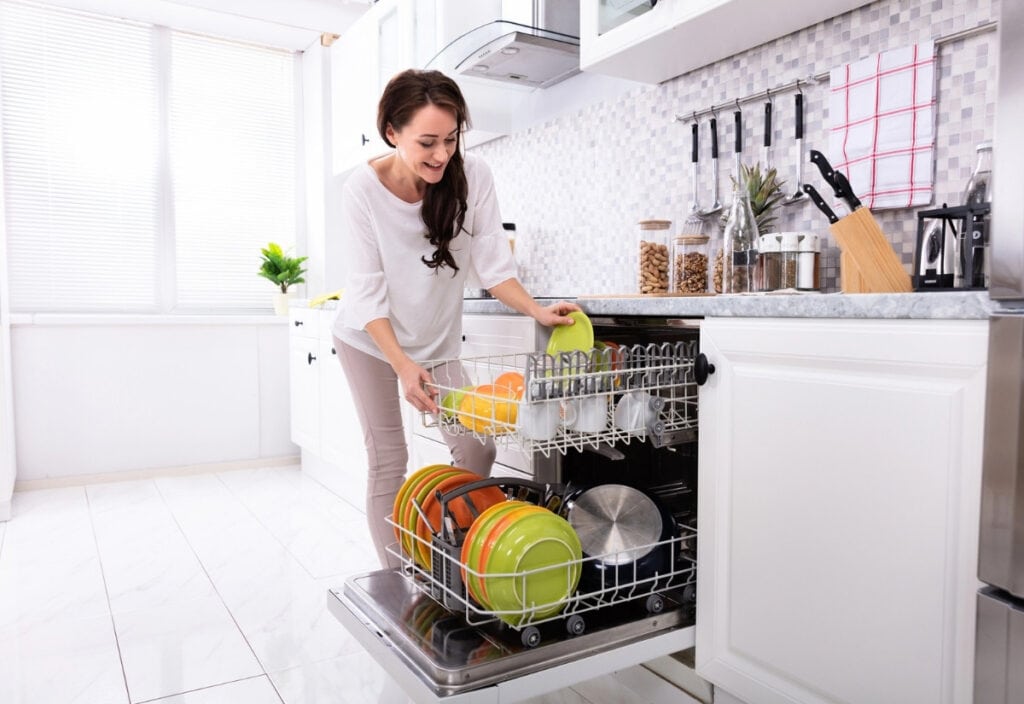
Instead of rinsing all your dishes within an inch of their lives, scrape large bits of food off the dishware without water. Load silverware, except for sharp knives, with the dirtiest part up.
Rinse aid is a must, especially if you live in an area with hard water. It clears the spots from the glasses, and repairmen say it also helps the soil sensors work more efficiently. Most dishwashers don’t have a self-cleaning mode, so periodically clean your dishwasher with vinegar.
You still need to handwash
Some items are not intended for the dishwasher. Others can’t fit, and a few are not recommended for machine cleaning due to various reasons. For example, Melamine plates and bowls, which are usually made for kids, are not resistant to heat and will often crack or chip. The same holds for glassware with screen-printed or foil-printed designs, assuming you want to keep the design.
Oversized cookware may be difficult to fit in the wash or may take up so much space that it causes a problem. Whenever you’re loading the dishwasher, you should use the tines to separate breakables and glassware. But you might not want to risk it with some older, delicate heirloom dishes that can easily break. And of course, hand-wash anything labelled not suitable for dishwasher use, such as specialty knives or non-dishwasher-safe materials.
Doing the dishes
If you’re one of the 19% who have a dishwasher and choose not to use it, consider upgrading to a new model. Most dishwashers last an average of 10 years, saving you nearly 20,000 gallons of water and uncounted hours of time.
While not everything can be loaded into and cleaned by the dishwasher, it’s generally better for the planet and your wallet whenever you use it. If you’re avoiding home-cooked meals because of the cleanup, you’re not alone. Recipes like one-pot chicken and rice are both simple and dishwasher friendly.
Kristin King is the creator of Dizzy Busy and Hungry, where she has been sharing practical, family-friendly recipes since 2013. She is also the author of “Dinner Time Sanity Saver Cookbook,” offering stress-free meal solutions. Kristin lives in New Jersey with her husband, two sons and four cats, balancing her corporate career with her love of cooking and the outdoors.