
A shaky photo of a polar bear from a crowded ship’s rail used to be the best a wildlife trip could offer. Guests fought for a spot at the railing, adjusted around someone else’s shoulder in the frame and hoped the animal didn’t move before the shutter caught up. That tradeoff is no longer the default, as a handful of expedition operators have stopped treating photography as something guests squeeze in around the itinerary and started building the itinerary around photography instead, with dedicated instruction, smaller groups and routes chosen for light and access rather than convenience.
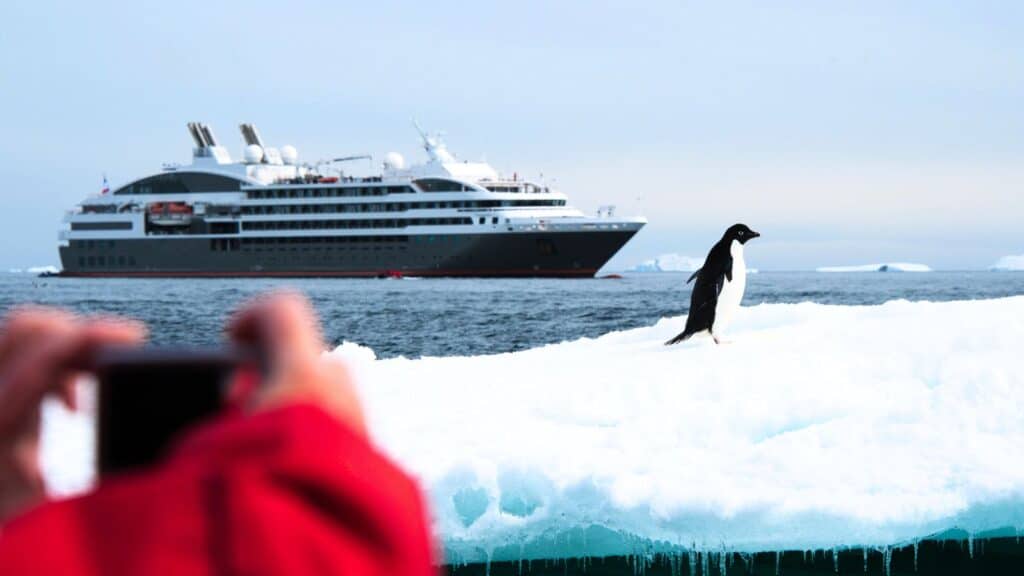
A guide who happens to carry a camera is not the same as a guide hired specifically to teach composition, timing and how to read an animal’s behavior before it moves. On these trips, that difference decides whether a guest comes home with a snapshot or an image they would frame. Operators building around photography first are also capping group sizes well below standard expedition norms, on the theory that a photographer needs space at the rail, not just access to the deck.
Demand for this kind of travel is climbing fast
Expedition-style trips, particularly those built around wildlife and remote access, are seeing some of the strongest growth in travel this year. The cruise industry’s own trade association points to expedition and exploration cruising as one of its fastest-growing segments.
Travel agency Fora is seeing the change up close, reporting expedition cruise bookings up 168% year over year this summer, with National Geographic-Lindblad Expeditions ranking among the category’s most-booked lines. That growth is fueling a parallel rise in operators willing to narrow their focus even further, designing entire departures around a single specialty rather than general sightseeing.
Secret Atlas puts guests inside the aurora, not just near it
Secret Atlas caps its Northern Lights Expedition Micro Cruises at 12 guests, departing this September for Scoresbysund, the world’s largest fjord system, off the coast of East Greenland. Guests receive 1-to-1 tuition from polar photographers Randy Hanna and Virgil Reglioni, who work with the ship’s captain to reposition the vessel around the sky and ice rather than a fixed route. The ice-strengthened ships can anchor directly among sea ice, giving photographers a stable platform for long exposures that a larger, less maneuverable vessel could not offer.
Quasar Expeditions trades the ship’s rail for a private 4×4
In Patagonia, Quasar Expeditions runs customizable photography safaris through Torres del Paine, El Calafate and El Chaltén, offered self-guided or fully guided over six to 11 days. Guests photograph pumas, glaciers and landscapes from the privacy of their own vehicle alongside expert naturalist photographers. The format gives photographers control over timing and positioning that a fixed group itinerary typically does not allow.
National Geographic-Lindblad Expeditions lends out the camera itself
National Geographic-Lindblad Expeditions is pairing its Dec. 20 Antarctica Direct: Fly the Drake Passage departure, aboard the National Geographic Orion, with National Geographic Photography Expert Dr. Gabby Salazar. Guests get complimentary access to the OM System Photo Gear Locker, borrowing professional camera bodies and accessories at no extra cost, while Salazar offers hands-on coaching during Zodiac excursions and shore landings. The support extends beyond scheduled workshops, with informal instruction happening at the rail whenever wildlife appears.
Ecoventura pairs Galapagos wildlife with a low guest-to-guide ratio
Ecoventura operates the only Relais & Châteaux vessels in the Galapagos, a 10-cabin ship carrying just 20 passengers on its Specialty Photography Departures. Each sailing is led by two hand-picked naturalist guides, two of whom are trained through National Geographic programs, at a ratio of 10 guests to one expert. That ratio gives photographers time to wait out a shot of nesting blue-footed boobies or a sea lion pup rather than moving on with a larger group.
The specialization is a sign of where expedition travel is headed
The rise of these trips points to a broader change in what expedition travelers expect from a booking. General wildlife access, once the entire pitch, is becoming the baseline rather than the draw. Operators are competing instead on how much they can teach a guest to do with that access, whether through a photography expert, a smaller group or a vehicle a guest does not have to share. As demand for this kind of specialized instruction grows, expect more operators to follow with their own dedicated departures rather than folding photography into a broader wildlife trip.
For travelers used to coming home with a memory card of near-misses, this changes the calculation of which trip is worth booking in the first place.
Jennifer Allen is a retired chef turned traveler, cookbook author and nationally syndicated journalist; she’s also a co-founder of Food Drink Life, where she shares expert travel tips, cruise insights and luxury destination guides. A recognized cruise expert with a deep passion for high-end experiences and off-the-beaten-path destinations, Jennifer explores the world with curiosity, depth and a storyteller’s perspective. Her articles are regularly featured on the Associated Press Wire, The Washington Post, Seattle Times, MSN and more.