
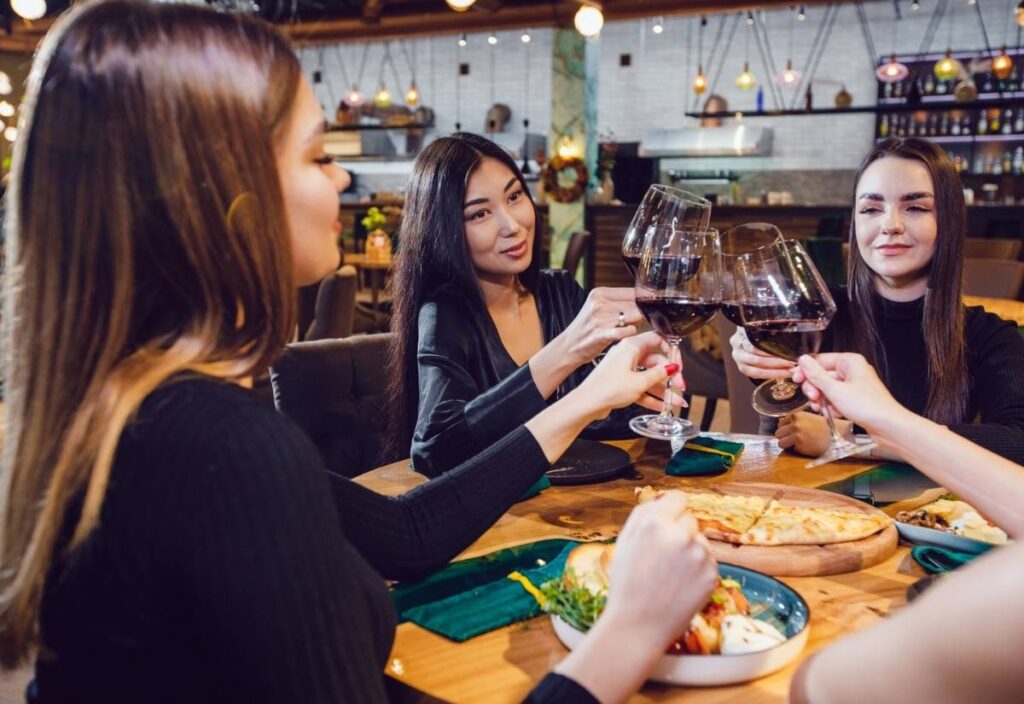
On Feb. 13, restaurant reservations increasingly come in for six or eight rather than two; bars promote themed cocktail nights, and group texts that started weeks earlier finally settle on a table and a time. What began as a throwaway line in a television script now carries real weight on the February calendar, as Galentine’s Day draws diners, shoppers and planners in its own right.
This post may contain affiliate link(s). As an Amazon Associate, I earn from qualifying purchases. See Disclosures.
Introduced in a 2010 episode of “Parks and Recreation,” Galentine’s Day began as a fictional brunch celebrating female friendship; it was playful, specific and not intended as a national observance. Over the past decade, however, it has moved from pop culture reference to recurring ritual, broadening a month once defined almost exclusively by romantic couples.
From a television reference to an annual tradition
After the episode aired, the term circulated online, first as a joke and then as a caption for actual gatherings. By the mid-2010s, Feb. 13 posts featuring coordinated outfits, themed dinners and brunch tables appeared with regularity; what had been ironic participation began to look like habit.
Businesses responded in stages, as greeting cards and novelty items showed early commercial interest and marketing campaigns followed once brands recognized an audience distinct from traditional Valentine’s messaging. Feb. 13 was no longer treated simply as the eve of Valentine’s Day but as a separate occasion with its own consumer base. Restaurants added programming around the date, and retailers integrated it into seasonal campaigns, reinforcing the idea that Galentine’s Day was not a one-season novelty but a repeat event.
Restaurants expand the Valentine’s window
For years, Valentine’s Day drove February dining through couple-focused fixed menus and tightly managed seatings; Feb. 13 often served as a quieter prelude. That distinction has narrowed.
Group reservations change the pace of restaurant service and the size of the check; larger tables lean toward shared plates, extra courses and additional rounds of drinks. Some operators now build Feb. 13 events specifically for friend groups, offering brunches, tasting menus or cocktail workshops that differ from the traditional Valentine’s format.
The effect is a wider mid-February dining window rather than a single concentrated peak; traffic now stretches across Feb. 13 and 14, softening what was once a one-night surge and creating two distinct but related occasions.
Retail messaging broadens
Valentine’s spending in the United States routinely reaches into the tens of billions of dollars, according to industry projections. Within that total, messaging has gradually expanded beyond couples to include friends and self-gifting.
Cards addressed to friends, curated gift assortments and party decor appear alongside traditional romantic merchandise, and beauty brands and specialty food companies increasingly position February products around shared experiences rather than only romantic exchange. The shift does not diminish the centrality of couples; instead, it widens the frame of who February is for.
Social media reinforces the date
Digital platforms accelerated Galentine’s early growth and continue to sustain it. Hashtags tied to Feb. 13 recur annually across TikTok and Instagram, while Pinterest searches for party themes and menus rise in late January. The visibility creates repetition, and repetition builds expectation.
The tone has also evolved. Early celebrations carried a wink; by 2026, participation appears straightforward and planned. Invitations go out in advance, reservations fill quickly and group photos are anticipated as part of the evening rather than as afterthoughts.
Generational reach
Millennials helped normalize Galentine’s during its early years, and as that cohort moved into higher earning brackets, spending around friend gatherings followed. Gen Z has embraced the date with an emphasis on shared experiences and coordinated presentation, with dinners, spa visits and short domestic trips often taking precedence over traditional gift exchanges.
Hospitality businesses have responded with February packages aimed at friend groups, further embedding the date in travel and leisure planning. Participation now extends beyond younger consumers, with workplace gatherings and neighborhood dinners contributing to broader acceptance.
A fixed point in February
Galentine’s does not replace Valentine’s Day; it sits beside it. Businesses prepare for both, and consumers plan accordingly, treating mid-February as a sequence rather than a single evening.
Jennifer Allen is a retired professional chef and long-time writer. Her work appears in dozens of publications, including MSN, Yahoo, The Washington Post and The Seattle Times. These days, she’s busy in the kitchen developing recipes and traveling the world, and you can find all her best creations at Cook What You Love.