
Millions of monarch butterflies converge on the same mountain forests in Mexico every November, a migration scientists could never trace in real time, one butterfly at a time, until now. Tiny solar-powered trackers are following individual monarchs this year, and the early results are upending some of what scientists assumed about the trip. Not every tagged butterfly is even headed to Mexico.
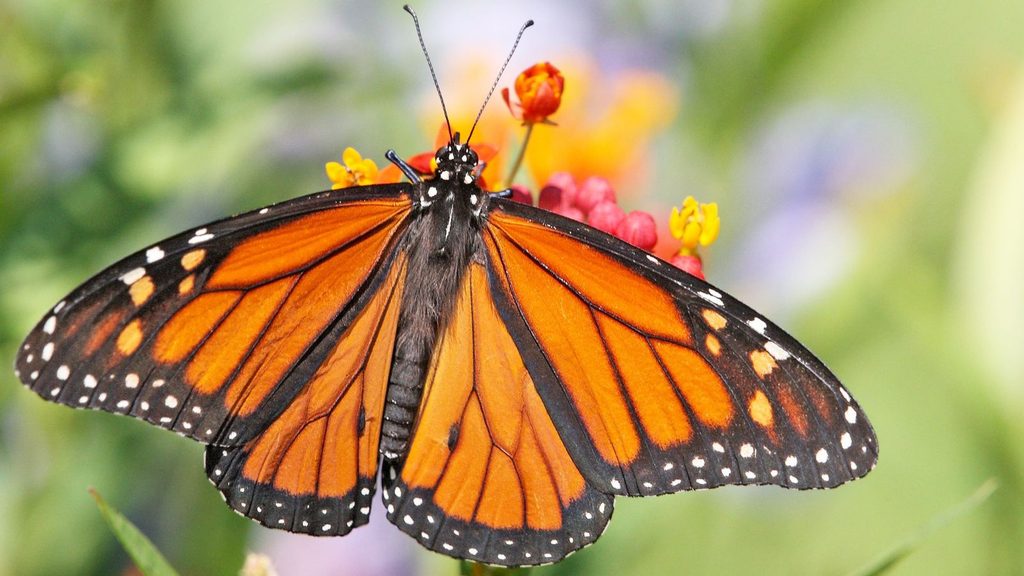
Figuring out exactly where any single monarch ends up, and whether Mexico is even the destination, only became possible recently because monarchs are too small for most wildlife trackers. A monarch weighs less than a gram, too little for the battery-powered devices long used on birds and larger animals. Researchers at Cellular Tracking Technologies built a solar-powered tag instead, called BlūMorpho, weighing about 60 milligrams and running without a battery.
The tag broadcasts an identification signal on the same radio frequency used by Bluetooth, letting any nearby smartphone, not just specialized equipment, log a detection. David La Puma, who helped develop the tag and works with Project Monarch, the research collaboration coordinating the effort, told Vermont Public the technology opened up tracking for a whole category of species that had always been too small to tag before.
Hundreds of monarchs now carry tiny trackers
One of those tagged monarchs, nicknamed “Chew,” left northeastern Utah on Sept. 2. Chew became the first radio-tagged monarch known to cross the U.S. border and be detected in Mexico, after Project Monarch recorded it in Santa Catarina, in the Mexican state of Nuevo León, on Oct. 11.
Chew’s tag is one of hundreds the collaboration has deployed this fall, building on more than 400 of the devices put on monarchs last fall alone, spanning more than 20 partner organizations across the United States, Canada, Mexico and Cuba. Mexican partners in the effort, including the government’s National Commission of Protected Natural Areas and WWF Mexico, search for tagged butterflies with handheld receivers once the insects reach the mountain reserves, while ordinary smartphones carried by visitors act as passive detectors the rest of the way.
The tagging push is part of a newly formed Tri-National Insect Movement Collaborative, launched this summer by the U.S. Fish and Wildlife Service’s Center for Pollinator Conservation along with partners in Canada and Mexico. Researchers chose monarchs as the collaborative’s first focus species because their migration crosses all three countries end to end.
A separate team led by Dr. Leone Brown at James Madison University has been studying whether the tags themselves affect survival. Early results suggest survival is unlikely to be affected in properly tagged monarchs, which eases a concern that comes up whenever researchers attach anything to a wild animal this small, though the research is still ongoing.
A second monarch took a different route north
A second tagged monarch, known in Project Monarch records as Mona, mapped a different path before reaching the same border region. Mona began migrating from northwestern Minnesota. He flew in a nearly straight line to the Missouri River in central South Dakota, then turned south, with his last confirmed detection in the Big Bend area of the Trans-Pecos region of southwestern Texas, directly on the Mexican border.
A team tagged 30 monarchs at Long Point, Ontario, last September 2025. Several were tracked crossing Lake Erie and passing through urban and suburban stretches of Ohio instead of following a direct inland route. A year earlier, researchers tagged a monarch named Lionel at Cape May Point, New Jersey. The tag produced hundreds of detections as the butterfly moved down the Atlantic coast to St. Augustine, Florida, logging one smartphone ping at a time.
A discovery that caught the research team off guard
Some of the stopovers have surprised the scientists doing the tracking. Desirée Narango, who leads a team of scientists at the Vermont Center for Ecostudies, told Vermont Public that watching monarchs settle into old industrial parks and other urban sites genuinely surprised her team.
Those habitats had not previously been a focus of monarch conservation work, which has centered on wildflower meadows and protected grasslands. Vermont is one of about 20 North American locations where scientists tag monarchs this way for Project Monarch.
The detection network itself, powered by everyday smartphones rather than specialized gear, is what made the discovery possible in the first place. More than 3,000 community scientists have joined the effort through the Project Monarch app since 2023, and each person who walks near a tagged butterfly without realizing it adds a data point to the map.
Not every tagged butterfly is headed to Mexico
Some tagged monarchs are not bound for the mountain forests at all. Vermont Center for Ecostudies researchers confirmed that some eastern monarchs skip the trip to Mexico entirely, instead overwintering in Florida and the Caribbean. Scientists had long assumed nearly the entire eastern population made the same trip south.
The same researchers say the project aims to identify exactly where monarchs travel. This will allow conservation efforts to better protect them from climate change, habitat loss and pesticide use along whichever route they actually take.
The eastern migratory population has fallen more than 80% from counts once in the hundreds of millions, according to the Xerces Society, the same conservation group coordinating several of the tagging sites. Ray Moranz, a pollinator conservation specialist at the Xerces Society who led the Florida study, said in the group’s press release that the findings are some of the best evidence yet that monarchs migrate north out of Florida each spring.
The butterflies’ legal protection is still an open question
The tracking data arrives while the monarch butterfly’s own legal status remains undecided. The U.S. Fish and Wildlife Service proposed listing the species as threatened under the Endangered Species Act in December 2024, then delayed a final rule until a court settlement set a new deadline of June 6, 2030. Each detection adds to the migration data that scientists and regulators will have by then.
Jennifer Allen is a retired chef turned traveler, cookbook author and nationally syndicated journalist; she’s also a co-founder of Food Drink Life, where she shares expert travel tips, cruise insights and luxury destination guides. A recognized cruise expert with a deep passion for high-end experiences and off-the-beaten-path destinations, Jennifer explores the world with curiosity, depth and a storyteller’s perspective. Her articles are regularly featured on the Associated Press Wire, The Washington Post, The Seattle Times, MSN and more.