
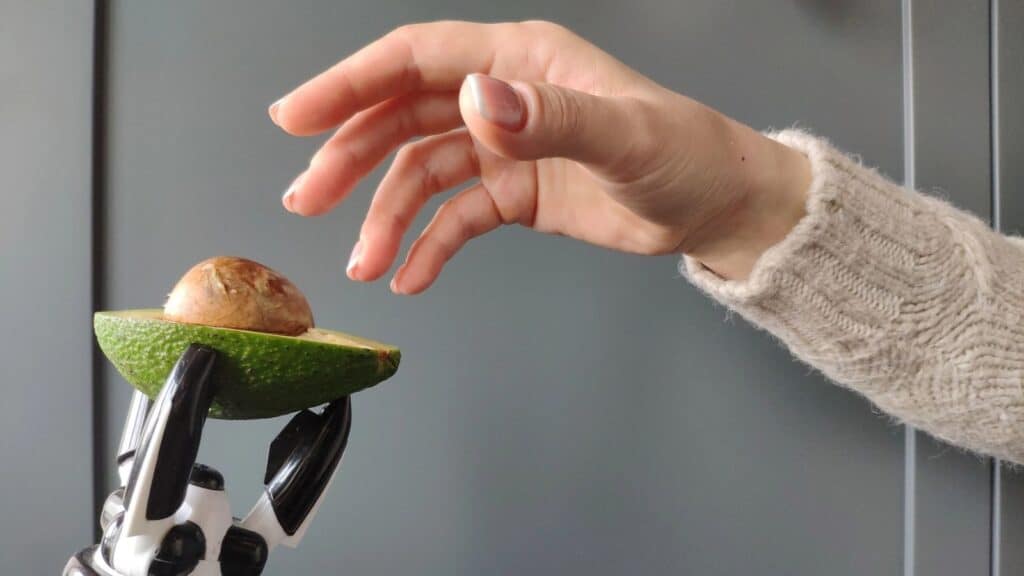
Somewhere in California, a flying robot with two arms exists for one job: wrestling avocados off the tree. Twisting works for many fruits, but avocados put up more of a fight. So the robot has a second arm, and its only job is to hold the stem steady while the first arm does the twisting.
This post may contain affiliate link(s). As an Amazon Associate, I earn from qualifying purchases. See Disclosures.
If National Avocado Day proves anything on July 31, it’s that most people give more thought to the guacamole bowl than to what it took to get the fruit off the tree. Most harvesting robots work from the ground, rolling beneath neat rows of trees, but avocado orchards refuse to cooperate. The ground is uneven, and the fruit often hangs too high to reach without climbing into the air first.
2 arms, 1 very stubborn fruit
The UC Riverside team built a drone with a fixer arm and a gripper arm working together. The fixer arm holds the avocado’s stem in place first, absorbing that stored tension. Only then does the gripper arm move in, grasp the fruit and twist it free. An onboard artificial intelligence vision system detects avocados on the tree and calculates exactly where each arm needs to go. Researchers trained it on a custom dataset of more than 1,000 avocado images, combining real orchard photos from UC Riverside with a public fruit-image dataset.
A stereo camera feeds the system a 3D view of the tree, letting it judge not just where an avocado sits but its exact depth and angle, so the arms know how to approach it. In lab trials, the fixer arm successfully secured the stem in all 10 attempts, while the gripper arm went on to retrieve the avocado in eight of those 10 tries.
The team tested the robot on real trees at UC Riverside’s own agricultural research orchard, not just in a lab. A U.S. Department of Agriculture research grant helped fund the project, tying it to a national push to make farming less dependent on manual labor. The team first developed the work in 2024, and the journal Advanced Robotics Research recently published it. It’s still a research prototype rather than a commercial machine, but researchers have successfully used it to harvest real avocados from orchard trees.
The other half of the problem
Picking an avocado off the tree is only half the challenge, since knowing whether it’s actually ready to eat is the other half. That’s the problem a separate team at Oregon State University set out to solve. Researchers there built a smartphone-based AI that predicts an avocado’s ripeness and internal quality from a photo, no squeezing required. Trained on more than 1,400 iPhone images of Hass avocados, the system correctly predicts firmness about 92% of the time and flags spoiled fruit with over 84% accuracy.
The project was a joint effort between Oregon State and Florida State University, with assistant professor Luyao Ma leading the work alongside doctoral student In-Hwan Lee. The lead researcher’s own motivation was refreshingly relatable: as a frequent avocado toast eater, she’d grown tired of cutting into ones that looked fine from the outside but turned out overripe underneath.
Why 2 separate universities are working on this
Food waste reduction is an official national target: the USDA and the Environmental Protection Agency have set a goal to cut food waste in the U.S. by 50% by 2030, and both projects aim to chip away at that number by reducing how much fruit gets tossed before it’s ever eaten. It’s a strange kind of coincidence that two universities in the United States, working independently, both landed on the same fruit as the one worth building new technology around.
Both projects still have work ahead of them, with UC Riverside’s robot headed toward further field testing before anything like commercial deployment, and Oregon State’s researchers still refining their AI before it could land in a consumer app. Together, they suggest that some of the avocado’s biggest frustrations, from harvesting it to judging its ripeness, are becoming problems researchers know how to solve.
Jennifer Allen is a retired professional chef and long-time writer. Her work appears in dozens of publications, including MSN, Yahoo, The Washington Post and The Seattle Times. These days, she’s busy in the kitchen developing recipes and traveling the world, and you can find all her best creations at Cook What You Love.