
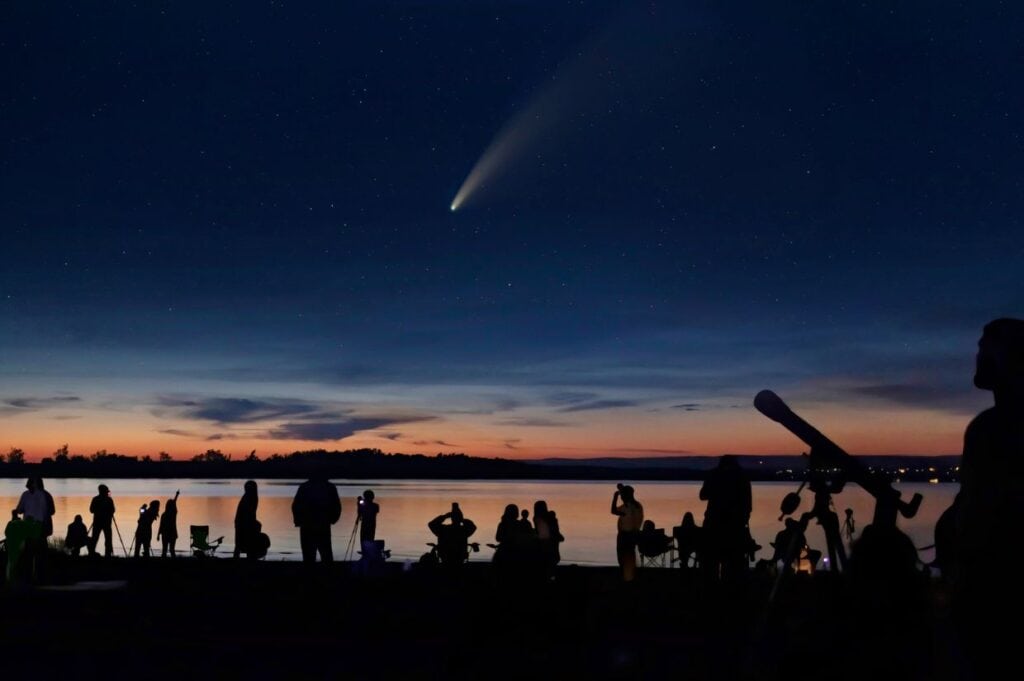
June 30 marks a night when Earth drifts through the dusty trail of Comet 7P/Pons-Winnecke, triggering one of the summer’s most accessible sky events. The result is a brief but dazzling display of meteors that can be seen without telescopes, filters or special equipment. In a year when outdoor interest continues to rise, National Meteor Watch Day 2025 explains when, where and why to watch the sky, offering guidance to turn a passing phenomenon into an intentional experience.
This post may contain affiliate links that may earn us a commission. For more information, see our Disclosures.
The event is a rare opportunity to see celestial activity with the naked eye and almost no barrier to entry. With perfect timing and minimal effort, it’s one of the most rewarding celestial events for casual skywatchers.
What is National Meteor Watch Day?
National Meteor Watch Day is a grassroots celebration that encourages people to look up and connect with the night sky. The day often overlaps with the final stretch of the June Bootids, a lesser-known but occasionally active meteor shower linked to Comet 7P/Pons-Winnecke. Its unpredictable activity around late June is exactly what makes National Meteor Watch Day a timely invitation to keep an eye on the sky.
Understanding meteor showers
Meteor showers create nature’s own fireworks display when Earth passes through debris left behind by a comet, causing small bits of rock and dust to burn up in the atmosphere. As these particles travel at high speeds, they generate heat through friction, producing bright, fleeting streaks of light across the sky that we recognize as meteors.
Even when there’s no major outburst, meteor showers often deliver quiet surprises to those patient enough to watch. On nights like National Meteor Watch Day, these streaks offer more than just a visual display; they create a reason to pause and step away from daily routines.
When and where to watch the sky
The best time to catch meteors on National Meteor Watch Day is between midnight and dawn, when the sky is darkest and your chances of spotting those brief flashes are higher. This is when Earth is turned most directly into the path of incoming debris, making meteor activity easier to see. This one is refreshingly simple, unlike some celestial events that call for telescopes or special equipment. All you really need is a clear view of the sky, a little patience and something warm to wear while you wait.
Location matters, though. Rural areas and elevated spots offer darker skies and broader views. Try to find a spot that’s far from streetlights and buildings, like national parks, open fields or even a backyard with minimal light can do the trick. Some top choices in the United States offer stargazing spots with outstanding conditions.
Big Bend National Park in Texas is one of the darkest places in the continental U.S. Its remote location along the Rio Grande makes it a top-tier destination for unobstructed night sky views. Visitors often report seeing the Milky Way in crisp detail, and its wide desert landscapes make it easy to set up for a night of skywatching.
In Pennsylvania, the Cherry Springs State Park is officially designated by DarkSky International as a Gold Level Dark Sky Park. Nestled in the Allegheny Mountains, it’s a favorite among amateur astronomers on the East Coast. The park even has a Night Sky Viewing Area with clear sightlines and amenities designed for overnight stargazing.
With high elevation, low humidity and minimal light pollution, Great Basin National Park in Nevada offers an excellent place for meteor watchers. With its annual astronomy festival and open skies stretching over ancient bristlecone pines, it’s a perfect location to take in the slow streaks of a meteor shower. The moon will be in its darkest phase at the end of June, meaning its light won’t overpower the fainter meteors.
Tips to make the most of it
There’s more to meteor watching than just glancing up. A little planning where you go, how you prepare and what you bring can turn a short skywatching session into a memorable experience. These tips help make the most of the night, whether it’s your first time or a yearly tradition.
Give your eyes time to adjust
Once you step into the dark, your eyes need about 20-30 minutes to adapt to the low light fully. This adjustment allows you to see dimmer meteors that might otherwise go unnoticed. Avoid looking at your phone screen or flashlights during this time, and use a red light if you need visibility without disrupting your night vision.
Get comfortable
Stargazing is a waiting game. A reclining lawn chair or camping mat helps avoid neck strain from looking up too long. Dress in layers, bring a blanket and don’t underestimate how cold it can get even in summer, especially in open or elevated areas.
Use a stargazing app
Stargazing apps like Star Walk 2 or Stellarium help you identify constellations and even track active meteor showers in real time. Many include augmented reality features that overlay star maps onto your camera view, making it easy to know where to look. Some even include meteor alerts based on your location.
Check the forecast
Clouds are the main spoiler for meteor watching. Check the hourly forecast for your area using weather apps, like Clear Outside and Astrospheric, that include cloud cover predictions, with some even showing sky transparency ratings. If conditions look iffy, consider scouting alternative viewing spots within driving range.
Pack smart
Think of this as a mini overnight adventure. Bring water, snacks, a flashlight, insect repellent and a portable charger. A thermos of tea or coffee can go a long way on a chilly night, and keeping essentials nearby means you won’t need to interrupt your night sky time.
A night worth planning for
National Meteor Watch Day 2025 is shaping up to be more than a night of stargazing, inviting people to look up instead of scrolling down. With dark skies, a waning crescent moon and the quiet unpredictability of the June Bootids, June 30 brings all the right conditions for skywatchers and first-timers. It’s a rare blend of simplicity and spectacle, accessible to anyone willing to step outside. This could be the start of a new summer tradition, where the night sky becomes the destination, not just the backdrop.
Zuzana Paar, creator of Amazing Travel Life, is a seasoned traveler and writer who has explored 62 countries and lived in St. Lucia, Dubai, Vienna, Doha and Slovakia. Her work has been featured in Fox News, NY Daily News, MSN and more; she has also appeared live on the Chicago WGN Bob Sirott Radio Show. When she’s not discovering new destinations, she shares travel tips and insider insights to help others experience the world in a unique and unforgettable way.