
Somewhere past the last gas station with cell service, deciding whether to keep driving or turn back for the night matters more this August than it has in years. Fifty miles farther means darker roads; it also means darker skies, and this month, dark skies are the whole point. The Perseid meteor shower peaks the mornings of Aug. 12 and 13, and for anyone willing to add a few extra miles to a late-summer road trip, this year’s conditions make the detour worth it.
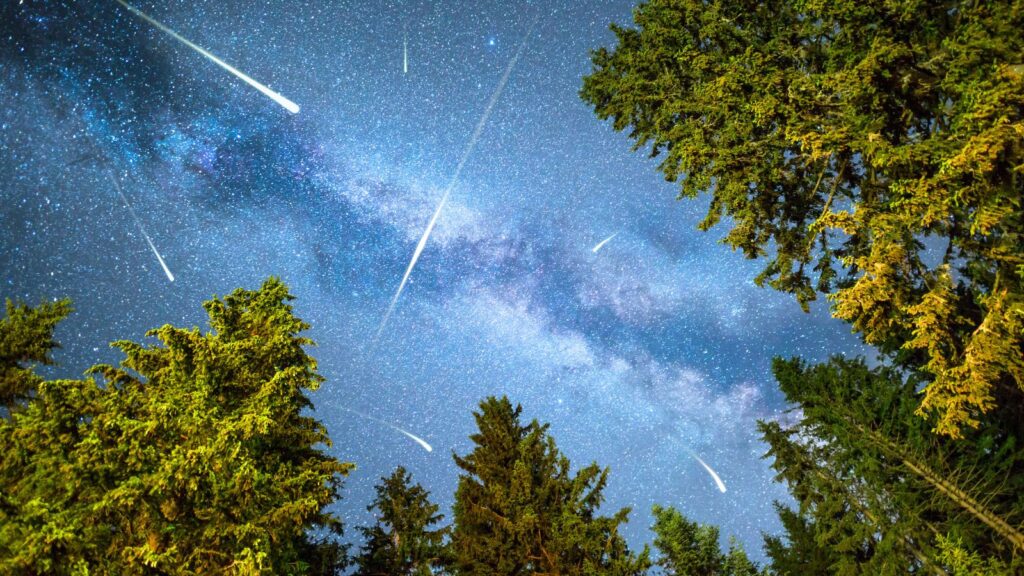
Truly dark skies are getting harder to find close to home, since most Americans live somewhere where light pollution blurs out all but the brightest stars. That’s why a growing number of road trippers are building entire routes around finding real darkness instead of avoiding it. A meteor shower gives that instinct a deadline. It’s one thing to look up from a backyard and hope for the best. It’s another to drive toward a specific patch of sky on a specific night, knowing the show is guaranteed to start on time.
This year, the shower’s peak lines up with a new moon, meaning the sky will have zero moonlight washing out fainter meteors. That’s the difference between spotting a handful of streaks and watching dozens light up the horizon. Under fully dark skies, skywatchers can expect 90 meteors or more per hour. That’s the kind of night worth planning a trip around, and this August, several destinations are freshly built for exactly that.
Badlands National Park joins the dark sky map
South Dakota’s Badlands National Park was designated an International Dark Sky Park on July 17. It is the first and only site in the state to receive the honor and one of just two in the National Park Service’s Midwest region. The designation caps years of work reducing light pollution across the park, including lighting retrofits and ongoing sky-quality monitoring.
For road trippers cutting through the northern Plains, the timing works out well. The designation came less than a month before the Perseids peak, giving an already striking daytime stop an equally striking reason to stay past sunset.
Sun Valley Resort earns a first for the US
On July 13, Sun Valley Resort in Idaho became the first resort in the country certified through DarkSky International’s Approved Lodging and Resorts Program. The certification recognizes the resort’s outdoor lighting standards and its high-altitude terrain, which keeps light pollution low across the property.
Guests can head to Galena Summit, roughly 30 miles north, or stay closer at Bald Mountain Summit and Trail Creek Cabin, all recommended viewing spots in and around the resort. For guests staying there this month, it means meteor-watching without leaving the property.
Bar Harbor pairs Acadia with a coastal detour
On the East Coast, Bar Harbor, Maine, ties for seventh among affordable U.S. stargazing spots, ranked for cost and proximity to dark skies. The town sits alongside Acadia National Park, giving visitors ocean views by day and dark skies close by at night.
Year-over-year search interest in Bar Harbor is up 28%. For road trippers working the Northeast, it offers a combination that’s hard to find elsewhere: coastal scenery without a long drive to reach genuinely dark conditions.
Broken Bow shows steep search growth
Farther south, Broken Bow, Oklahoma, ranks ninth on the list, with search interest up 91% year-over-year, one of several destinations posting steep growth as more travelers plan trips around dark skies. The town sits within the Ouachita National Forest, remote enough from major cities to keep skies dark. For travelers routing through the South-Central U.S., it’s a newer name on the stargazing map.
That growing interest in dark-sky travel isn’t limited to these four stops: Page, Arizona, saw the steepest year-over-year search growth of any destination on the list, up 169%, even though it didn’t crack the top three overall. Combined with several new certifications added just this summer, from national parks to resorts, the signal is consistent: travelers are actively planning trips around dark skies, not just hoping to stumble into one. A meteor shower used to be something people caught by accident. Increasingly, it’s something they’re driving toward on purpose.
Dark sky certifications are still a relatively new distinction, and DarkSky International has added several U.S. sites just since May. For late-summer road trippers, that means the map of worthwhile detours keeps growing. This year, the Perseids give a reason to check it before planning the next tank of gas.
Jennifer Allen is a retired chef turned traveler, cookbook author and nationally syndicated journalist; she’s also a co-founder of Food Drink Life, where she shares expert travel tips, cruise insights and luxury destination guides. A recognized cruise expert with a deep passion for high-end experiences and off-the-beaten-path destinations, Jennifer explores the world with curiosity, depth and a storyteller’s perspective. Her articles are regularly featured on the Associated Press Wire, The Washington Post, Seattle Times, MSN and more.