
In late March, the spice maker McCormick and the consumer giant Unilever agreed to a $44.8 billion deal to combine their operations around a single category: flavor. It is one of the largest food deals in years and a wager on how Americans cook and eat now. The same shift these companies bet on has been building for a while, both on restaurant menus and in home kitchens.
Packaged food has lost ground as shoppers move away from processed meals they no longer consider healthy. The food product merger would bring Unilever’s Hellmann’s and Knorr under the same roof as McCormick’s existing lineup of French’s, Frank’s RedHot, Cholula and Old Bay. That allows Unilever to shift away from prepackaged dinners and lean heavier on spices that enhance all meals.
A record-size bet on flavor
McCormick, the company behind the red-capped jars in most American spice cabinets, agreed to merge with Unilever’s food business, a combination Bloomberg reports values the food unit at $44.8 billion. According to CNN, the combined company would generate roughly $20 billion in annual sales. That would rank it among the largest flavor and condiment companies in the world, and the deal is expected to close in mid-2027.
The logic behind it is plain: seasoning has not lost ground. When McCormick reported second-quarter results in June, net sales rose 16.7% to $1.94 billion, but most of that increase came from a Mexico acquisition and higher pricing rather than from shoppers buying more spice. Organic growth was 1.7%.
From the menu to the pantry
The consumer side of the shift shows up first on restaurant menus. The National Restaurant Association’s 2026 What’s Hot forecast, based on a survey of hundreds of chefs and released in November, named comfort food reimagined through global flavors as a defining trend for the year, with dishes such as Caribbean curry bowls moving from specialty menus into the mainstream. Chad Moutray, the association’s chief economist, called comfort and value the twin pillars shaping American menus.
That momentum is measurable. Hot honey now appears on 11% of U.S. menus after growing nearly 200% over four years, according to the food research firm Datassential, and Korean gochujang ranks among the fastest-growing condiments in terms of consumer awareness. Both trade on the same sweet-and-spicy profile, now common enough to carry its own name, swicy. These are not niche restaurant flourishes, but flavors people then look for at the grocery store.
What the spice cabinet now holds
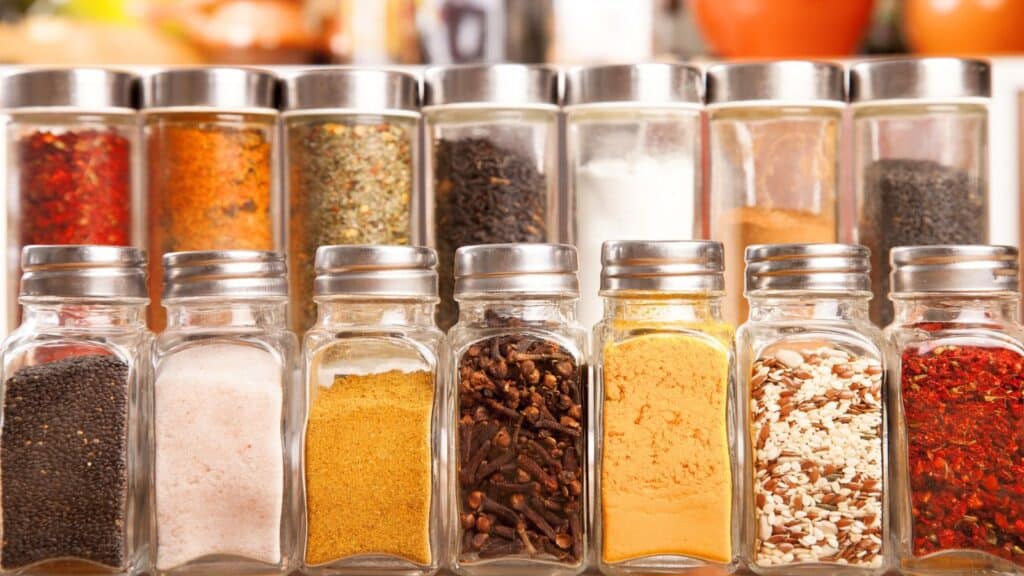
The home spice cabinet has followed the menu. A rack that a generation ago held garlic powder, paprika and dried oregano now often carries za’atar, garam masala, gochugaru, berbere, Tajín and furikake. The change is less about cooking fully traditional dishes from scratch than about borrowing flavor systems: za’atar over roasted vegetables, garam masala stirred into a pot of lentils, chili-lime on grilled corn, furikake on a bowl of rice. A spoonful of gochugaru is the difference between plain broth and a Korean tofu soup.
The approach travels across cuisines and price points. A few dollars’ worth of spices turn the same beans, rice or eggs into a different meal, which matters at a time when grocery prices remain elevated. Curry powder and a cup of red lentils become a pot of mulligatawny, the Anglo-Indian soup adapted from a South Indian pepper broth. A handful of tomatoes and a box of pasta become a penne pomodoro.
A shelf that keeps getting more personal
What the spice rack records, in the end, is a kitchen that has grown less standardized. Immigration and diaspora cooking, restaurant trends, social media recipes and wider grocery store shelves have each added jars. Budget cooking and the steady rise of vegetarian and flexitarian meals have added more. The result is that two American spice cabinets increasingly look nothing alike.
The companies now spending billions are counting on exactly that. The McCormick and Unilever deal would place roughly $20 billion in annual sales under one company built entirely around flavor, on the premise that seasoning is the part of the meal Americans are least willing to give up.
Shruthi Baskaran-Makanju is a food and travel writer and a global food systems expert based in Seattle, Washington. She has lived in or traveled extensively to over 60 countries, and shares stories and recipes inspired by those travels on Urban Farmie.