
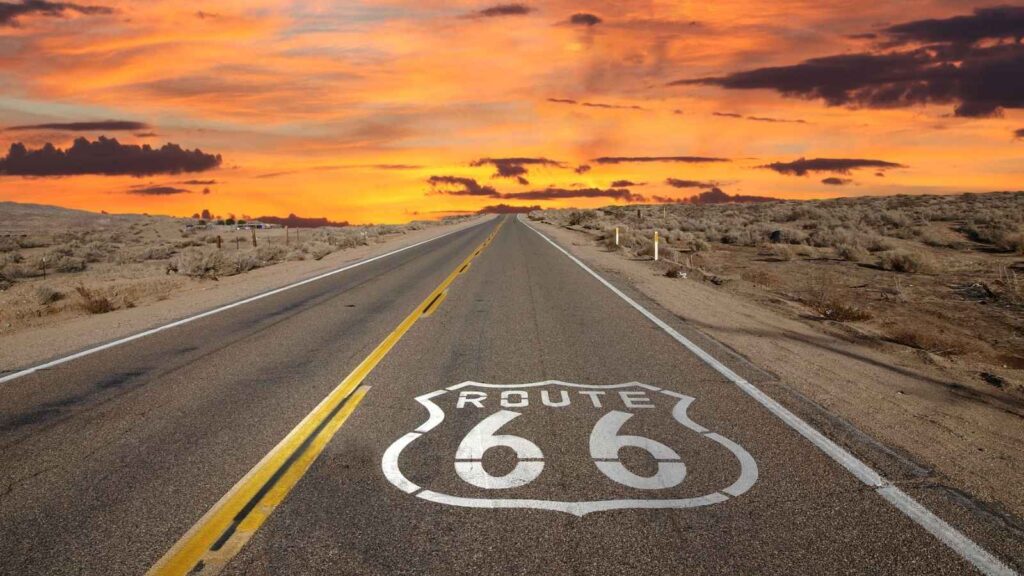
Americans are taking more road trips this summer than they have in years, and food is increasingly what they’re planning them around. Route 66 turns 100 this year, while domestic travel is surging as travelers pull back from international trips. More travelers also build itineraries not around mileage or landmarks but around what’s on the plate: which barbecue pit is worth the detour, where the green chile is freshest, how to find the diner that’s been feeding the town for 50 years without ever being written up anywhere.
This post may contain affiliate links that may earn us a commission. For more information, see our Disclosures.
The appetite for road travel shows up across nearly every major summer travel report. About 71% of Americans plan to drive on their next vacation, while 64% expect to take a road trip this summer. Social conversations about domestic vacations are also up 77% year over year. The question travelers are asking isn’t whether to drive, but where to eat when they get there.
The Mother Road at 100
Route 66 stretches 2,448 miles from Chicago to Santa Monica, and the Michelin Guide named it one of its top North America food destinations for this year: classic diners, regional barbecue and Indigenous Puebloan cuisine across eight states. What makes it work as a food itinerary isn’t any single stop. It’s that the highway forces you to eat regionally, mile by mile, in a way no city trip can replicate.
In Chicago, Lou Mitchell’s has been flipping pancakes since 1923; a short walk away in the West Loop, Swadesi pulls a different crowd with its chicken tikka toastie, a 2024 opening that has become its own Route 66 ritual.
In Tulsa, the Dilly Diner in the Blue Dome District, along the old Route 66 alignment, serves griddle cakes made with locally sourced buttermilk. Further west, the Indian Pueblo Kitchen in Albuquerque, owned and operated by the 19 Native American Pueblo tribes of New Mexico, serves enchiladas with red or green chile and blue-corn stews that don’t exist in the same form anywhere else.
A region, not a restaurant
Michelin’s American South guide covers 228 restaurants across Alabama, Georgia, Louisiana, Mississippi, Tennessee and the Carolinas, evidence that the South is one of the most underexplored food road trip corridors in the country. Driving it reveals why: whole-hog barbecue in eastern North Carolina, hot chicken in Nashville, po’boys and gumbo in New Orleans, low-country seafood along the Georgia and South Carolina coasts.
Not every great food stop announces itself. Greenville, South Carolina, is the birthplace of Duke’s Mayo, has a Michelin-starred French bistro in Scoundrel and fits its entire restaurant scene into a walkable downtown. It is the kind of place that the interstate routes you around.
Each state has its own argument about smoke, spice and technique, and the only way to follow it is to drive. The traveler who flies into Nashville and hits one restaurant gets a data point, but the one who drives from Memphis to Asheville gets a story.
The most underrated food road trip in America
Ask most travelers to name the great American food road trip, and they’ll say barbecue trail, maybe pie corridor. Few say New Mexico. The green chile harvest in the Hatch Valley produces a crop so tied to place that it cannot be replicated outside the state. The Turquoise Room in Winslow, Arizona, builds its menu around ingredients native to the Four Corners region, including tepary beans, Navajo-Churro lamb and desert herbs, in a corridor National Geographic flagged specifically for its Indigenous food culture. The food tells you where you are, and that’s the point.
How to read the room
The markers of the real thing are consistent: local parking lots packed with local cars, menus unchanged for decades, specials on a whiteboard and cash preferred. Michelin’s Bib Gourmand program features inspector-vetted restaurants known for strong value and approachable pricing, and those picks appear across every Route 66 state and throughout the South. Many are long-running local institutions that have fed their communities for decades without ever appearing in a travel magazine.
The demand is already there
Travelers are not turning to the road simply because flights are expensive. They are choosing the road because the drive itself, and the food along it, has become part of the destination.
America’s culinary geography has always existed: barbecue corridors, pie belts, chile trails and diner clusters along two-lane highways. What’s different this summer is the attention it’s getting. The most interesting food in this country has never been in the restaurants everyone already knows. It’s on the roads between them, in the towns the interstates bypassed.
Jennifer Allen is a retired chef turned traveler, cookbook author and nationally syndicated journalist; she’s also a co-founder of Food Drink Life, where she shares expert travel tips, cruise insights and luxury destination guides. A recognized cruise expert with a deep passion for high-end experiences and off-the-beaten-path destinations, Jennifer explores the world with curiosity, depth and a storyteller’s perspective. Her articles are regularly featured on the Associated Press Wire, The Washington Post, Seattle Times, MSN and more.