
If a trip to England is anywhere on your 2026 or 2027 calendar, one of the great pieces of Western history is about to be easier to see than it has been in nearly 1,000 years, and the smartest way to see it is not the one everyone is racing to book. The Bayeux Tapestry, the embroidered account of the Norman conquest of England in 1066, is returning to English soil for the first time in roughly a millennium. The London tickets will be brutal to get, but the full-size version an hour away will not.
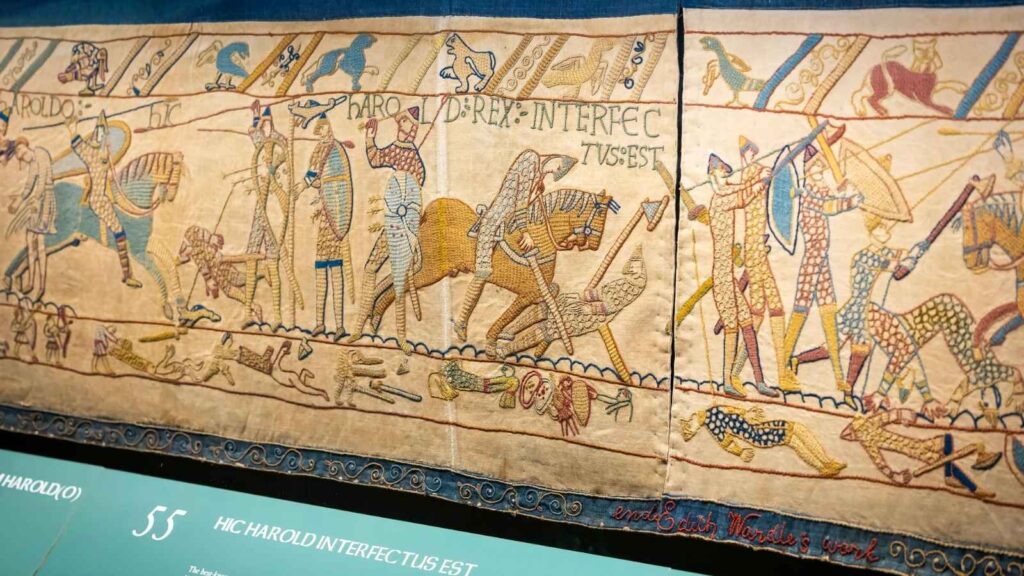
If the name rings a bell but the pictures do not, here is what you would actually be looking at. The tapestry is a 70-meter comic strip in wool, and it tells the story of 1066 with surprising drama. It opens with Edward the Confessor on the English throne, follows Harold Godwinson across the Channel and back, and shows Harold crowned king. Then a star with a blazing tail streaks across the top of the cloth, an omen the English read as catastrophe, and we now know as Halley’s Comet.
Ships cross the water, horses charge and the whole thing builds to the Battle of Hastings and the death of King Harold, traditionally known as the figure clutching an arrow to his eye. It is violent, strange and far more gripping than any textbook made it sound.
The original is leaving France for one simple reason: its home in Normandy is closed for a long renovation. That technicality gives England something it has not had since the embroidery was made, a chance to see it on home soil. And despite the name, it is not a tapestry at all. It is wool thread hand-stitched onto linen, every inch worked by people sitting with a needle the way you might over a winter, except the hands that made this have been gone for the better part of a thousand years, and their stitches are still here. Up close, you can see them. That is what a photo cannot give you.
The scale of interest is hard to overstate. The British Museum is bracing for its biggest year on record, with roughly 7.5 million visitors expected and timed tickets to the tapestry running from £25 to £33, or about $32 to $42 at current exchange rates. Tickets go on sale July 1.
The original, in London
The Bayeux Tapestry goes on display at the British Museum from Sept. 10, 2026, through July 11, 2027, in a purpose-built gallery where it will be laid out flat at full length for the first time. Under-16s go free with a paying adult, and tickets are tiered by day and time. When the loan ends, the tapestry returns to a brand-new museum in Bayeux.
The copy you can see for free, in Reading
Under an hour west of central London sits Britain’s own Bayeux Tapestry, and it is a marvel in its own right. Eight centuries after the original was sewn, 35 Victorian women picked up the same needle-and-wool craft and spent more than a year recreating the whole thing by hand, stitch for stitch. Their copy runs the same 70-meter length, and it has lived in its own gallery in Reading for decades.
Admission to Reading Museum is free, with a suggested $7 donation, and the gallery is open Tuesday through Saturday. If you want the full story behind every scene, guided tours run on Tuesday and Thursday afternoons and Saturday, at 2 p.m. for $13 per person, and they sell out quickly.
Reading is no random stand-in for the real thing. The town’s Norman roots run deep. Henry I, son of William the Conqueror, founded Reading Abbey in 1121 and is buried in its ruins, a short walk from the gallery. Leave time to explore the surrounding Abbey Quarter, where you can walk the medieval ruins and see the Abbey Gateway, the building where novelist Jane Austen went to school. The museum itself is worth an unhurried hour, and the cafe and town center are steps away.
Why this matters for American travelers
London tickets will be scarce; the Reading gallery will not turn you away. The two sit at either end of the same Elizabeth Line, with direct trains covering the distance in under an hour, so you can see both versions of the same story in a single day. If you only have time for one, Reading lets you stand in front of the entire 70 meters with no countdown and no timed slot.
Reading also happens to sit about 30 minutes from Heathrow, where most transatlantic flights land. A frequent airport coach connects the two in roughly 40 minutes, which makes the gallery a smart first-day or last-day stop before you have even reached your London hotel. The town leans into the moment, branding 2026 and 2027 its Year of the Normans.
So here is the planning math. The original is in England for less than a year, then gone for good, and its tickets will be the hardest to get in the country. The copy has been waiting in Reading for over a century and asks nothing of you but the train fare. The traveler who plans around that, rather than around the scramble, gets the better morning.
Mandy is a luxury travel, fine dining and bucket-list-adventure journalist with expert insight from 46 countries. She uncovers unforgettable experiences around the world and brings them to life through immersive storytelling that blends indulgence, culture and discovery, and shares them with a global audience as co-founder of Food Drink Life. Her articles appear on MSN and through the Associated Press wire in major U.S. outlets, including NBC, the Daily News, Boston Herald, the Chicago Sun-Times and many more.