
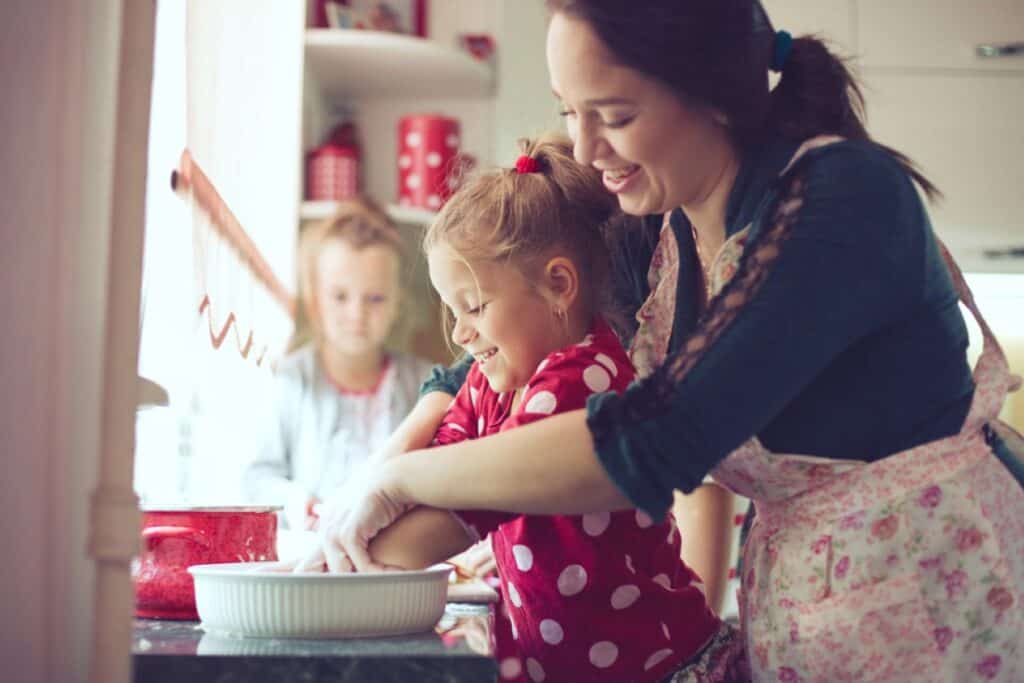
You know that dream where you’re baking cookies with your kids, everyone’s smiling, the kitchen smells like cinnamon and it’s all just… calm? Yeah — reality hits a little different. Suddenly, you’re ankle-deep in flour, someone’s licking the spoon mid-batter and somebody just ran off with a stick of butter. Cooking with kids without losing your mind isn’t a myth — it’s just a shift in expectations.
This post may contain affiliate link(s). As an Amazon Associate, I earn from qualifying purchases. See Disclosures.
The trick to cooking with kids isn’t to eliminate the chaos, but to lean into it — use it. Patience may get tested, but with a few smart strategies, that wild energy can actually work in your favor.
How to make it saner — and actually enjoyable
Cooking is right up there with learning to love movement — both are essential life skills kids can carry into adulthood. As Joe Wicks of The Body Coach puts it, “Is it calm, stress-free and serene? Absolutely not! It’s chaotic and messy…very messy! But the benefits it has on our children far outweigh any negatives. Plus, it’s an investment that will pay off in so many ways.”
That kind of honesty is a good reminder that it’s okay if the kitchen looks like a science experiment gone rogue. What matters most is that kids are learning something real — and connecting with you while they do it. So, how do you keep things fun without completely losing control? These next tips can help.
Prepare ingredients in advance
Think of preparing ingredients as setting the stage before the show. Slice, dice and portion out ingredients before inviting your little sous chefs to the counter. It cuts down on the chaos and lets you guide them through each step without juggling a knife in one hand and a measuring cup in the other.
Pro tip: Use small bowls for a DIY cooking show vibe.
Accept the mess
The mess isn’t just inevitable; it actually supports development. In fact, messy play is a powerful tool for young learners, especially in preschool and early learning environments. According to Accelerate Learning, it sparks creativity by giving kids the freedom to experiment and express themselves in a low-pressure setting. More than that, it builds social-emotional skills like sharing, teamwork and adapting to unpredictable situations. Unlike traditional games with clear rules, messy play invites problem-solving and flexible thinking — skills that come in handy when that pancake flips sideways or the flour bag tips over mid-recipe.
“Cooking with kids can be challenging. Keep in mind that it will probably take longer than when you’re cooking alone. Give them specific jobs to do and show them exactly how to do them. Be ready for messes and have cleaning supplies ready just in case.” says Heidi Bruaw, Real Life of Lulu. So instead of fighting the mess, plan for it. Lay down a washable mat, keep a stack of damp cloths nearby and give kids their own “splash zone.” A little prep makes it easier to breathe through the flour clouds and sticky countertops — and even laugh about them later.
Embrace imperfection
The cookies might be lopsided, the toast might be a little too toasted — but here’s the thing — imperfection is where kids build confidence. Let go of the idea that everything needs to look Pinterest-perfect. That pancake shaped like a dinosaur? It’s a masterpiece.
Writer Becky Allender of the Allender Center at the Seattle School captures this perfectly: “Along with a ‘humble mind’ is the understanding that perfection is not the goal. It’s imperfection that is truer. Living into that reality offers a kind of liberation.” When we model that kind of ease and self-acceptance, our kids feel it, too. The kitchen becomes more than a place to make food — it becomes a space where mistakes are welcomed, messes are part of the story and confidence is built in the wobble of it all.
Use child-friendly tools
Kids feel more in control — and you feel more at ease — when the cooking tools fit their hands and skill level. Using the right equipment not only boosts their confidence but also makes the whole process safer and more engaging.
Look for tools made specifically for young chefs: crinkle cutters for slicing soft fruits and veggies, hand-crank egg beaters for mixing without electricity and step stools that help them safely reach the counter. Even having a designated kid-sized apron or prep station can give them a sense of ownership. The goal isn’t to turn your kitchen into a preschool classroom — it’s to give kids tools that match their abilities so they can participate fully and safely.
Recipes that work well with kids
Not every recipe is a good fit when you’re cooking with kids — and that’s okay. What you want are simple, forgiving options that leave room for creativity, mistakes and joy. These kinds of easy recipes not only keep things simple but also create space for fun, playful competition.
No-bake treats
No-bake treats are lifesaving when you don’t want to fuss with ovens or hot pans. Try energy bites made from oats, nut butter and honey — they’re quick to mix, don’t require baking and can be rolled into snack-size balls by even the littlest hands. Or build simple yogurt parfaits layered with fruit and granola, letting kids assemble their own in clear cups so they can see each layer come together. Chocolate bark is another favorite — just melt chocolate in the microwave and let kids sprinkle their favorite toppings. No-bake recipes are low-risk, fast and give kids the chance to be creative without the pressure of heat or timing.
Personalized pizzas
Pizza night becomes a hands-on adventure when kids get to build their own mini pies. Use naan, pita bread, or pre-made dough for the base. Then, set out a variety of sauces, cheeses and toppings so they can customize their creations. It’s an easy way to talk about flavors, food groups and even texture combinations — all while letting them feel like the head chef.
Breakfast favorites
Let’s be honest — pancakes and waffles are basically a blank canvas. Kids can help mix the batter, pour it onto the griddle (with supervision), and top their stacks with fruit, nuts, yogurt, or even a swirl of peanut butter. It’s a chance to talk about balance and portions while making breakfast feel like a special event.
Simple pasta dishes
Pasta is one of the simplest meals around, which makes it perfect for cooking with kids. Set up a pasta bar with cooked noodles, chopped vegetables, proteins like beans or chicken, and a few sauces. Kids get to mix and match based on their preferences and learn how to build a well-rounded meal along the way.
Baking basics
Cookies, muffins and quick breads are excellent for practicing kitchen basics like measuring, scooping, cracking eggs and mixing. These tasks build fine motor skills and introduce concepts like sequencing and timing. Plus, they offer a tangible reward at the end — a sweet treat they helped make from start to finish. It’s a confidence boost in every bite.
Teaching without lecturing
Learning in the kitchen doesn’t have to come with a quiz. Cooking naturally invites all kinds of educational moments — and kids don’t even notice they’re learning. According to the University of Nevada, Reno, cooking with children is one of those rare activities that supports multiple areas of development at once. It helps young learners build math, science, language, motor, art and social skills — all through hands-on, real-life experience. Even better? Kids especially enjoy learning with their parents, which makes it a meaningful way to grow together while having fun. Here are other ways to turn everyday cooking into a playful, educational experience.
Sensory exploration
Let kids explore colors, textures and smells as you go. Is the dough sticky or soft? Does the herb smell sweet or sharp? These questions build vocabulary and help them pay attention to what food really feels like. Sensory Processing Disorder Parent Support highlighted that it’s important to include sensory integration in the kitchen while cooking. Activities like rolling dough, stirring food or washing dishes aren’t just chores — they’re sensory motor exercises that help kids regulate their bodies and build coordination. Even the environment matters. Calming decorations, soft lighting or comfortable sensory-friendly seating can make the kitchen feel more inviting for kids who are sensitive to stimulation.
Math skills in disguise
Cooking is full of math: counting scoops, measuring ingredients, setting timers and even doubling recipes. It’s a real-world way to sneak in numbers without sitting down at a desk. As Famplified points out, cooking isn’t just a survival skill — it’s a hands-on classroom. Measuring ingredients helps children grasp units and fractions, while following a recipe step-by-step teaches sequencing. Cooking also encourages kids to explore math through shapes and patterns when cutting food, or through ratios when combining ingredients. These hands-on moments make math feel useful and practical, not just something for paper and pencils.
Teamwork tips
Give kids job titles like “chief stirrer,” “sprinkle captain,” or “taste tester in training.” Assigning roles creates structure and encourages cooperation, especially when more than one child is involved. It helps reduce arguments over who gets to do what and turns cooking into a team effort.
You can also introduce a simple rotation system or team tasks, like one child gathers ingredients while another measures them out. This teaches turn-taking and accountability. Narrate what each team member is doing and praise their contributions — it builds confidence and shows them that working together can be both productive and fun.
Why it’s worth it
A study in the Canadian Journal of Dietetic Practice and Research explains that children develop their eating habits during the first few years of life. That means the earlier they learn to enjoy colorful fruits, crunchy veggies and nutrient-rich meals, the better. Cooking together gives them a head start — not just in nutrition, but in shaping habits that can last a lifetime. These shared moments in the kitchen can set the stage for how kids feel about food, responsibility and themselves for years to come.
Life skills that stick
Cooking is an incredibly important life skill for children to learn. According to One Yummy Mummy, cooking with kids can be so much more than just making cupcakes and licking the bowl. By involving them in everyday meal prep, they not only learn about ingredients and where food comes from but also gain essential life skills they’ll carry into adulthood.
Positive food memories
Cooking together is about more than just making food — it’s about creating lasting memories. The moments kids spend in the kitchen help them form positive, joyful associations with food. Instead of seeing it as a chore or something to rush through, they learn to appreciate it as something fun, creative and a shared family experience. Over time, those memories build a healthy, balanced relationship with food that can last a lifetime.
Real-life bonding
Cooking together is an opportunity to slow down and share moments that can’t be replicated elsewhere. When kids and parents work through these together, it strengthens bonds. They learn patience, resilience and the joy of collaborating as a family. It creates space for conversation, cooperation and laughter — even when the cookies burn or the flour explodes.
Where chaos meets connection
For some, cooking with kids is an overwhelming mess; for others, it’s a beautiful moment of connection, teaching and memories in the making. Next time you find yourself in the kitchen with little hands stirring away, just remember — it’s not about the perfect dish, but the laughs, the learning and the little things that make the whole experience unforgettable.
Mandy Applegate is the creator behind Splash of Taste and seven other high-profile food and travel blogs. She’s also co-founder of Food Drink Life Inc., the unique and highly rewarding collaborative blogger project. Her articles appear frequently on major online news sites, and she always has her eyes open to spot the next big trend.