
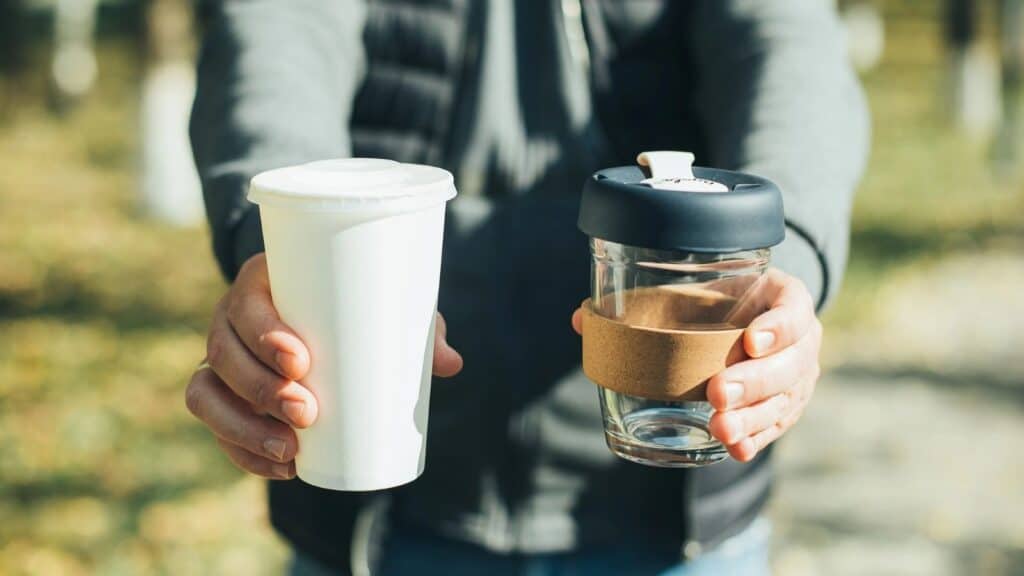
Earth Hour on March 28 will do more than dim lights for an hour. In bars and cafes, it will bring a routine packaging choice into focus as customers decide whether to bring reusable cups or accept another disposable one. For a country that orders drinks and takeout on repeat, that decision carries well beyond a single night.
This post may contain affiliate link(s). As an Amazon Associate, I earn from qualifying purchases. See Disclosures.
The National Restaurant Association says 47% of adults pick up takeout at least once a week, while 37% order delivery weekly. With orders happening that often, cups, lids, containers and bags become a regular part of how food is bought and consumed.
Earth Hour puts packaging on display
Earth Hour puts packaging waste in front of customers at a time when bars and cafes can easily connect the message to everyday orders. Earth Hour 2026 brings the campaign into its 20th year, giving food businesses a clear opportunity to ask patrons to think about the waste tied to a routine coffee or takeout order.
The campaign’s handbook reinforces that message by urging organizers to cut unnecessary paper and disposable plastic use and to encourage people at food-centered events to bring their own containers and cutlery. That request becomes immediate because the cup is either reusable when it reaches the counter, or it is not.
Packaging waste keeps the stakes high
The Environmental Protection Agency estimates the United States generates around 96 million tons of packaging materials waste and recycles 39% of it. This leaves a large share of boxes, bottles, cups and containers outside the recycling stream each year, which is why reuse matters beyond one campaign night or one company pledge.
In addition, EPA’s National Strategy to Prevent Plastic Pollution says the U.S. needs action across six objectives, including better material and product design, lower waste generation, stronger waste management and less harm to waterways and the ocean. Reuse fits that framework because the most effective way to cut packaging waste is to avoid creating another disposable item.
Off-premises orders keep packaging in play
An NRA report from 2025 suggests packaging remains a current consumer issue. More than 6 in 10 younger adults said they used takeout, drive-thru and delivery more often than a year earlier, rather than treating off-premises dining as a leftover habit.
Packaging also matters as part of the order itself, not only the discussion on waste. The association reported 90% of off-premises customers would likely order a wider variety of takeout or delivery items if restaurants used improved packaging that better maintained temperature, taste and quality.
Restaurants have reason to act
The NRA projected $1.5 trillion in industry sales and 15.9 million jobs in 2025, so decisions to use cups, lids, bags and containers play out across one of the country’s largest private-sector industries. The same group said half of operators reported that off-premises sales made up a larger share of revenue than in 2019.
Packaging is no longer only an environmental talking point for restaurants. The NRA’s 2026 Culinary Forecast includes compostable and reusable packaging among its top industry priorities, which suggests operators increasingly view them as part of everyday service for takeout and delivery.
What comes after Earth Hour
Earth Hour may offer a visible moment for reuse, but the bigger question is this: What will Americans do after the campaign when they order their next drink or meal? In a food economy where off-premises dining is routine, packaging decisions now have broader consequences for daily restaurant operation and waste. The shift from an occasional gesture to a standard practice of using reusable cups and containers will help determine how much disposable waste continues to move through everyday restaurant service.
Mandy writes about food, home and the kind of everyday life that feels anything but ordinary. She has traveled extensively, and those experiences have shaped everything, from comforting meals to small lifestyle upgrades that make a big difference. You’ll find all her favorite recipes over at Hungry Cooks Kitchen.