
Old buildings are getting a new lease on life as many are being converted into boutique hotels and resorts. Developers and hotel brands are turning historical sites into high-end stays that keep their original architecture while meeting current hospitality demand. The approach is becoming a go-to move across the hotel sector, pairing preservation with standout accommodations that come with a backstory you can actually walk through.
This post may contain affiliate links that may earn us a commission. For more information, see our Disclosures.
Adaptive reuse is the repurposing of a building for a use that’s different from its original purpose. And when you consider that buildings account for about 42% of global carbon emissions, it isn’t just for aesthetic value that older buildings are given new life again. Adaptive reuse lets developers bring these properties back into use while carrying history into the guest experience.
City landmarks return as modern-day hotels
Developers are relying on existing structures to expand lodging in dense city centers while limiting new construction. In the United States, office-to-residential projects account for about 38% of roughly 147,000 adaptive reuse housing conversions. That sustainable approach is now extending to hotels, where long-standing properties are reopening for new uses.
In downtown Asheville, North Carolina, The Flat Iron Hotel reopened in 2024 after a full restoration. The narrow 1926 structure drew influence from the Flatiron Building and later served as the first home of WWNC Radio. Early broadcasts from the site included Bill Monroe’s debut.
Interior details from its early years remain visible: a hand-operated lift is still in service, and restored window lettering marks former tenants such as tailors and dentists. Historical plaques add context without interrupting daily use. The Red Ribbon Society bar now occupies the former boiler room, bringing activity to a space that once served a different role. The hotel continues to operate in the center of Asheville while keeping its early identity intact.
Original architecture influences hotel layout and use
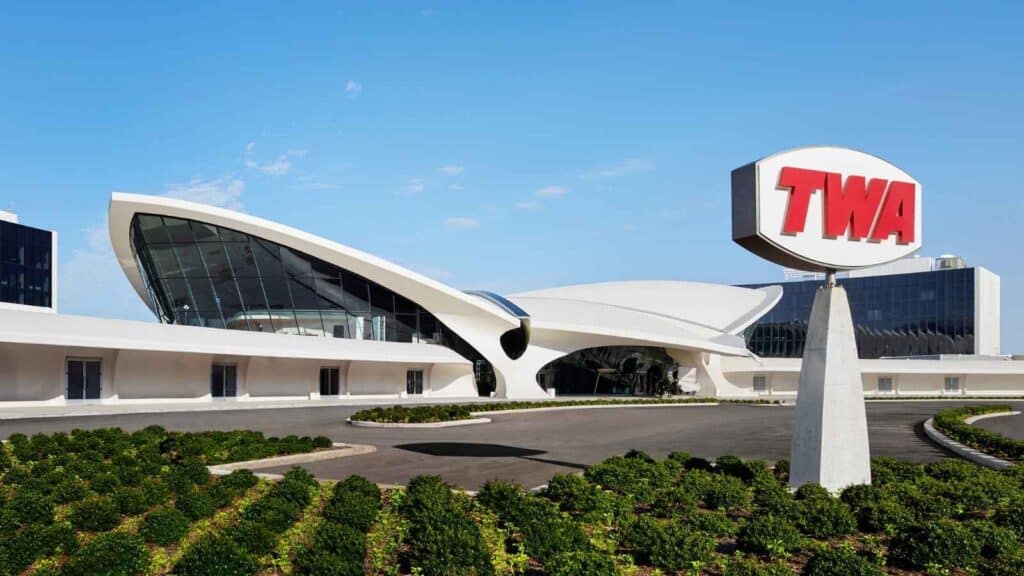
Recognizable design features guide a hotel’s layout after conversion, defining room placement, shared areas and guest flow while reducing major structural changes. At TWA Hotel, for example, the former TWA Flight Center remains the property’s core. The terminal opened in 1962 and was designed by Eero Saarinen; it received landmark designation from the New York City Landmarks Preservation Commission in 1994 and was added to the national and state registers in 2005. Original flight tubes now connect the terminal to guest rooms, which directs movement across the site.
Historic features remain part of the guest experience at TWA Hotel, with split-flap boards and lounge areas still in place, keeping the airport setting visible. Two additional buildings add 512 rooms with runway views, a restored Lockheed Constellation operates as a cocktail lounge and a rooftop pool overlooks active air traffic.
At Hotel Emma, the former brewhouse at the Pearl Brewery site sets the structure for the entire hotel. The property now includes 146 rooms within a mixed-use district that combines retail, dining and cultural venues. Design firm Roman and Williams kept industrial elements visible across guest rooms and shared areas.
Hotel Emma is located in San Antonio, Texas, which is part of the UNESCO Creative Cities Network as a City of Gastronomy. Restaurants such as Supper, Larder and Sternewirth connect the property to that designation. Event space totals 6,160 square feet across indoor and outdoor settings, and amenities include a rooftop pool, fitness center, library and retail shop. Guest service includes a welcome margarita and horchata at turndown, which links the stay to local traditions.
Large historic properties become destination resorts
Expansive sites with historic roots are being converted into resorts that operate as self-contained travel destinations. Their size supports lodging, dining and recreation across one property, while existing structures define the guest experience.
At Saint John’s Resort, a former Catholic seminary spans 200 acres, with the grounds retaining key features such as vaulted ceilings and stained glass. Cloistered courtyards still connect different parts of the property, while a 1940s crypt now serves as a wine grotto. Large halls and shared areas support guest stays and events, with architectural details carried through each space.
In the mountains of Colorado, Dunton Hot Springs operates within a restored 19th-century mining town and is part of Relais & Châteaux. The site includes 13 log cabins and one insulated luxury tent, all arranged within the original town footprint. A multi-year renovation preserved the structures, including the saloon, which serves as a central gathering point, and the bar still features a carved signature attributed to Butch Cassidy. Natural hot springs are accessible throughout the property through a bathhouse, outdoor pools and private soaking areas.
Reused buildings support high-end restaurant concepts
Adaptive reuse also extends into dining, where older structures are converted into restaurants with distinct design elements. At Leluia Hall, a church building that dates back more than a century, now operates as a restaurant led by Jeff Tonidandel and Jamie Brown. The renovation preserved the stained-glass windows and exposed the ceiling rafters. Four light fixtures from the 1915 structure remain in use, adding continuity across the space.
The team also handles much of the interior buildout, and furniture is produced on site using North Carolina hickory and white oak. Tables, bar sections and service stations are made by the restaurant staff, which keeps materials consistent throughout the dining room. The result supports daily service while maintaining the building’s character.
Preservation efforts align with local economic growth
Historic buildings are considered a part of how cities plan for growth, with their value attached to ongoing use rather than preservation alone. This shift places older structures within economic strategy, where they can support tourism, business activity and long-term investment. As more projects move in this direction, hotel offerings may become more varied and grounded, giving guests a stronger connection to the past while staying in spaces that continue to serve a modern purpose.
Jennifer Allen is a retired chef turned traveler, cookbook author and nationally syndicated journalist; she’s also a co-founder of Food Drink Life, where she shares expert travel tips, cruise insights and luxury destination guides. A recognized cruise expert with a deep passion for high-end experiences and off-the-beaten-path destinations, Jennifer explores the world with curiosity, depth and a storyteller’s perspective. Her articles are regularly featured on the Associated Press Wire, The Washington Post, Seattle Times, MSN and more.