
It was the incessant roar that woke most people in the wee hours of the morning on Friday, Sept. 27, 2024, in Augusta, Ga. Like the proverbial freight train sound that accompanies a tornado. But whereas a tornado is fast and relatively short-lived, this roar continued unabated for hours.
This post may contain affiliate link(s). As an Amazon Associate, I earn from qualifying purchases. See Disclosures.
While terrified residents hunkered down inside, a devastation unlike any seen in the area took place outside. Folks had gone to bed on the evening of Sept. 26, anticipating tropical-force wind gusts of 30-35 mph during the night. Instead, residents of a city three hours from the nearest coastline found themselves smack in the middle of a hurricane with 100 mph wind gusts.
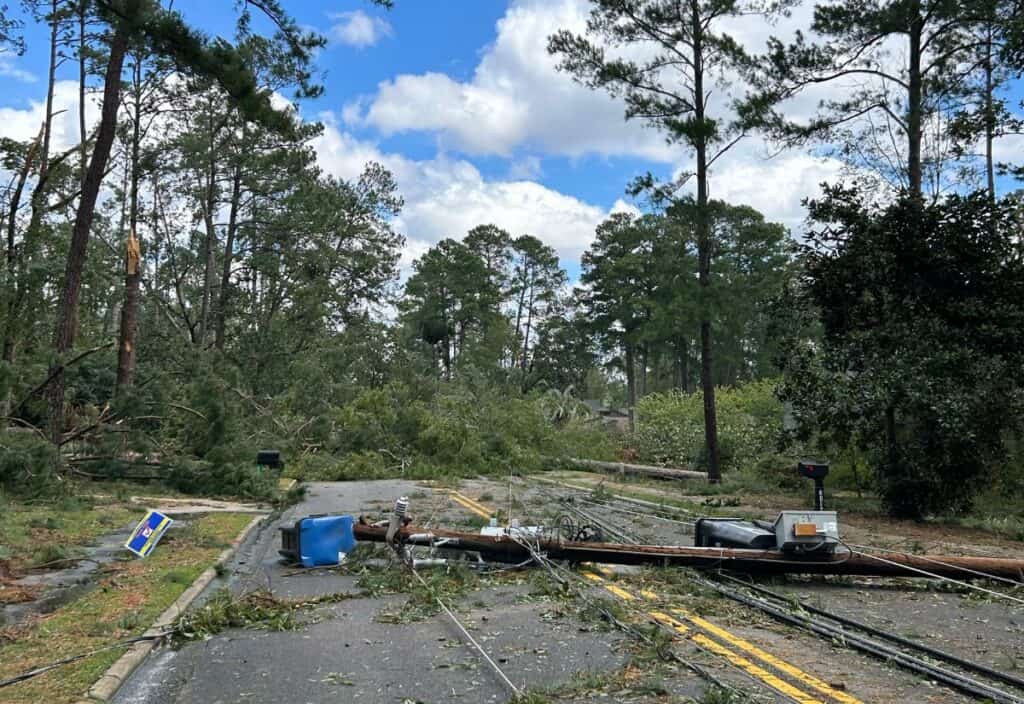
When people emerged in daylight, they found the landscape forever changed. The damage was catastrophic.
An unexpected turn
Hurricane Helene landed on the Florida Gulf Coast as a powerful Category 4 storm. Early models projected the storm’s northward trek toward Atlanta, weakening over land. But late on Sept. 26, Helene took a sharp turn to the east, veering off its predicted path and slamming into the Central Savannah River Area, or CSRA, as a Category 1. The region, which spans 13 counties in Georgia and five in South Carolina along the Savannah River, was not prepared for a direct hit — and certainly not one of this intensity.
Eleven lives were lost in the CSRA from trees falling on homes. The phrase war zone was uttered again and again. Fallen trees covered roads, roofs, power lines, buildings, cars — and golf courses. While Augusta National Golf Club hasn’t disclosed specifics of its damage, drone footage showed numerous trees downed across the course. For comparison, Champions Retreat, a golf club just a few miles away, lost more than 1,400 trees.
From the pandemic to the storm
When the COVID-19 pandemic forced the postponement of the 2020 Masters, many thought that would be the biggest disruption the tournament would ever see. For the first time, Augusta National hosted the event in November, but no patrons were in attendance. Local businesses struggled, and the city lost millions in tourism dollars.
Fast forward to 2024, and Augusta again faced the possibility of losing the Masters — this time to a storm rather than a virus. After Hurricane Helene tore through the region, uncertainty hung in the air. Could the city recover in time?
The Augusta Rule and the scramble for rentals
Every year, homeowners in Augusta rent out their homes to patrons, players, media and sponsors during Masters week. It’s a tradition that’s been part of the city’s culture for decades — and one that got a boost in 1976 with what’s now known as the Augusta Rule. Officially added to the federal tax code as Section 280A(g), the rule allows homeowners to rent their homes for up to 14 days each year without reporting the income on their taxes.
Augusta’s hotel capacity can’t support the crowd alone. Many corporations lease several homes at a time — one as a host house and others as sleeper homes. According to Golf Digest, host homes often command six-figure weekly rentals, while Golfweek reports sleeper homes range from $10,000 to more than $30,000.
After the storm, that tradition was in jeopardy. Some homes were too damaged to list. Others were racing against the clock to repair roofing, fencing or water damage. The National Hurricane Center released a report detailing Helene’s aftermath, which said that in the Augusta area, nearly 400 homes were destroyed, with another 3,000 having major damage and 3,500 with moderate damage. But even with few contractors available, insurance difficulties and price-gouging by tree removal companies, by late February, many listings had returned.
Stacey Greenway, vice president at Tournament Housing and Events, said, “There are definitely some homes that are not going to be available for rent this year, but luckily, they were not already rented. So we’ve called a few homeowners and said, ‘Hey, are you available?’ but they said they won’t be able to rent, so we just had to move on.
“But as far as any houses that were already contracted, all of them have been able to make their repairs, and we’ll be ready. If any town can pull it together, it’s Augusta.”
Augusta National’s response
In the immediate aftermath, Augusta National Golf Club remained silent other than a brief statement expressing support for the community and saying they were assessing damage to the course. The club donated $5 million toward community recovery efforts.
Given the utter destruction in the surrounding neighborhoods and streets, speculation ran high that the famous golf course had sustained extensive damage. Finally, in January, as the tournament drew closer, Chairman Fred Ridley spoke about the course’s condition and the club’s role in the city’s recovery.
“As far as the impact, the long‑term impact, we have not quite as many trees as we did a year ago,” Ridley said. “As far as the golf course goes, it’s in spectacular condition. I think we had minor damage to the course, the playing surfaces themselves, but we were able to get that back in shape, but I don’t think you’re going to see any difference in the condition for the Masters this year.
“Hurricane Helene was really a devastating event for the Augusta community and for a number of communities in the Southeast, particularly in western North Carolina, which I know you probably read about. We suffered a fair amount of impact from the hurricane, as did the entire community.
“I think what I’m most proud of is the response of our entire organization to that natural disaster, which is really what it was. And not only what they did to get Augusta National back in shape, but as importantly, how they pitched in with the Augusta community and really helped out because there were many, many people — many of our people were out of their homes for a number of weeks. No electricity. The community didn’t have water for a while. So, I’m just really proud of how our entire organization responded to that.”
And while the storm’s impact was visible throughout the city, many never doubted that the course would be pristine by April. Anecdotally, among locals, Augusta National is known for its ability to make the tournament experience almost magical for its patrons. In years past, local lore has it that a tree fell during the night on one of the restrooms on the course. Before patrons arrived the following day at the tournament, the tree had been removed, and the building was restored as if nothing had ever happened.
Despite trees scattered across Augusta like matchsticks, locals were confident in the National’s ability to recover. Ask anyone in town, and they’d tell you that by April, no visitor would guess a hurricane had roared through six months earlier.
Citywide recovery and cleanup
The scope of recovery was enormous. Richmond County hauled away 59,456 loads of debris — a staggering 3,168,495 cubic yards. That’s enough to fill more than 950 Olympic-sized swimming pools or nearly three Empire State Buildings.
Columbia County had already collected more than 3 million cubic yards by January. According to Chief Engineer Kyle Titus, a debris monitoring firm and a disaster contractor managed eight subcontractors, removing 45,000 cubic yards of debris daily.
The largest power restoration in Georgia’s history
Georgia Power says that Hurricane Helene was the most destructive hurricane in the company’s 140-year history. Helene knocked out power to 1.5 million Georgians, shattering 11,800 power poles and damaging nearly 5,800 transformers. Georgia Power mobilized 20,000 workers from 35 companies across North America in its largest restoration effort ever.
In the CSRA alone, crews removed over 1,000 downed trees and nearly 11,000 dangerous limbs. More than 250 trucks worked daily across Richmond and Columbia counties, clearing debris and restoring power. While most of Georgia regained electricity within eight days, some residents waited weeks for the lights to come back on.
Back to tradition — and the food that defines it
Beyond the fairways, the Masters’ iconic food returns: pimento cheese and egg salad sandwiches for $1.50, the peach ice cream sandwich and the signature pulled pork barbecue or chicken salad on white bread. For locals and fans, these aren’t just snacks. They’re part of what makes the Masters feel timeless — and proof that Augusta’s traditions endure, even after one of the worst natural disasters in the city’s history.
Augusta is ready
This year’s tournament won’t just be about who slips on the green jacket. It will be a symbol of perseverance for the city, the region and the people who made it possible. The azaleas are blooming. The gates will open. Against all odds, Augusta is ready.
Lucy Brewer is a professional writer and fourth-generation Southern cook who founded Southern Food and Fun. She’s passionate about preserving classic Southern recipes while creating easy, crowd-pleasing dishes for the modern home cook. Lucy currently lives in Augusta, Ga.