
Seaweed moves beyond sushi rolls and into dishes that you might not suspect. Chefs, food brands and beverage makers are working it into snacks, baked goods and cocktails, using familiar formats to reach a wider audience. That interest in nutrient-dense, lower-impact ingredients gives seaweed a real shot at becoming a regular ingredient on menus.
This post may contain affiliate link(s). As an Amazon Associate, I earn from qualifying purchases. See Disclosures.
The seaweed cultivation market is projected to grow from $25.23 billion in 2025 to $28.43 billion in 2026, which represents a 12.7% annual increase. Its expansion is evident in product development and restaurant menu innovation, where it stands out as an ingredient few diners see coming.
Seaweed reaches pantries and snack aisles
Seaweed farming expands as coastal communities use marine resources to support income and local activity. In 2024, global fisheries and aquaculture production reached about 193 million tonnes, with aquaculture projected to grow from 52% of total current output to 56% by 2034. That increase in farmed marine production solidifies seaweed’s place in the supply chain, helping it move into grocery aisles, restaurant kitchens and specialty retail.
Availability in snack and pantry aisles across American stores has made it easier to try without changing established eating habits. Roasted sheets and crisp chips sit alongside standard snack options, providing a direct entry point for new buyers.
Supply also expands through smaller-scale operations, such as Strong Arm Farm in California, that collects wild seaweed from the Sonoma Coast. They harvest several native edible species by hand during seasonal low-tide periods, where the seaweed is rinsed and sun-dried before being supplied to chefs and local markets.
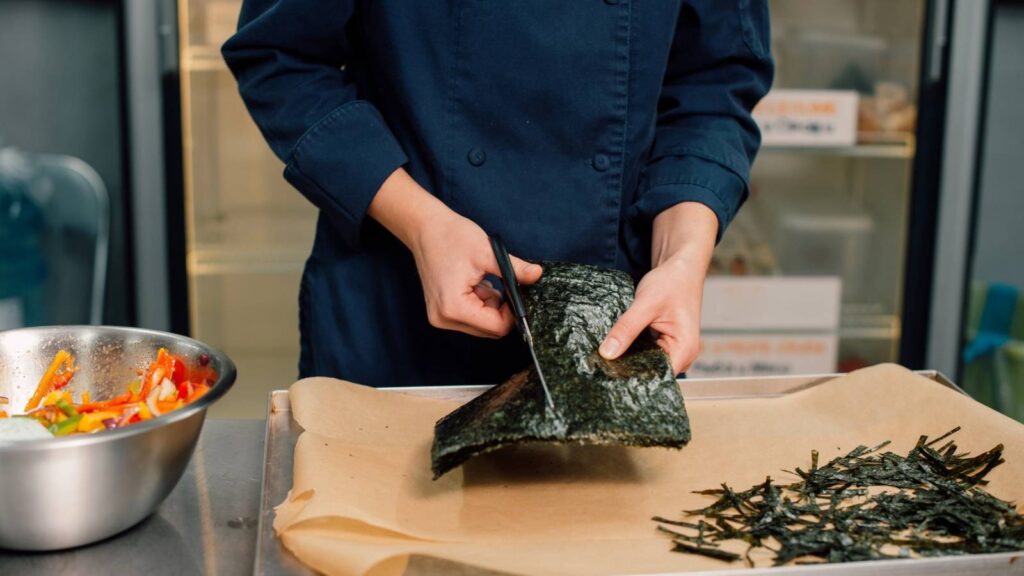
In the kitchen, seaweed is used in familiar ways that fit into everyday meals. Nori and dulse flakes are added as toppings for rice, eggs and vegetables, while blends such as furikake combine seaweed with sesame seeds and salt for quick use. Prepared items such as kelp-based sauces, spreads and fermented products are available in specialty stores and online retail, with brands such as Barnacle Foods and Atlantic Sea Farms offering options that work in standard recipes.
Restaurants and brands add seaweed blends
Food manufacturers incorporate seaweed into packaged products, where it can be added without altering texture or structure. Kelp powders appear in bread, crackers and snack bars to increase fiber and mineral content, while ingredients such as carrageenan and alginate help stabilize a wide range of foods. Many plant-based products and alternative noodles also use seaweed to support structure and consistency.
Restaurants take a similar approach by working it into familiar dishes. Eventide Oyster Co. uses nori in a vinaigrette served with its New England clam bake, placing it alongside shellfish, potatoes and drawn butter.
At The Blue Bar, located within the Algonquin Hotel in New York City, New York, kombu is used in the braising liquid for lamb ribs. “Kombu is part of the aromatic base in the braising liquid for the lamb ribs. I use it almost like a quiet seasoning rather than something that announces itself. It doesn’t make the dish taste seaweed-like; instead, it brings depth, savoriness and a very natural umami quality that rounds out the lamb. What I like about kombu is that it adds complexity, minerality and subtle salinity while keeping the profile clean. It enhances the meat rather than masking it,” said Chef Ali Dey Daly, who recently introduced new menus at The Blue Bar.
Other kitchens use seaweed to build depth in sauces and pasta dishes. The Matheson incorporates kombu into a beurre blanc served with Dungeness crab creste di gallo, combining it with chili oil, bok choy and preserved lemon.
Larger operators such as Hurtigruten, a Norwegian coastal cruise operator, include seaweed in about 60 dishes, or roughly 20% of onboard meals, with applications ranging from soups and pasta to butter and seasoning. At its Kysten restaurant, seaweed appears in both savory dishes and desserts, along with newer items such as seaweed bread and caviar, suggesting ongoing product development.
Craft beverages test seaweed-based ingredients
In many craft beverages, seaweed introduces subtle mineral and saline notes. Some distillers include kelp and other coastal botanicals in gin, adding complexity without overpowering the base spirit. Hurtigruten serves a seaweed-infused gin developed exclusively for its ships, made with Arctic kelp related to its coastal operations. The product is part of a broader effort to incorporate locally sourced, lower-impact ingredients into both food and drink offerings.
Breweries and nonalcoholic producers also test these applications in certain lagers and ales, including small amounts of seaweed to add a light savory note, while teas and functional drinks use it for its micronutrients.
Seaweed faces competition across food categories
Seaweed enters a crowded field of functional ingredients already competing for limited shelf space across food categories. Its long-term position will likely depend on how it compares with alternatives that offer similar nutritional and formulation benefits. As it becomes more common across products, clearer benchmarks around quality, sourcing and performance may determine which options stand out.
Jennifer Allen is a retired professional chef and long-time writer. Her work appears in dozens of publications, including MSN, Yahoo, The Washington Post and The Seattle Times. These days, she’s busy in the kitchen developing recipes and traveling the world, and you can find all her best creations at Cook What You Love.