
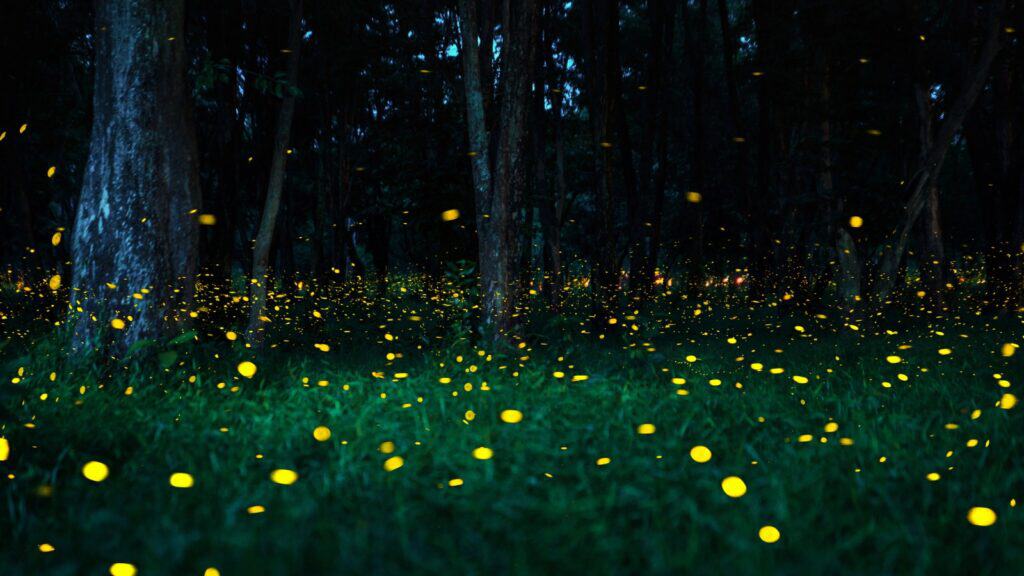
Every year, 20,000 families apply for fewer than 1,000 parking passes to a unique event at the Great Smoky Mountains National Park. Fireflies, or lightning bugs as they are more commonly called in the South, are a familiar backyard sight in the eastern part of the United States during the summer, especially along the Appalachian Mountains. But fireflies that synchronize their flashes are far less common, with only three species found in North America.
This post may contain affiliate links that may earn us a commission. For more information, see our Disclosures.
Noctourism has grown in recent years. Tourists now book northern lights trips, nighttime safaris and visits to dark sky parks. For the last two years, the aurora borealis has been more visible than usual, and this year, the total solar eclipse in August has sparked interest.
A Booking.com survey identified astrotourism as one of its travel trends for 2025, with 62% of respondents considering a trip to a dark sky destination for celestial viewing. But noctourism includes more than just the night sky; analysts point to the influence of TikTok and Instagram in promoting other nighttime events, such as bioluminescent beaches and temple tours by moonlight.
Trips to see synchronous firefly events are also on the rise, where rare displays depend on darkness, timing and limited access. As interest has grown, many locations have resorted to lotteries to control crowds and protect firefly habitats.
Why fireflies flicker
These special beetles exhibit a form of bioluminescence, a term that encompasses all organisms that produce light through chemical reactions. In fireflies, as in most bioluminescent organisms, the reaction involves a compound called luciferin and an enzyme luciferase. The reaction is extremely efficient: almost all of the energy produced is light and not heat. That’s the opposite of how the incandescent light bulb found in homes works.
Fireflies use their light flashes to signal for mates, with males typically flying higher while flashing to attract females. On the other hand, females wait on the ground or close to it, only signaling to a male once they have selected him as a mate.
Only three species of firefly exhibit synchronicity of their flashes, for reasons that are not well understood yet. The most abundant type is Photuris frontalis, more commonly known as Snappy Sync. They are found throughout the Southeast, especially in moist bottomlands like Congaree National Park. They can flash up to 70 times a minute in unison without pauses.
Photinus carolinus is less common, found in isolated pockets of the Appalachian Mountains, such as the most famous population in the Great Smoky Mountains National Park. They are known for their unusual set of five to eight quick flashes, followed by a pause. The last type of synchronous firefly is Photinus knulli, found in small, scattered populations in the American Southwest and Northern Mexico.
Fireflies spend most of their life as ground-dwelling larvae, eating snails and other insects. Once they reach adulthood, they only live three to four weeks, with the mating season taking up most of that. That is why the window to see the synchronous firefly displays is so short, often only lasting two weeks or so.
Where to see synchronous fireflies
There are only a handful of well-known, publicly accessible locations in the U.S. to see synchronous fireflies, although private tours, campgrounds and locals often know of spots off the general radar. The season starts in mid-May in warmer places like Mississippi and South Carolina, late May to early June in Southern Appalachia and through the end of June in northern sections of the Appalachians.
Tennessee
Elkmont Campground in the Great Smoky Mountains National Park is probably the most well-known spot for synchronous fireflies in the U.S. Among the 19 types of fireflies in the park, there is a large population of synchronous Photinus carolinus at the campground and along the surrounding trails. Because of high demand, the park has a lottery system for parking spots, giving out around 120 spots per night over the eight nights of the projected height of the mating season. Only approximately 1,000 out of over 20,000 applicants get a spot. There are also around 220 campsites at Elkmont Campground, and spending a week there to catch the firefly show means reservations go fast.
Lamar Alexander Rocky Fork State Park in the northeast corner of Tennessee also has a population of Photinus carolinus, which was only discovered in 2017. Because of its remote location and limited parking, only 10 sparking spots per night are awarded through a lottery during the firefly season. There is no lodging in the park, only backcountry camping, so many visitors stay in nearby Johnson City or Jonesborough.
If you don’t win the lottery at Elkmont or Rocky Fork, try nearby Molly Branch, just east of Knoxville and about an hour from the national park. It is a private landholding that discovered a population of Snappy Syncs in 2002, and it opened to the public in 2018. Tickets are required, and an Airbnb is available on-site for those who want to spend multiple nights.
South Carolina
Congaree National Park is one of the best-known places to see synchronous fireflies outside the Smokies. This park is the largest expanse of old-growth bottomland in the Southeast and has a large population of Snappy Syncs that thrive in warm, humid environments. The mating season usually runs from mid- to late- May. Due to demand, the park does have a lottery system that opens in April.
Mississippi
Like Congaree, Mississippi’s warm, humid environment favors the Snappy Sync variety of synchronous fireflies. Small populations are found scattered throughout the state. Guided tours are offered by Wall Doxey State Park as well as the Mississippi Craft Center, which has fireflies along the boardwalk behind the center. The small Jeff Busby State Park along the Natchez Trace is another viewing area.
North Carolina
Grandfather Mountain is a nonprofit nature park located about 90 minutes north of Asheville. Like the Smokies, this Appalachian location has a population of Photinus carolinus that flash 5-8 times before pausing. The private park sells tickets to their viewing event, which begins with talks by naturalists before moving outside to see the show once night falls.
West Virginia
Watoga State Park, West Virginia’s largest state park, became an International Dark Sky Park after efforts to reduce light pollution. During that process, officials documented a population of Photinus carolinus. This is one of the only places to see this variety of firefly without buying a ticket or entering a lottery, although that may change in the coming years as noctourism continues to grow. The mating season runs from mid to late June.
Pennsylvania
The Pennsylvania Firefly Festival is held the last weekend of June in Tionesta, Pennsylvania, just outside the border of Allegheny National Forest. Pennsylvania has more than 30 firefly species, and the firefly is the state insect. Like similar hardwood Appalachian forests in the Smokies and West Virginia, the Alleghenies have populations of Photinus carolinus.
The festival has free exhibits and expert talks, but the guided tours are ticketed through a lottery system. However, there are also public campgrounds and private tour companies in the area that have access to areas where the synchronous fireflies can be found.
Tips for viewing the fireflies
Fireflies are sensitive to light pollution, so visitors should use flashlights or headlamps with red filters and avoid using camera flashes and phone lights. The best viewing usually begins after dark, often between 9 and 10 p.m. Thunderstorms can stop flashing for the night, while light rain may not, so visitors should be prepared for wet conditions. Visitors should stay on marked trails and watch their step. Female synchronous fireflies often remain on or near the ground, and low-flying species such as blue ghosts can also be easily disturbed.
Synchronous fireflies draw travelers to their extraordinary show
Synchronous firefly viewing is on the rise as interest in noctourism and experiential travel continues to dominate recent travel trends. And as light pollution continues to increase, travelers are seeking increasingly hard-to-find dark sky adventures. While synchronous fireflies are more common in Asia, their rarity in North America means that watching the forest light up with thousands of synchronous flickering lights feels like winning a lottery.
Amanda Luhn is a freelance writer who escapes from her never-ending cabin renovation by traveling, whether that is camping in her beloved Smoky Mountains or hopping on a plane to a new country. She writes for her family travel blog, Simply Awesome Trips, and her East Tennessee blog, Knoxville Backyard & Beyond.