
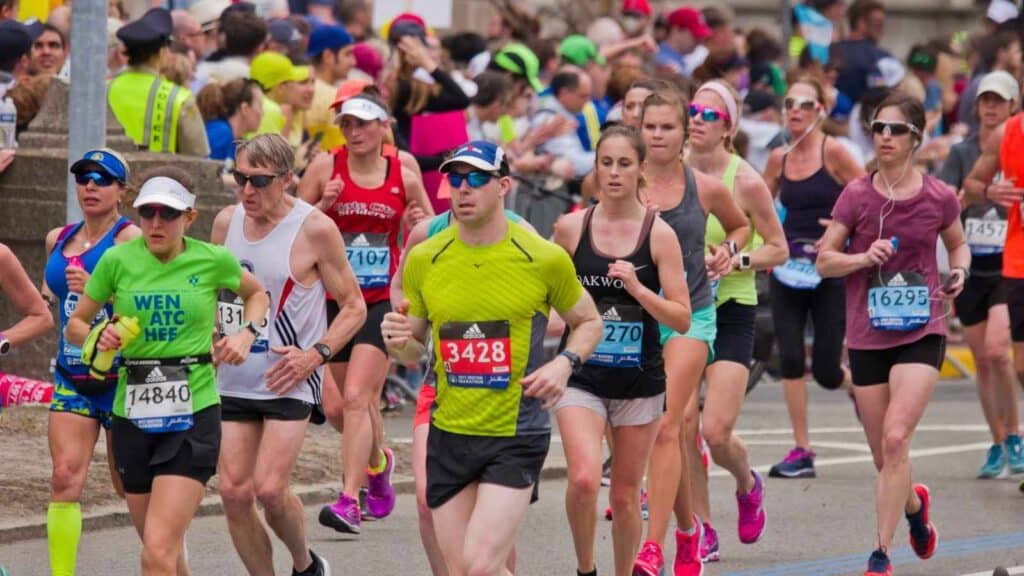
The Boston Marathon returns on April 20, 2026, with a race format that sets it apart from other major U.S. marathon weekends. Unlike larger events such as the New York City Marathon and Chicago Marathon, Boston follows more selective entry standards and a course that runs through multiple towns. Those differences affect who gets to the line and turn the event into a crowd-heavy affair, with spectators lining streets across several communities.
This post may contain affiliate links that may earn us a commission. For more information, see our Disclosures.
More than 24,000 qualified athletes have been accepted into the 130th running of the Boston Marathon, reinforcing its performance-based entry model within the World Marathon Majors. That same approach extends to its Patriots’ Day timing, a weekday schedule that brings out large crowds.
Boston’s early start still defines the race
A total of 33,249 runners applied during registration week for 30,000 spots in the Boston Marathon. That demand stems from its long history and the continuity it has maintained since its first race in 1897, making it the United States’ oldest annual marathon.
Other major races developed later as participation grew. The New York City Marathon began in 1970, followed by the Chicago Marathon in 1977, with both expanding alongside rising interest in large-scale road races. Boston has updated entry rules and race operations over time, but its identity remains closely tied to its original scheduling and long-standing place in the sport.
Qualification standards raise the bar
Entry into the Boston Marathon depends on prior race results, setting a clear threshold before registration opens. Most runners must meet time standards based on age and gender, which limits the field to those who have already reached a defined level of performance.
Meeting the listed time is often not enough, as accepted qualifiers ran an average of 4 minutes, 34 seconds faster than the standard for their group due to demand exceeding available spots. This creates a competitive entry process that continues beyond the qualifying mark itself.
Major races such as the New York City and Chicago marathons rely more heavily on lotteries and charity programs to fill large fields. These systems allow broader participation, while Boston’s approach keeps entry tightly linked to performance and influences both the pace and the overall composition of the field.
Fewer runners create more space on the course
The Boston Marathon typically fields about 30,000 runners, while the New York City Marathon exceeds 50,000 participants. That difference affects spacing from the start, with more consistent gaps between runners in the early miles.
Race organizers also group the participants into waves based on qualifying times to align runners with similar pacing. This reduces congestion and helps maintain steady movement without frequent slowdowns caused by mixed speeds.
Lower density can ease movement through aid stations and narrower sections of the route. With fewer runners at any given point, participants can maintain pace with less interruption compared with larger events that accommodate a wider range of entry categories.
Point-to-point route alters progression
Beginning in Hopkinton and finishing in Boston, the race follows a one-directional route through several towns. This layout creates a steady forward progression rather than repeating the same streets. The course profile adds difficulty, with the Newton Hills, including Heartbreak Hill near mile 20, coming after an extended stretch and requiring careful pacing late in the race.
Each section of the route brings a different environment and crowd presence, with support building and shifting as runners move closer to the finish line. Other major marathons often use looped or out-and-back courses centered in one city, while Boston’s route carries runners across multiple communities over the full distance.
State holiday draws locals out to watch
The Boston Marathon takes place on Patriots’ Day, which changes how the city operates during race day. Public schools and state offices close, allowing more residents to gather along the course during daytime hours. Some workplaces adjust schedules, while most private businesses remain open.
Crowds build throughout the day instead of concentrating around a single window. Spectators line multiple sections of the course, maintaining consistent support from early miles through the finish. Unlike the New York City and Chicago marathons, which run on standard weekends, the Boston Marathon falls on a state holiday that draws daytime crowds and extends spectator presence along the route.
Boston raises expectations for race weekends
The Boston Marathon sets a reference point for what a long-running event can look like without constant change. Its structure has remained largely intact as demand continues to build year after year. That contrast may lead other events to reconsider how much they adjust as interest in major races continues to grow.
Jennifer Allen is a retired chef turned traveler, cookbook author and nationally syndicated journalist; she’s also a co-founder of Food Drink Life, where she shares expert travel tips, cruise insights and luxury destination guides. A recognized cruise expert with a deep passion for high-end experiences and off-the-beaten-path destinations, Jennifer explores the world with curiosity, depth and a storyteller’s perspective. Her articles are regularly featured on the Associated Press Wire, The Washington Post, Seattle Times, MSN and more.