
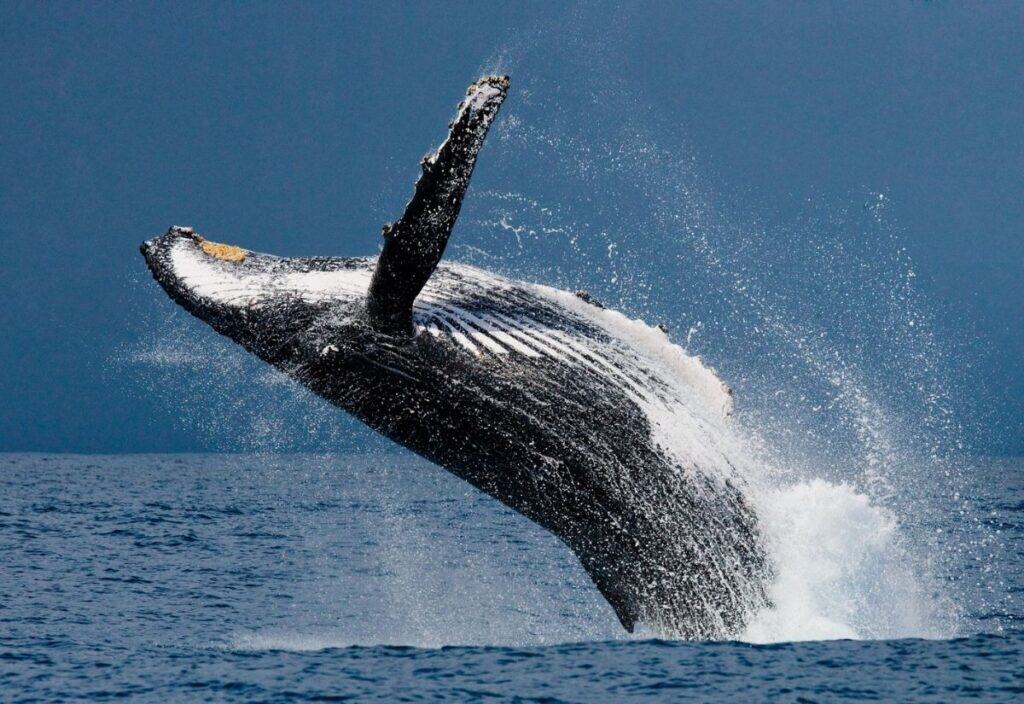
The humpback whales breaching off Alaska’s Inside Passage in July are the same animals fluking through Banderas Bay by December. They travel roughly 3,000 miles each way, feeding in Alaska’s cold, nutrient-rich waters through summer, then heading south to Mexico’s Pacific coast to breed and calve through winter. Most travelers encounter them once on a cruise, a tour or a beach and count themselves lucky, but those who understand the migration book both windows: two trips, two oceans, one continuous story.
This post may contain affiliate links that may earn us a commission. For more information, see our Disclosures.
More Americans chase the whale-watching experience than ever. AAA projects 21.7 million Americans will go on ocean cruises this year, marking the fourth consecutive record year, with Alaska ranking among the top destinations outside the Caribbean. The timing is good: the Alaska season is open now aboard a fully overhauled ship, and the Mexico window begins again in December at a Riviera Nayarit resort positioned directly on Banderas Bay.
The Alaska window: Celebrity Solstice
Celebrity Cruises spent $250 million overhauling its Solstice Series ships, beginning with Celebrity Solstice, which relaunched in March and began its Alaska season out of Vancouver in May. The renovation introduced eight new onboard experiences, updated every stateroom, added 54 new cabins and, most relevant to Alaska, redesigned the ship around how passengers actually use it in this part of the world.
Alaska cruisers don’t park themselves by the pool; they move. For hours at a stretch, they rotate between observation decks and outdoor gathering spaces while glaciers and snow-covered peaks slide past. The Solstice refresh leaned directly into that reality. Sunset Park, the new top-deck outdoor destination, runs the length of the ship’s upper deck with expanded seating, cabanas, a bar and a cafe. In Alaska, it functions as one of the best viewing platforms at sea. Enclosed panoramic lounges give everyone somewhere warm to watch when the temperature drops near Hubbard Glacier.
The seven-night round-trip itinerary out of Vancouver moves through the Inside Passage to Hubbard Glacier, Icy Strait Point, Juneau and Ketchikan. Of those ports, Icy Strait Point delivers the most concentrated whale activity. Southeast Alaska’s Inside Passage, including the waters around Icy Strait, holds one of the highest concentrations of feeding humpbacks in the North Pacific. Unlike Juneau, where whale watching tours depart from Auke Bay Harbor, roughly 20 minutes from the cruise docks by bus, ships tie up at Icy Strait Point near the water excursion launch. Walk off the gangway, and the boats are there.
The port itself is owned and operated by the Huna Tlingit people and is worth a full day off the ship. The Sky Peak Gondola climbs Hoonah Mountain to 1,550 feet in approximately 8 to 10 minutes, with the line going nearly vertical through old-growth Tongass National Forest before opening to panoramic views of Glacier Bay and the coastline below. It’s a must before or after any time on the water.
Book an early-season sailing, and the wildlife profile expands. April and May bring orca pods swimming the Inside Passage alongside the first humpback arrivals, plus gray whales moving north through coastal waters on their migration to Arctic feeding grounds. By June, the humpbacks dominate, and bubble-net feeding, a coordinated hunting behavior where groups of whales spiral upward through self-made columns of bubbles to trap fish, becomes a genuine possibility off Icy Strait.
“If whale watching is the goal of your vacation, choose a smaller cruise ship as the captain has more flexibility to move the vessel when whales are sighted,” advised Karee Blunt, owner of the travel site Our Woven Journey.
The winter window: Armony Marival Resort & Spa
Armony Marival Resort & Spa sits on Destiladeras Beach in Punta de Mita, on the northern arm of Banderas Bay, with unobstructed views across the water to the Marietas Islands. The whale-watching season here runs December through late March, when the Mexico DPS population, the same humpback stock that feeds Alaskan waters through summer, arrives to breed and calve in the bay’s warm, sheltered waters.
The resort has a system for it. A gong mounted near the entrance to La Brise, the property’s open-air palapa restaurant, is struck by guests or staff the moment a whale surfaces within sight of the property. Guests who know what it means stop mid-conversation and move toward the water. From the infinity pool overlooking the bay and the Marietas Islands, the sightlines are long and clear. During peak season, mothers breach alongside their calves close enough to shore that no binoculars are needed, just a clear morning and a chair facing the water.
“If you’re whale watching from the shore, don’t rush,” Bella Bucchiotti of xoxoBella said. “Give yourself time, bring binoculars and watch for signs like birds gathering or a sudden splash in the distance. The longer you stay, the better your chances of seeing something memorable.”
For time on the water, book a whale watching tour in Banderas Bay. In Mexico, SEMARNAT, the federal environmental agency, requires all whale-watching operators to carry official permits displayed visibly on the vessel. Under federal regulations, certified boats must maintain a minimum of 200 feet from whales for smaller vessels and 260 feet for larger ones, avoid encircling animals and reduce speed to a near-idle when whales surface nearby. The protocols exist to protect breeding and calving behavior, and operators who follow them tend to produce better sightings: whales that aren’t pressured surface more naturally and stay longer.
What the migration means for the traveler
These are not two separate wildlife encounters. The Alaska Department of Fish and Game documents individual humpbacks returning to the same feeding areas year after year; site fidelity passed from mother to calf, a culturally transmitted migration map that has guided the same family lines through the same waters for generations. The whale breaching off Icy Strait in June may well be the same animal fluking through Banderas Bay the following February. Researchers identify individuals by the unique markings on their flukes, and photo-identification databases now connect sightings across both ranges.
The population is recovering, following the commercial whaling that decimated humpback numbers through the mid-1970s. Responsible wildlife tourism standards have supported a slow rebuild. Seeing them now, in either ocean, is better than it has been in a generation.
Book both windows
The Alaska season runs from May through September, while the one in Banderas Bay opens in December. For a traveler willing to treat whale watching as a two-season pursuit, the calendar works cleanly: a Solstice sailing this summer, Armony in winter. The same whales make the same journey every year; the question is whether you meet them at one end or both.
Jennifer Allen is a retired chef turned traveler, cookbook author and nationally syndicated journalist; she’s also a co-founder of Food Drink Life, where she shares expert travel tips, cruise insights and luxury destination guides. A recognized cruise expert with a deep passion for high-end experiences and off-the-beaten-path destinations, Jennifer explores the world with curiosity, depth and a storyteller’s perspective. Her articles are regularly featured on the Associated Press Wire, The Washington Post, Seattle Times, MSN and more.