
Slow travel is drawing Americans to Britain’s canals, where boats drift at walking speed to Stratford, Bath and Edinburgh. The appeal is in the iconic stops as much as the chance to linger along towpaths and in pubs.
This post may contain affiliate links that may earn us a commission. For more information, see our Disclosures.
I love slow travel and moving at a pace where the journey feels as rewarding as the destination. Britain’s canals capture that spirit. Gliding past swans, waving at walkers and tying up outside a pub for the evening are exactly the details that make this kind of trip stand out.
From industry to leisure
Dug in the 18th century to carry coal and iron during the Industrial Revolution, Britain’s canal network became the backbone of trade before turning into a route for leisure. The system stretches for more than 2,000 miles and once formed the arteries of the nation’s economy. By the mid-20th century, most working boats had vanished, replaced by trucks and rail.
In the last few decades, the canals have been reborn as leisure corridors. Restored towpaths, the paths once used by horses to pull boats, now draw walkers and cyclists, while narrowboats carry travelers through locks and under stone bridges. To make that possible, rental companies have sprung up across the network. Drifters, one of the leading operators, runs 40 bases across England, Scotland and Wales, offering everything from quick three-night breaks to week-long loops on hundreds of miles of canals.
Routes that tell a story
The destinations along the canals are part of the draw. A route south of Birmingham leads to Stratford-upon-Avon, where Shakespeare’s birthplace anchors a town of half-timbered houses and theaters. I’ve taken this route, and arriving in Stratford by water feels different than stepping off a train. The approach is unhurried, and you drift right into the historic core where the Royal Shakespeare Theatre sits beside the canal.
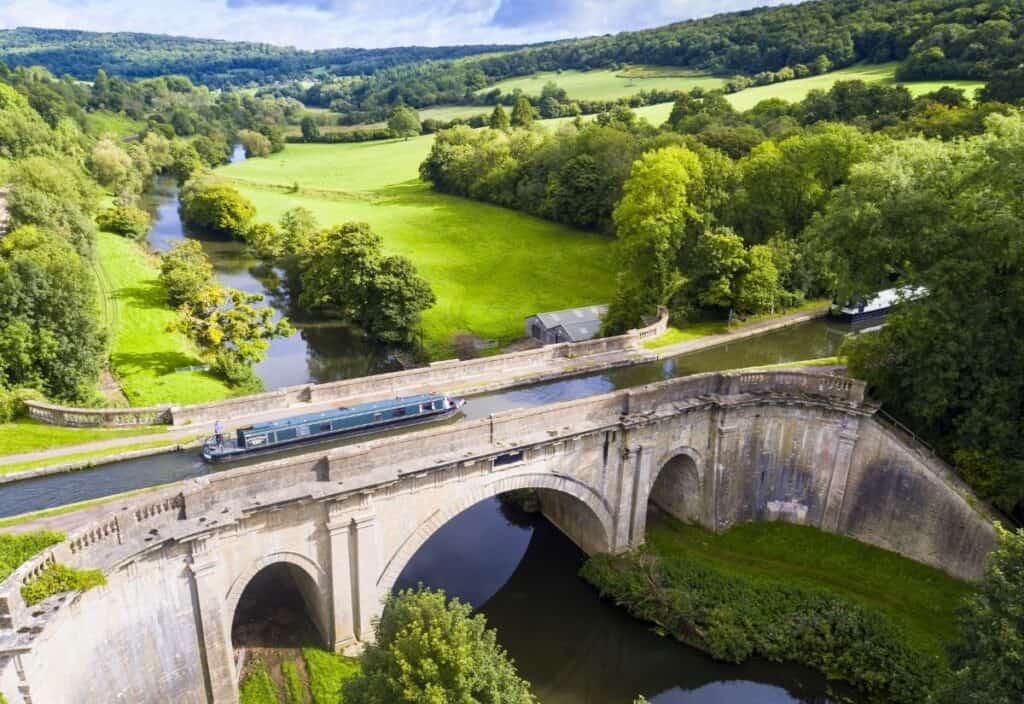
The Kennet and Avon Canal winds toward Bath, where Georgian crescents rise above Roman baths. Oxford and Cambridge can both be reached by water, while in Scotland, the Union Canal stretches into the center of Edinburgh.
In North-Eastern Wales, the Pontcysyllte Aqueduct & Canal World Heritage Site delivers one of the most dramatic moments: boats glide 126 feet above the River Dee on an iron trough, with open air on one side and towpath on the other. Travelers often call it the highlight of the entire system.
Wherever the route leads, mooring is part of the charm. It’s usually free along the towpath, and stopping for a pint or a village walk becomes part of the daily rhythm. Unlike racing between train stations, the journey itself sets the pace.
Life on board
For Americans used to road trips or RV rentals, the idea of captaining a narrowboat can sound daunting. In practice, it’s accessible. No license is needed, and rental companies include a hands-on tutorial before departure. Boats measure just under 7 feet wide to fit Britain’s narrow locks, but range in length from 48 to 69 feet. Longer boats offer more space for families or groups, and some operators provide king beds or extra headroom.
Inside, the setup resembles a compact cabin. Kitchens include gas cookers with an oven and grill, plus pots, pans and utensils. Bathrooms have showers, and bedding and towels are provided for overseas visitors. The fridge is small, so groceries are bought in regular top-ups at towns along the route. Boxed wine definitely stores better than bottles.
With supplies managed this way, packing feels closer to preparing for a camping trip than checking into a hotel. Waterproof jackets are essential for the unpredictable British weather, and deck shoes or sneakers work best on wet surfaces. Slippers are handy once you’re inside for the evening.
How days unfold
A typical day starts with casting off in the morning mist, cruising past fields edged with stone walls. On the Stratford route, I like to work the lock gates myself, leaning into the heavy wooden beams while walkers pause to help or simply watch.
Lunch might be at a pub garden where the boat is moored just outside. Afternoons pass slowly: bridges lift, swans escort the vessel and churches appear above the trees. By evening, it’s time to tie up for the night; sometimes in a quiet stretch of countryside, sometimes beside a lively canalside inn. One evening, tying up outside a canalside inn, I stepped straight from the deck into the beer garden, the kind of moment that shows why canal travel is as much about the stops as the cruising.
That mix of activity and calm is part of the appeal. Steering keeps you engaged, but the pace leaves plenty of time to sit back and watch the landscape slip by.
Timing the trip
The season runs from late spring through early fall, when days are longer and generally drier. July and August bring the warmest weather but also the busiest canals. In Scotland, travelers are warned to avoid June, when midges swarm near the water.
It’s also helpful to know where to stop along the way. Mooring remains free in most places, though popular spots at harbors and marinas may charge a small fee or limit stays to 48 hours. With more than 2,000 miles of canals, though, finding a quiet berth is rarely difficult.
Why Americans are booking
Operators say Americans are among the fastest-growing groups of canal travelers. Many liken it to an RV trip on water, with the added twist of castles and pubs along the route. Unlike a cruise ship, narrowboats hold only a family or small group, giving the trip a do-it-yourself feel.
For some, the appeal is heritage, tracing industrial history through locks and aqueducts. For others, it’s about slowing down. In a world of fast trains and packed itineraries, the canals give permission to linger.
Why slow travel resonates
Narrowboats rarely go faster than 4 miles an hour. That leaves plenty of time to wave at walkers, watch herons skim the surface and see fields drift past like a painting. I love slow travel because it makes space for those small details, and Britain’s canals show how even the most iconic sights can be experienced at a pace that lets the journey linger.
Mandy is a luxury travel, fine dining and bucket list adventure journalist with expert insight from 46 countries. She uncovers unforgettable experiences around the world and brings them to life through immersive storytelling that blends indulgence, culture and discovery, and shares it all with a global audience as co-founder of Food Drink Life. Her articles appear on MSN and through the Associated Press Wire in major U.S. outlets, including NBC, the Daily News, Boston Herald, Chicago Sun-Times and many more.