
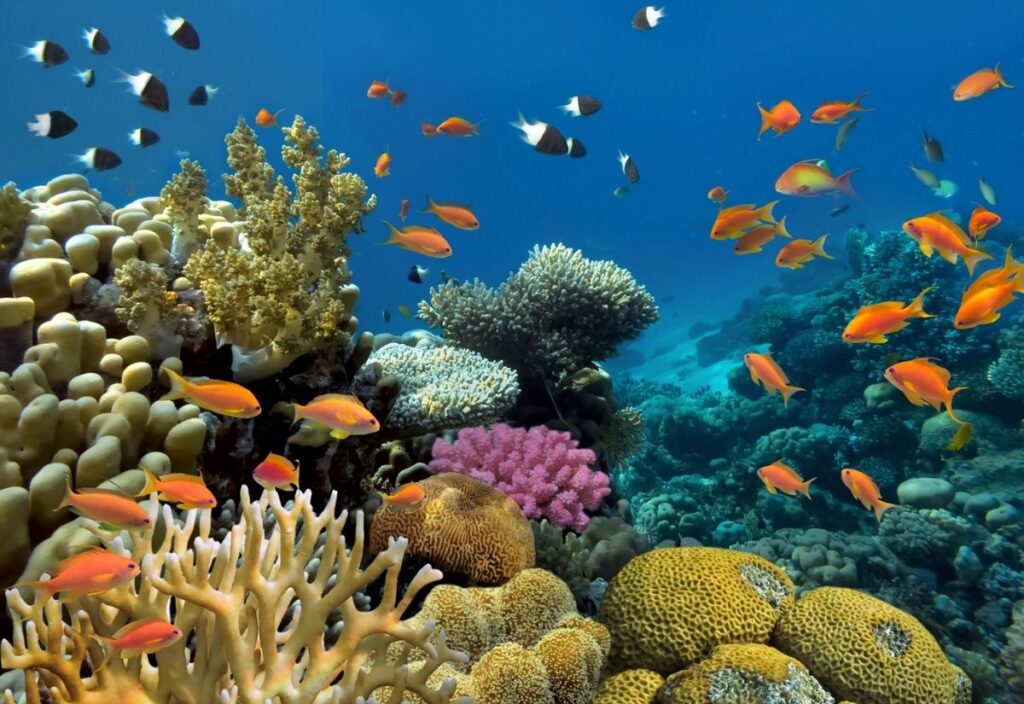
The Maldives holds more than 3% of the world’s coral reefs, and in 2025, luxury resorts are turning that natural wealth into a new symbol of prestige. Coral nurseries, floating platforms and large-scale farms are becoming as much a marker of high-end travel as overwater villas and infinity pools.
This post may contain affiliate links that may earn us a commission. For more information, see our Disclosures.
Diving through the Maldives, I’ve seen how nurseries rise out of the blue like underwater gardens. Coral fragments sway in grids below the surface, tended as carefully as any luxury resort. These living projects have become markers of progress, showing that prestige in the Maldives now includes restoring the reefs that define it.
Coral conservation as a luxury marker
Coral reefs shelter fish, protect shorelines and support millions of livelihoods in island nations. For the Maldives, their survival isn’t just ecological; it’s economic, tied directly to climate resilience and tourism.
The country’s over 2,000 coral reef structures are home to around 1,100 fish species and 180 types of coral. Resorts now market this restoration by encouraging guests to sponsor frames or plant fragments, tying their stay to a tangible contribution beneath the waves.
Guests planting coral frames
Four Seasons Maldives initiated its reef restoration following the 1997-1998 El Niño event. Since then, the resort has planted more than 9,000 coral frames. At the Marine Discovery Centre, guests join biologists to collect and preserve fragments, transforming their luxury stay into a hands-on conservation effort.
Armando Kraenzlin, the regional vice president and general manager at Four Seasons Landaa Giraavaru, says, “The Reefscapers teams at Four Seasons Resorts Maldives are all inspired by a shared love for the ocean and a determination to protect it from harm caused by human actions. As the restoration sites grow, we are seeing significant growth in the numbers of smaller species that live in and around the coral.”
Coral farms on a grand scale
Soneva Fushi runs one of the Indian Ocean’s largest coral farms. Spanning a hectare, its program grows up to 150,000 coral fragments a year using micro-fragmentation, spawning labs and mineral accretion technology. This level of scientific detail makes Soneva one of the most advanced coral programs in the Maldives.
Dr. David Vaughan, who has helped design and supply micro-fragmenting labs, underscores the importance of this work, saying, “While these new technologies enable us to restore reefs using coral strains resilient to current conditions, and do so at an accelerated pace, we must also address the root causes of climate change and other stressors to facilitate the recovery of reefs. I remain hopeful.”
Floating nurseries adapt to change
At Nova Maldives, guests help plant fragments in floating nurseries designed to adapt to rising sea temperatures. Working with marine biologists, visitors see their corals grow stronger before being transplanted onto the house reef.
The floating design provides a stable environment, allowing fragments collected from nearby waters to develop resilience before being planted. It gives guests the rare chance to see their contributions take root in real time.
Community and resort partnerships
Cora Cora Maldives is part of a five-year project with Mars Global, making the Maldives its second-largest restoration site, after Australia’s Great Barrier Reef. Guests and staff join “Freedom Fighters” to plant reef stars and rope nurseries that speed growth.
At Alila Kothaifaru Maldives, their green initiatives include conserving up to 70% of the island’s vegetation and native trees and on-site recycling for collected waste from reef cleanups. During World Ocean Day on June 5, guests helped remove 20 kilograms of trash from their house reef. These activities remind visitors and locals alike that even small actions to protect the planet matter.
Coral nurseries as luxury capital
Coral nurseries sustain biodiversity, support reef fish and strengthen ecosystems against climate threats. Through nurseries and fragmentation techniques, resorts accelerate natural recovery and aim towards solving environmental issues, such as rising seas and warming waters. These advances demonstrate why coral nurseries matter, incorporating conservation into the evolving identity of luxury tourism in the Maldives.
A new wave of prestige
In the Maldives, I’ve learned that prestige isn’t measured only in private villas, but also in the living reefs returning to strength beneath the waterline. Floating nurseries and large-scale farms now stand alongside infinity pools and butler service as markers of what luxury means here.
Mandy is a luxury travel, fine dining and bucket list adventure journalist with expert insight from 46 countries. She uncovers unforgettable experiences around the world and brings them to life through immersive storytelling that blends indulgence, culture and discovery, and shares it all with a global audience as co-founder of Food Drink Life. Her articles appear on MSN and through the Associated Press Wire in major U.S. outlets, including NBC, the Daily News, Boston Herald, Chicago Sun-Times and many more.