
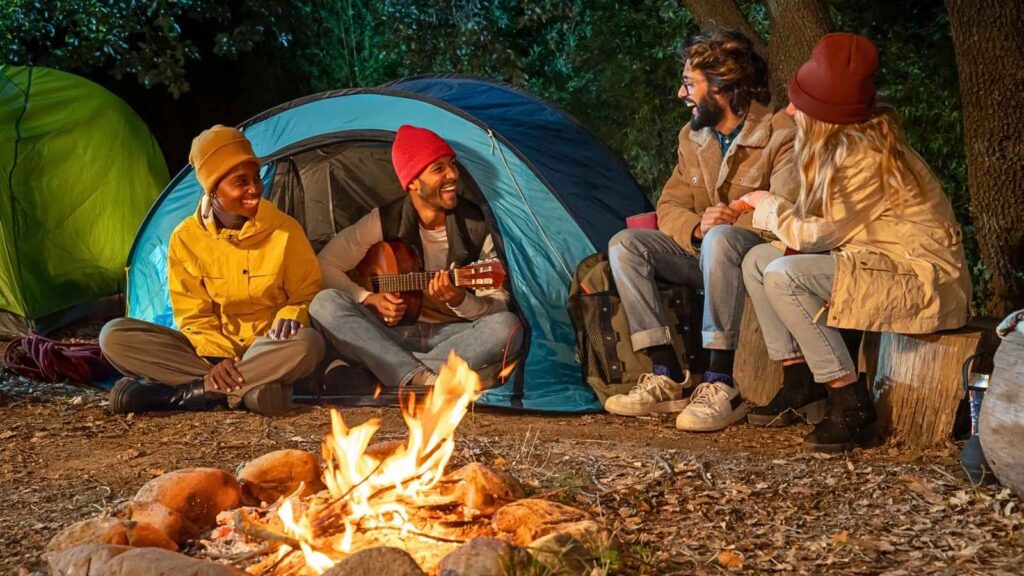
A new kind of wellness retreat takes over America’s campgrounds this summer, and it doesn’t involve a single spa treatment. Analog camping, tech-free and deliberately unplanned, is built entirely around one idea that recreating a childhood camping trip might be one of the most effective things you can do for your mental health. Half of the campers are already doing it on purpose.
This post may contain affiliate links that may earn us a commission. For more information, see our Disclosures.
Camping has always had its hold, but what draws people to the outdoors in 2026 looks different from anything the industry has tracked before. The tent and the sleeping bag are still there, but the itinerary is largely gone. So is the phone.
Travelers across generations are gravitating toward what the outdoor hospitality industry now calls “analog camping”: unstructured, tech-light trips where the point is not to do more, but to do less. The goal is not entertainment, but restoration. And underneath that, researchers and travel data point to the same driver, which is nostalgia.
Nostalgia is not just a feeling; it is a motivation
Half of campers say they are planning a trip this year specifically to recreate a childhood camping experience, according to a 2026 camping and outdoor hospitality report. That is not a niche preference. It is the clearest indicator of what is drawing people back to the woods. Not bucket lists, not Instagram backdrops, not adventure programming. Memory.
The science backs the impulse. A 2025 study in Humanities and Social Sciences Communications found that nostalgia actively reduces psychological distress and strengthens emotional resilience. The past is doing real work on the present. For millions of people, it is a shortcut back to something that felt uncomplicated, and feeling that again, even briefly, turns out to matter enormously to mental health.
What analog camping actually looks like
Six in 10 campers say traditional campfire activities and hands-on outdoor skills, such as building a fire and learning navigation, are a primary reason they book a trip, per the same camping and outdoor hospitality report. Screen-free evenings, meals that take longer to cook than they take to eat, games that require eye contact; these are not deprivation tactics, but deliberate choices to trade stimulation for presence.
The mental health returns are visible in the data. Nearly half of campers, 49%, say they book trips with the explicit goal of improving their mental well-being. A striking 81% report better sleep, reduced stress or improved recovery after time outdoors. And 77% of campers say being in nature alone is enough, no wellness programming, no guided experiences, no spa add-on required. Just trees, sky and time.
The campground as something more than a campground
One of the quieter findings in the KOA data lands differently in the context of 2026. Three-fourths of campers now describe campgrounds as third places, environments outside home and work where genuine community forms. Sociologists have long identified third places as essential to social well-being, but in an era when loneliness has become a recognized public health concern, the campsite is doing something that few other travel formats can claim: it puts strangers in close proximity with no agenda and lets connection happen naturally.
The generational texture of that finding is worth a closer look. Gen Z campers are most likely to form lasting bonds with other guests, with 43% saying they stay in touch long after the trip ends. Millennials say that interactions with neighboring campers are what make their trips memorable. Boomers, returning to camping after years of lighter participation, report the highest frequency of meaningful interactions per trip. What looks like a quiet night around a fire turns out to be something people carry with them.
The industry reads the same data
Outdoor travel operators have noticed. A 2026 wellness tourism trend report names “cocooning wellness” as one of the year’s defining travel movements: short-drive, close-to-home escapes focused on nervous system recovery rather than stimulation. The campground, in that framing, is not a budget alternative to a resort. It is the destination.
The report puts numbers to it: over 52 million North American households camped in 2025, exceeding pre-pandemic levels and generating a $66 billion local economic footprint. Thirty-one percent of campers plan to spend more nights outdoors this year than last. The industry is not chasing a trend; it is watching a values reset happen in real time.
The part that the data cannot quite capture
What is actually happening this summer is simpler than any report can fully express. People are remembering that they already know how to feel better. They learned it the first time someone handed them a stick and a marshmallow and told them to pay attention to the fire. The expertise required is low, the equipment list is short and the itinerary is mostly blank.
That, as it turns out, is the whole point. Whether it is a first-time tent pitch or a deliberate recreation of a trip taken 30 years ago, analog camping in 2026 is asking a question that most people find surprisingly easy to answer once they are actually outside: What does a good day feel like when there is nothing to optimize?
Jennifer Allen is a retired chef turned traveler, cookbook author and nationally syndicated journalist; she’s also a co-founder of Food Drink Life, where she shares expert travel tips, cruise insights and luxury destination guides. A recognized cruise expert with a deep passion for high-end experiences and off-the-beaten-path destinations, Jennifer explores the world with curiosity, depth and a storyteller’s perspective. Her articles are regularly featured on the Associated Press Wire, The Washington Post, Seattle Times, MSN and more.